A fierce fire reduced Vice Versa’s frozen storage facility to ashes in 2024. It was a devastating experience, but a close-knit team and solid insurance coverage kept the business going. This made a new frozen storage facility possible, giving the logistics provider carte blanche to optimize its processes even further.
Vice Versa is a logistics provider specializing in temperature-controlled transport and chilled and frozen storage, with its own crate-washing facility. Tonnie van den Boogaard founded the family business in 1985, and the second generation—Koen, Guus, and Mireille—has been at the helm since 2022.
Mireille explains: “We started out as a regular transport company. Being based in Oss, a town with a strong meat industry, we naturally found our way into temperature-controlled transport. The frozen storage facility came next, followed by the crate-washing facility. All of it grew out of our customers’ needs: we now handle several links in their supply chains.” The business model revolves around cold temperatures and distance covered, and the technology is designed accordingly. “The warehouse management system (WMS) gives customers real-time insight into their own inventory and stock movements. Completely transparent. The refrigeration system is monitored 24/7 and automatically takes action in an emergency.”
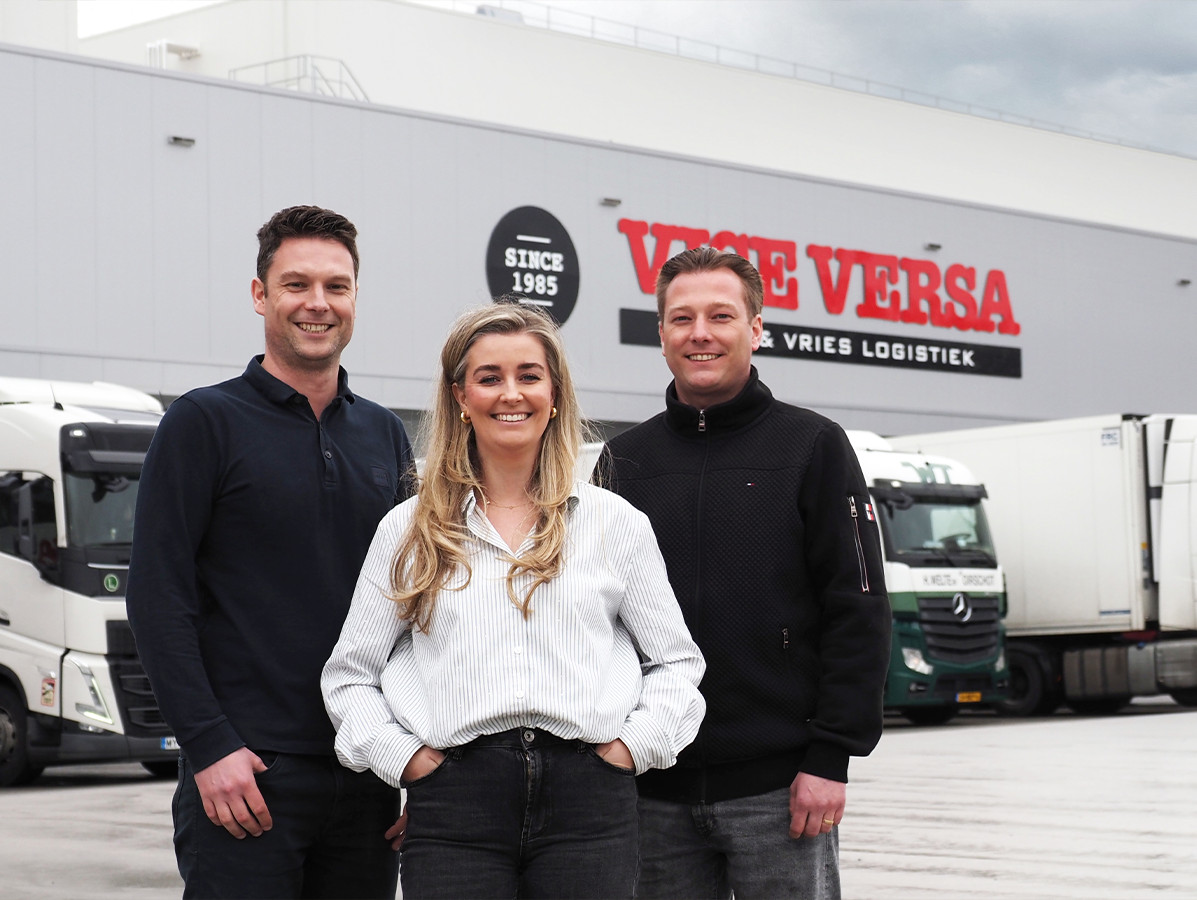
From left to right: Koen, Mireille, and Guus Van den Boogaard
Mireille describes Vice Versa as a true family business: “Very few layers of management, so we can make decisions and act quickly.” This proved its value when the frozen storage facility burned down in 2024. “It still feels surreal, as though you were walking around on a movie set. The scale was staggering.” It soon became clear that the facility would be a total loss: “At that point, everything you do is about your customers. Looking at what’s still possible. Arranging storage at other frozen storage facilities, for example.” Communicating with employees was just as important: “They faced a lot of uncertainty too. Because we handled that well at the time, we were able to retain almost everyone. Without our people, we wouldn’t be where we are today. They helped build the new frozen storage facility, literally and figuratively.”
According to Mireille, the new facility would not have been possible without good insurance coverage either. It is a lesson she is keen to share: “Making sure you’re properly covered for risks outside your core business can make the difference between a standstill and getting back on your feet.” Vice Versa worked with Bessels Architecten on the new facility. The guiding principle: the shortest possible distances for moving goods and the lowest possible energy impact. Mireille continues: “We had a blank canvas to work with, although the insurer did impose strict requirements. For example, we had to install a CO₂ fire suppression system. If a similar fire broke out now, it would be extinguished within two minutes.”
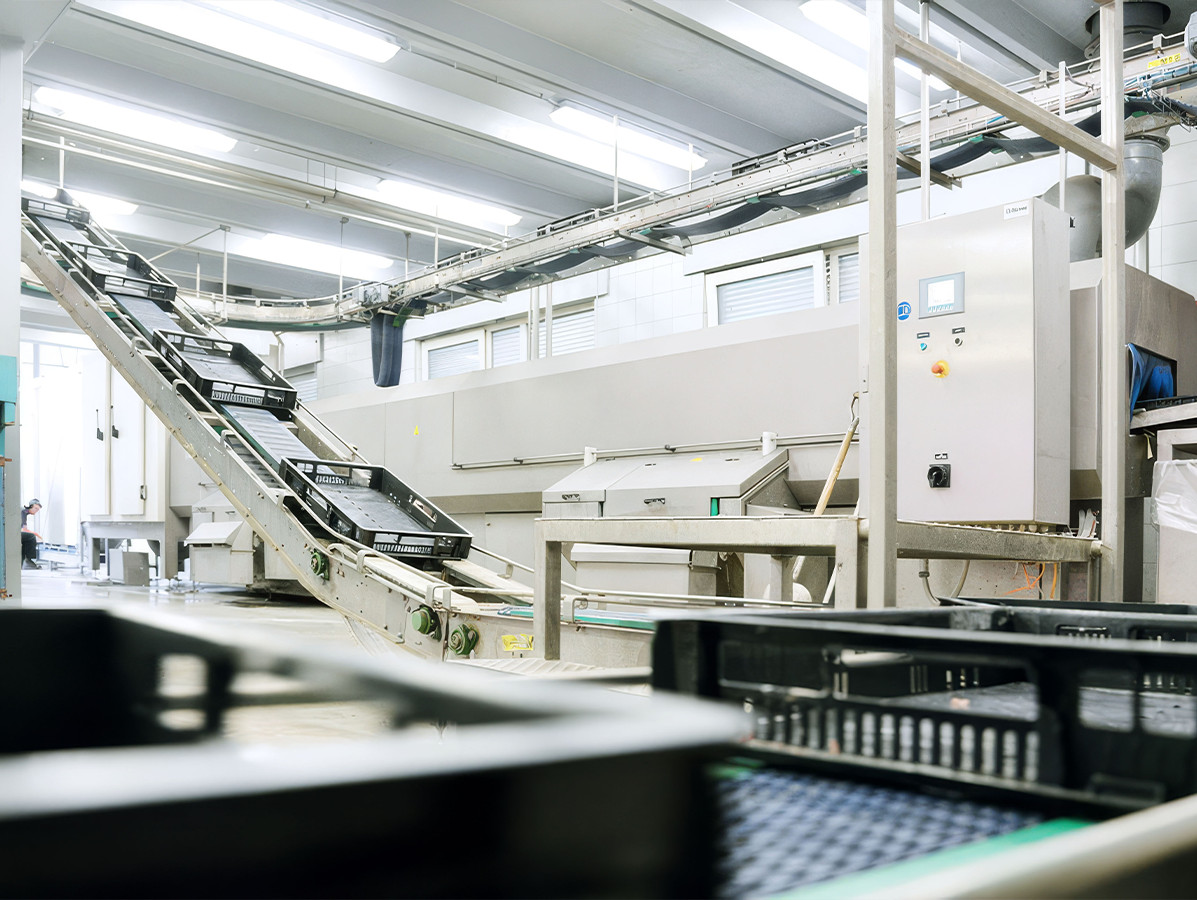
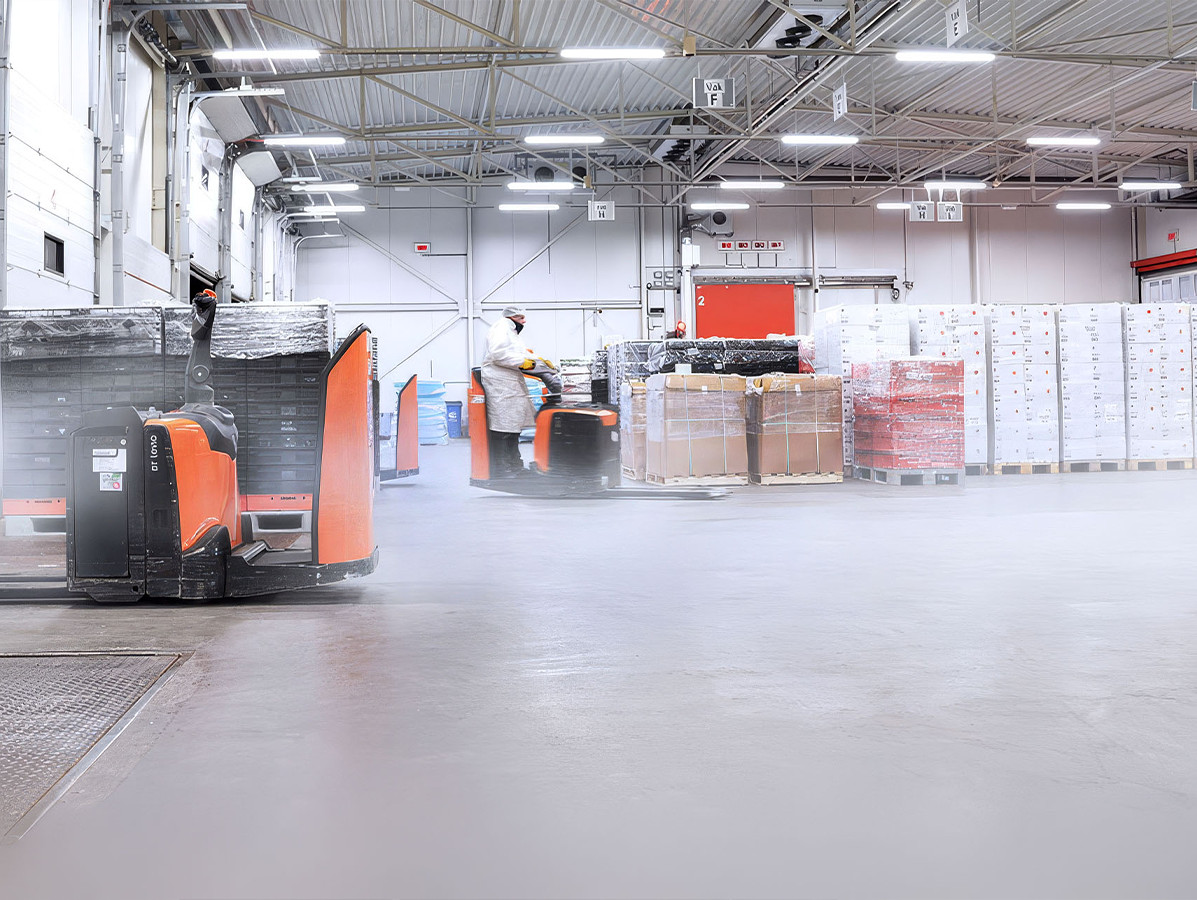
“We were actually already doing pretty well at the old facility. The fire simply gave us room to do even better.” In the new frozen storage facility, the blast-freezing process has been completely reversed: “Instead of blowing cold air into the product, we now extract the heat from it. That’s better from a microbiological standpoint, and the product freezes faster. This means higher quality and lower energy consumption.” The shuttles are new too: intelligent vehicles that move pallets autonomously, without human intervention. This increases storage density and speed and reduces the risk of damage. The crate-washing facility also received an upgrade: “We added a fully automated line here. The crates are automatically unstacked, washed, dried, and restacked. On around 90 percent of crate-washing lines, this is still done manually.”
The company has also made progress on energy efficiency. Mireille explains: “We have our own well to pump water for our cooling system. We use the waste heat from that system to heat our offices. There are more than 5,000 solar panels on the roof, and we adjust our energy consumption based on electricity rates.”
The fleet is not fully electric yet, but the charging infrastructure is already in place: “If we’re running an entirely electric fleet in five or ten years, we’ll be able to charge everything right here.”
And speaking of the future: the Vice Versa team recently gained an AI colleague to handle order processing. “If you don’t invest in that, you’re going to lose out,” says Mireille. Ten years ago, automation was still the exception; now it is the norm. AI is at the beginning of that same journey. Meanwhile, demand for frozen food continues to grow: “The population is growing, and perceptions of what’s healthy are changing. As a result, frozen food is taking an increasingly prominent place alongside fresh.” The fire destroyed the frozen storage facility, but not the determination to do better. With a growing market for frozen food ahead, Vice Versa is in a stronger position than ever.
Source: Vakblad Voedingsindustrie 2026
Magazine Voedingsindustrie has been made possible in part by:



© COPYRIGHT 2026 VOEDINGSINDUSTRIE | ALLE RECHTEN VOORBEHOUDEN
Powered by Wallbrink Crossmedia © 2026