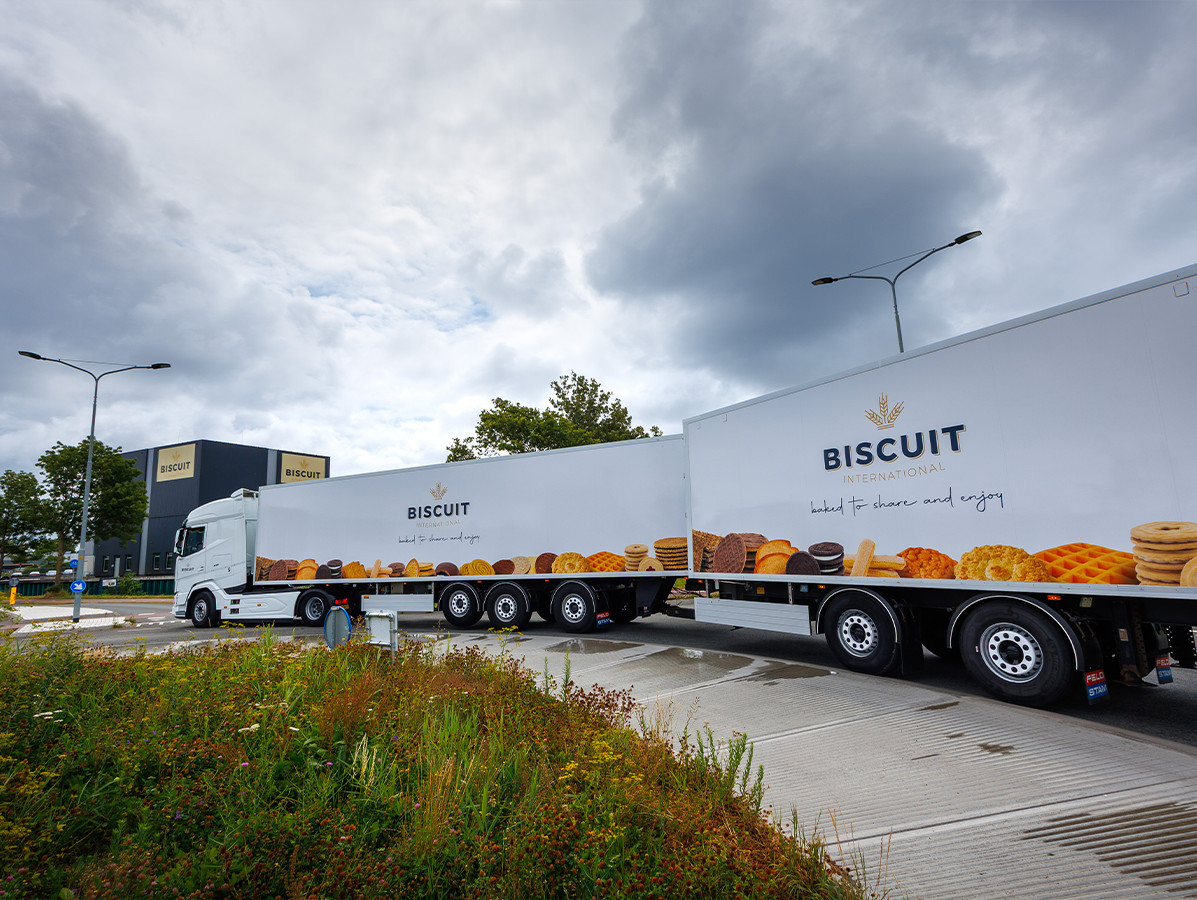
Even a delicious cookie has smart logistics behind it. At its Broek op Langedijk facility, multinational Biscuit International operates its own transport fleet. Specialized software keeps transport planning under control.
Do you enjoy biting into a pink iced cake, a coconut macaroon, or a similar supermarket treat? Chances are it comes from Biscuit International. The company produces 290,000 metric tons of cookies and bread substitutes annually and describes itself as the European market leader in this segment. One of its 32 European factories is in Broek op Langedijk, in the province of North Holland. It is hard to miss, if only because of the sweet aroma that greets you as you approach.
In some ways, “Broek” is a distinctive branch of the Biscuit International family. “The other factories focus entirely on production, but we also handle some warehousing here,” says transport team lead Jeroen Veldboer. Surrounded by products such as almond-filled cookies, he and transport planner Ineke Vos offer a glimpse behind the scenes. The friendly atmosphere hardly suggests a multinational operation, and, as Ineke explains, this is also the only location with its own trucks. “It makes us very flexible,” she says. “Sometimes the cookies are loaded during the night. They come out of the oven, go onto a truck bound for Broek op Langedijk, and are sorted here and dispatched to supermarkets and wholesalers. It doesn’t get any fresher.” “This network of factories also means that, wherever we finish unloading, from the northernmost tip of Groningen to South Limburg, we can pick up a return load for Broek op Langedijk,” Jeroen adds. “We keep empty running to a minimum.”
During quieter periods, around 20 trucks leave each day carrying sweet treats. During busier periods, that number can easily double. The Broek op Langedijk facility has a regular team of drivers for these deliveries. They are part of the company and take pride in their work, Ineke and Jeroen explain. Three-quarters have worked there for more than ten years. “Our driver Gerard has even retired, but still makes three trips a week. He started with us on November 1, 1976, so October 31, 2026, will mark 50 years with the company. Drivers want to work here; there’s even a waiting list. Why? I think it comes down to the friendly atmosphere and our flexible approach,” says Jeroen. “Does someone need to swap shifts or leave early? We can always work something out.”
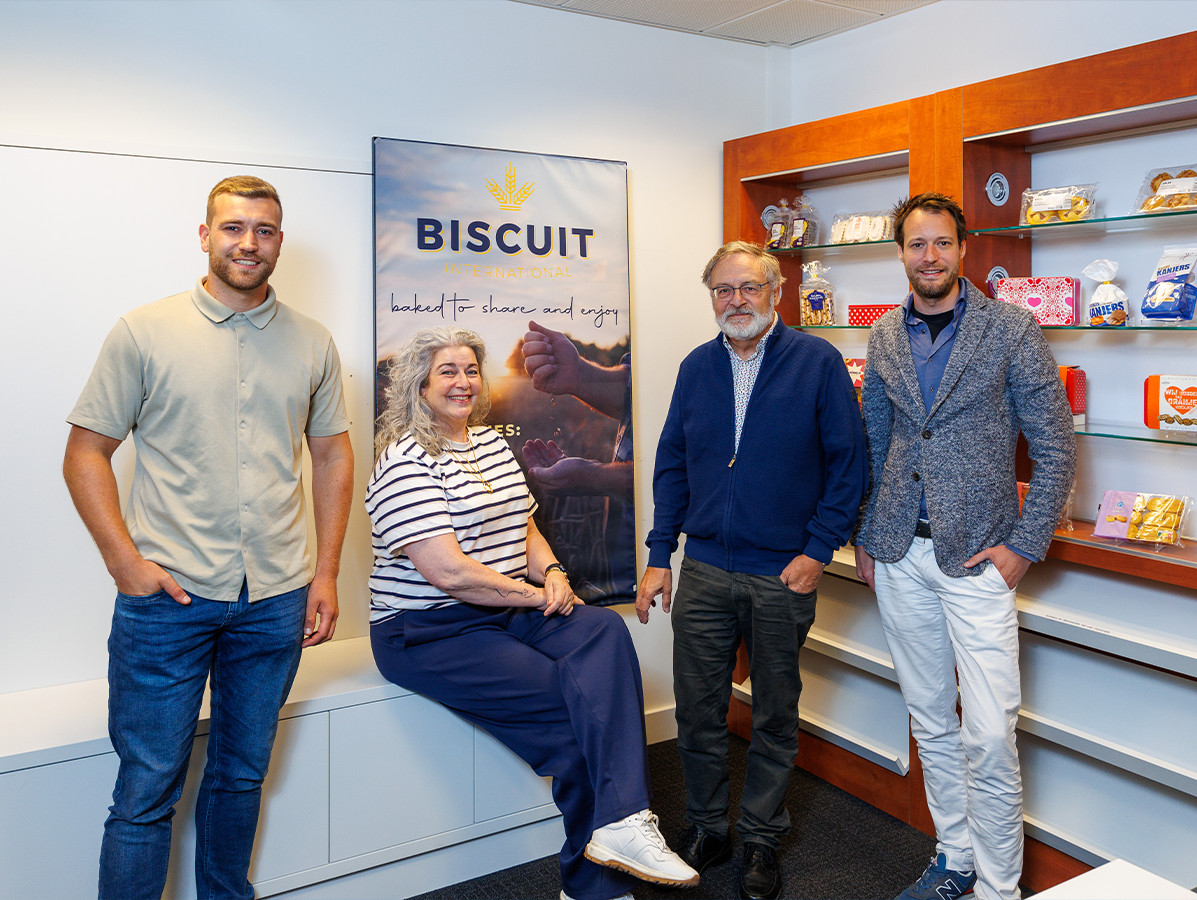
From left to right Jeroen Veldboer, Ineke Vos, Jops and Jan Robroeks
As a company that aims to keep its trucks as full as possible every day while meeting various requirements—delivery time windows alone add complexity—Biscuit International theoretically faces a challenging logistics puzzle. Operating an own-account transport fleet is also a specialized part of freight transport. The drivers almost act as company representatives: they feel connected to the business and its products and often have a good understanding of what is happening at the customer’s end. Own-account transport is also subject to different rules. This means the transport software needs to be adapted accordingly, explains Jops Robroeks, founder of Pijnacker-based EVO-it, which celebrates its 30th anniversary this year. His company specializes in transport software for businesses operating their own fleets, from small and medium-sized enterprises to multinationals. “We always start by examining the customer’s processes. We then tailor the software to match.”
The Broek op Langedijk facility has been using EVO-it software for some time. It currently uses LMS Ritplan & Praktijk, a transport planning system that factors in various requirements to calculate the most efficient routes, create an optimal schedule, and provide real-time visibility into the plan. “The drivers also use our driver app, which is part of this LMS,” says
owner and managing director Jan Robroeks. Yes, Jops’s son. He continues: “The app gives them information about their next trip and lets them record their progress, such as marking a stop as completed. We can fully customize the app to the customer’s needs. For example, the customer can add instructions requiring drivers to take and upload a photo at certain delivery locations. The navigation also automatically takes the truck’s specifications into account, including whether it is allowed to use a particular tunnel.”
The software ensures that everyone always has up-to-date information. That makes it much easier to adjust course, both literally and figuratively. It gives the team control over planning and reduces the risk of errors, Ineke and Jeroen explain. Jeroen: “Everything is recorded automatically, including waiting times. That shows us exactly where we can improve. Since we started using LMS, the gap between planned and actual trip times has become much smaller.”
www.biscuitinternational.com
www.evo-it.nl
Photos: ©Diederik van der Laan
Source: Vakblad Voedingsindustrie 2026
Magazine Voedingsindustrie has been made possible in part by:



© COPYRIGHT 2026 VOEDINGSINDUSTRIE | ALLE RECHTEN VOORBEHOUDEN
Powered by Wallbrink Crossmedia © 2026