
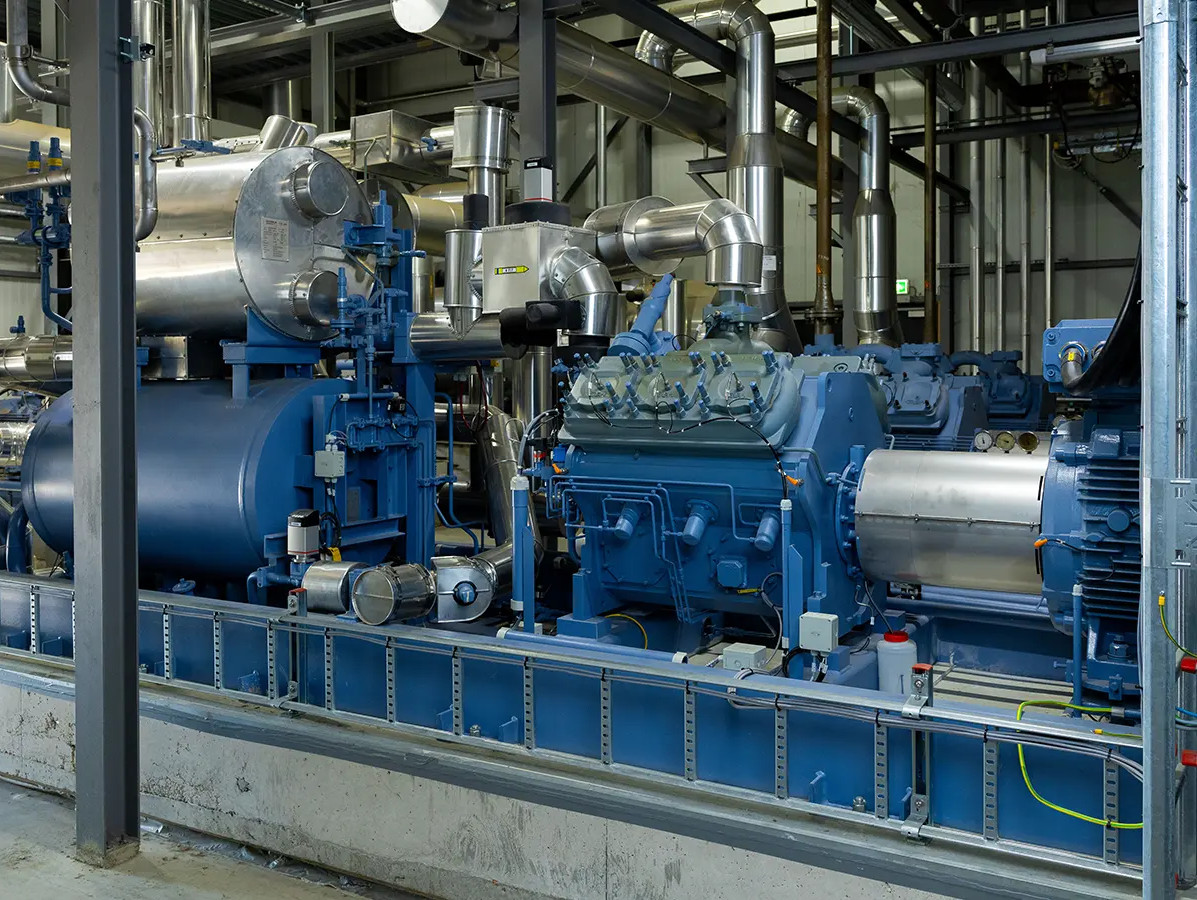
Marfo (Martinair Food) is taking major steps in sustainability, and not only through meals containing meat with the Beter Leven quality mark and a vegan product line. Significant energy savings are also being achieved in its production processes, including by converting cold stores to an NH3 (ammonia) system and installing a heat pump.
Marfo is best known for its convenience meals served during air travel. Airline catering still accounts for eighty percent of the international aviation specialist’s turnover, but twenty percent now comes from supplying defence organisations, canteens and healthcare institutions: the so-called third channel. “We take major trends into account in our product range. The rise of vegan and vegetarian meals and sustainable ingredients has certainly not passed us by,” says Rick Rumuller, Project Manager Engineering at Marfo. “Vegan demand does depend on the customer, however. When we look at our Asian customers, we see that meat is still very important there. In all our meals, we mainly use meat carrying the Beter Leven quality mark.”
“We are always working on innovations, such as the launch of puréed meals for people with swallowing difficulties,” Rick continues. Care meals are supplied under the Chef Martin label. Chef Martin’s Cuisine is an extensive range of frozen fresh meals and components suitable for various sectors and is part of Marfo B.V.
Innovation and sustainability are not limited to the product range. Many machines have also been upgraded in phases, enabling the company to achieve significant energy savings. This was made possible through a five-phase programme carried out together with GEA, which began as early as 2014. “Legislation has played, and continues to play, an important role in driving these changes,” explains John Molenwijk, National Project Manager at GEA Refrigeration Netherlands.
One example is the tightened European F-gas Regulation, which is intended to restrict the use of fluorinated refrigerants. This means that many refrigeration systems at companies now need to be modified or replaced. The European Union has decided to tighten F-gas legislation further and accelerate the phase-down of the F-gas quota. As a result, new European rules came into force on 1 January 2025, with a major impact on refrigeration and freezing systems that operate with refrigerants with a high Global Warming Potential (GWP). Under European policy, the use of so-called fluorinated refrigerants must be reduced to zero by 2050. Marfo is also affected by these requirements.
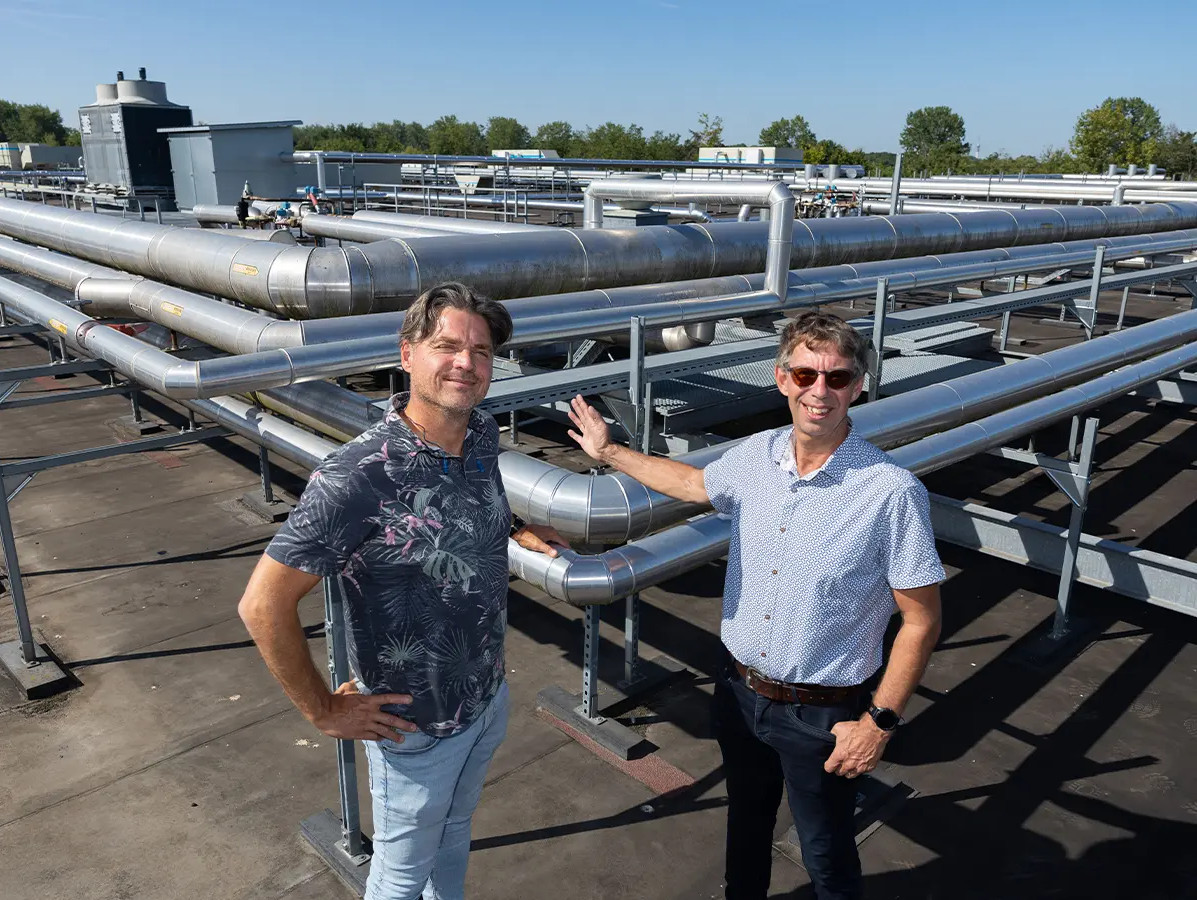
Rick Rumuller and John Molenwijk
“To make sure Marfo could meet all the requirements on time, we started discussing a phased plan with the company at a very early stage, in fact as far back as 2014,” says John. “Non-natural refrigerants such as R22 had to be phased out in favour of more natural and energy-efficient alternatives. In the event of a leak, systems using a non-natural refrigerant can also no longer simply be topped up. We guided Marfo throughout this process. Ultimately, the decision was made to install an ammonia (NH3) system using sustainable refrigerants with favourable thermo-energetic properties.”
In 2014, construction started on a new machine room containing a refrigeration installation equipped with three V1800 low-pressure compressors and two V1400 high-pressure compressors. An air-cooled condenser was also installed, and a blast-freezing tunnel was converted to NH3. “Previously, a temperature of –40 degrees Celsius was required to maintain the quality of the frozen meals. After extensive testing, we managed to establish that –33 degrees is also sufficient. This allows Marfo to save a great deal on energy costs,” says John. According to him, another benefit is that significantly more capacity can be obtained from the machines: instead of 250 kW, they now deliver 350 kW.
In 2016, construction began on an NH3 refrigeration plant, after which the various R22 refrigeration and freezing facilities were converted in phases. By 2020, all existing processing areas and cold stores had been transferred to the NH3 system. John: “Over the past few years, in the final phase, the air handling units – which no longer run on gas but on electricity – were replaced and connected to the NH3 system.”
In one of the final stages, in 2025, an additional heat pump was installed. “The available capacity on the electricity grid can currently affect the maximum efficiency that can be achieved. We have since developed software that ensures the heat pump is used up to the electricity limit.”
Throughout the intensive programme carried out together with GEA, Marfo was able to make use of the Stimulering Duurzame Energieproductie en Klimaattransitie (SDE++) scheme and the VEKI (Versnelde klimaatinvesteringen industrie) subsidy. SDE++ is an operating subsidy, while VEKI is a one-off investment subsidy.
Photos ©James Media
Source: ©Vakblad Voedingsindustrie 2026
Magazine Voedingsindustrie has been made possible in part by:



© COPYRIGHT 2026 VOEDINGSINDUSTRIE | ALLE RECHTEN VOORBEHOUDEN
Powered by Wallbrink Crossmedia © 2026