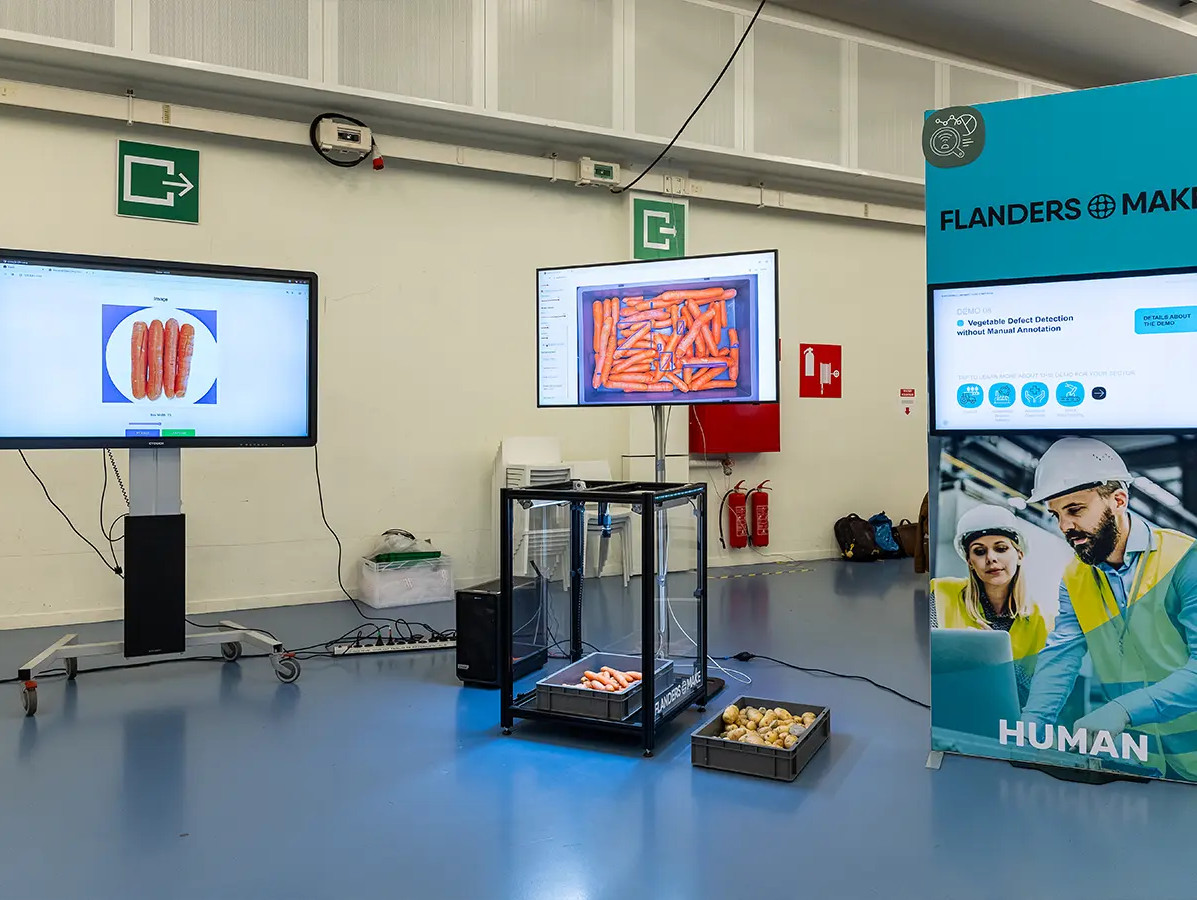
At Food Tech Event 2026, Flanders Make demonstrates how advanced technology can contribute in practical terms to more efficient, sustainable and reliable food production. Starting from real challenges in production environments, Flanders Make develops innovative solutions in digitalisation, automation, artificial intelligence, robotics and sensor technology. The focus is on inline quality control: faster, more objective and with less waste than traditional sampling and laboratory analysis.
Visitors are introduced to two demos that show how quality control and inspection can be integrated directly into the production process. Flanders Make offers a broad range of technologies, focusing on improvements in hardware (cameras, spectroscopic sensors), data processing with machine learning and AI, as well as practical implementation. This extensive expertise makes it possible to provide the most suitable solution for each specific case study, fully fine-tuned for integration into the relevant production process.
Flanders Make presents a camera solution that replaces expensive hyperspectral cameras with an affordable multispectral system. This significantly reduces hardware costs, while applications such as product classification or surface detection remain possible. The booth also shows how Flanders Make uses its own screening and validation pipeline to quickly determine the right camera configuration for each application. In addition, there is a custom sensor approach for the agri-food sector focused on detecting toxic substances, diseases, nutritional value or product defects. Compact and cost-efficient spectroscopic sensors are developed for this purpose, suitable for both solids and liquids and capable of operating at high production speeds. These sensors can also combine multiple technologies (fluorescence, Raman, reflection spectroscopy), enabling multi-element detection. Visitors gain insight into the entire process, from spectroscopic study to sensor design, prototyping, calibration and implementation.
Flanders Make has developed a ready-to-use AI workflow for visual inspection and robot vision that companies can reuse across different applications. This workflow combines the generation of synthetic data with automated training to deliver application-ready AI models without manual annotation. The workflow can start from 3D models of organic products and can handle different geometries and surface properties, including challenging and reflective surfaces. Based on these assets, the workflow automatically generates high-quality training datasets with built-in annotations. Where relevant, artificial defects can be introduced to represent realistic inspection scenarios. This data is then used to train and refine AI models for object detection, pose estimation and defect detection. The result is a validated AI model that can be integrated into a wide range of applications, such as waste sorting, bin picking, quality inspection and other robotic systems.
The exhibition booth offers not only technology, but above all insight into how innovation can be applied in a practical, cost-efficient and low-risk way. Visitors gain inspiration for their own production processes and discover how Flanders Make supports companies from feasibility study through to validation. Anyone looking for future-oriented quality control and smart AI solutions should not miss this booth.
Food Tech Event 20 and 21 May 2026 | Brabanthallen Hall 3 Booth 131
Source: vakblad Voedingsindustrie 2026 | Special Food Tech Event 2026
Magazine Voedingsindustrie has been made possible in part by:



© COPYRIGHT 2026 VOEDINGSINDUSTRIE | ALLE RECHTEN VOORBEHOUDEN
Powered by Wallbrink Crossmedia © 2026