
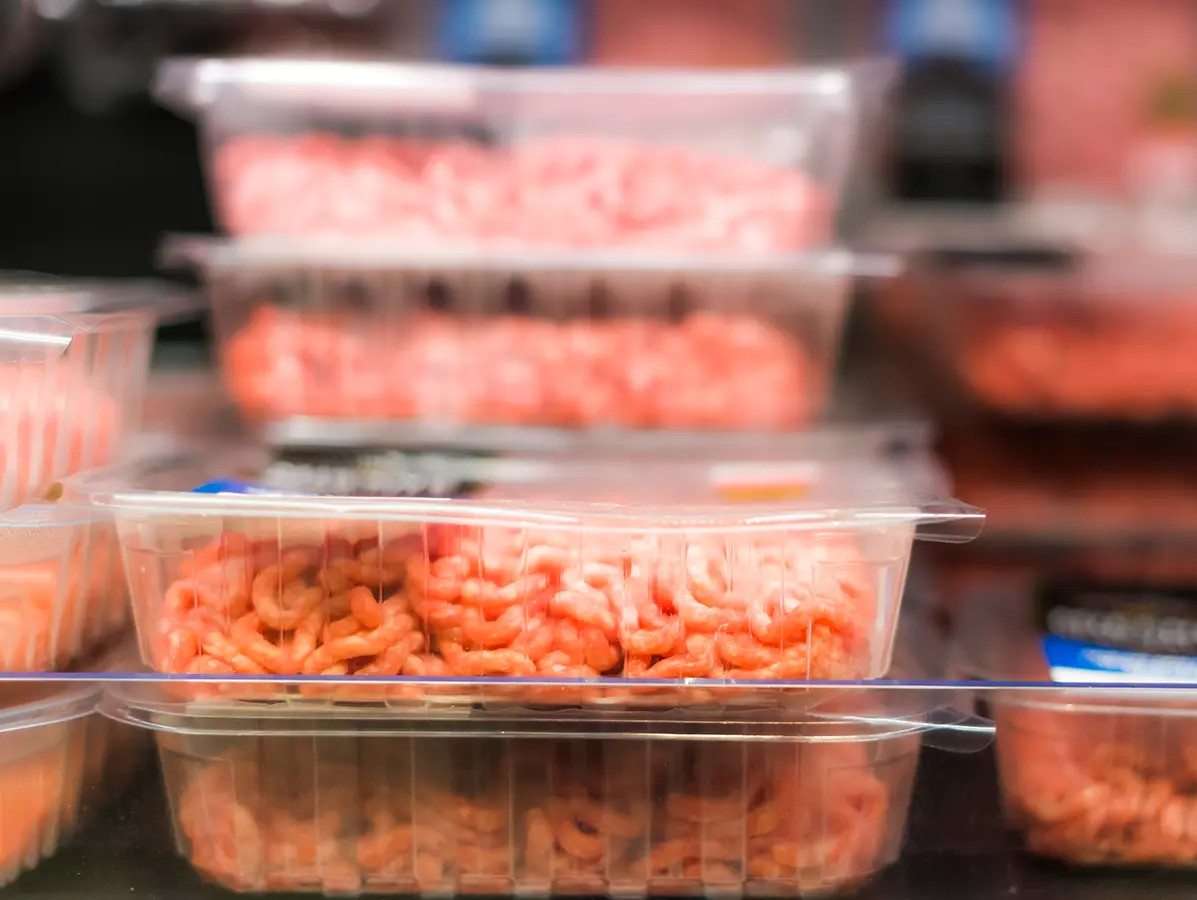
Meat products with plant-based ingredients are no longer niche. Research by Foodvalley shows that hybrid products are widely present on supermarket shelves. Price and nutritional value play a clear role in this.
Enriching meat with plant-based ingredients is not a new phenomenon. Until the 1990s, this combination was already used to improve texture and flavor. According to Foodvalley, the concept is now making a comeback.
The driver lies in rising meat prices and protein transition targets. Retailers are looking for ways to reduce the share of animal proteins. At the same time, hybrid products fit within existing eating habits. Consumers hardly need to change their routines.
Foodvalley analyzed 115 products, including composition, price, and Nutri-Score. Of these, 111 are meat preparations and 4 are dairy products. Within the analyzed range, Jumbo holds the largest share at 41%. Albert Heijn follows with 28%, and Lidl with 8%. The average plant-based share in meat products is 10.5%.
Fava bean protein is the most commonly used ingredient, followed by upcycled raw materials such as sugar beet fiber. Ingredients such as seaweed, vegetables, potato, jackfruit, and mycoprotein are also used. For 31 products, the Nutri-Score was compared with a reference. In 35% of cases, the hybrid version performs better. For 44 products, the price was compared. In 60% of cases, it is lower, averaging 4.4% or €1.27 per kilogram.
According to the Protein Transition Map NL, the Netherlands has at least 30 companies focused on plant-based enrichment. Their technology and ingredients offer opportunities for international scaling. During Plant FWD 2026, Foodvalley announces a collaboration with Food System Innovations. Under the name ‘Balanced Proteins’, the parties are working on further development of the category.
For the next twelve months, a doubling is expected in the number of different products in the meat aisle. In addition, experts expect growth in hybrid dairy, including quark, yogurt, and cheese.
Source: Foodvalley
Magazine Voedingsindustrie has been made possible in part by:



© COPYRIGHT 2026 VOEDINGSINDUSTRIE | ALLE RECHTEN VOORBEHOUDEN
Powered by Wallbrink Crossmedia © 2026