

Every day, food companies work to deliver products that are safe to consume. Yet it can still happen: a bacteriological contamination. Where do you begin when searching for the cause? In the production process itself, the environment, or one of the raw materials?
In 2020, Hogeschool Leiden launched the project Advanced Precision Food Safety (APFS). This research project uses DNA analysis to detect and combat pathogenic contamination more quickly and effectively. In addition to several companies processing meat, fish, vegetables, and fruit, research institutes and industry associations are also involved. Eco2Clean, a supplier of cleaning and disinfection products and a knowledge partner in hygiene and cleaning, has joined the project as well.
The first step was to assess how reliable the currently used research techniques are and which analytical methods deliver the best results. By comparing the DNA of bacteria, it becomes possible to create a family tree (phylogenetic tree) that shows which samples (pathogens) are genetically related — and therefore may share a common source. For example an ingredient, a machine, or a supplier. After analyzing these data, the results were incorporated into a web app.
The database was built using samples supplied by the participating food companies and laboratories from various sectors. Gert Visscher, founder and owner of Eco2Clean, emphasizes that the results were accessible only to project participants. “It was never disclosed which company provided which sample. When the analyses showed that certain samples were strongly related, Hogeschool Leiden contacted the company involved to ask whether they were willing to share information. This made it possible to jointly investigate the potential source of the contamination. In some cases, this even led to surprising insights for us. For example, positive samples from a fish company and a vegetable-processing company turned out to be genetically related!”
“The project also examined how effective different cleaning and disinfection products are at eliminating five biofilm-forming Listeria strains,” Gert continues. “That additional research question was enormously valuable to us.” The laboratory tests produced striking results. He adds: “It turned out that cleaning alone or disinfecting alone with traditional agents — such as alkaline, chlorine-based, quat-based products, or peracetic acid — has barely any effect on eliminating Listeria within biofilms. Products consisting of combinations of strong acids, however, do have a powerful killing effect. A product based on lactic acid and hydrogen peroxide also showed strong bactericidal activity, even without prior cleaning. In addition, enzymatic cleaning products proved highly capable of breaking down the biofilm and eliminating Listeria. With this information, we are now even better equipped to advise our customers.”
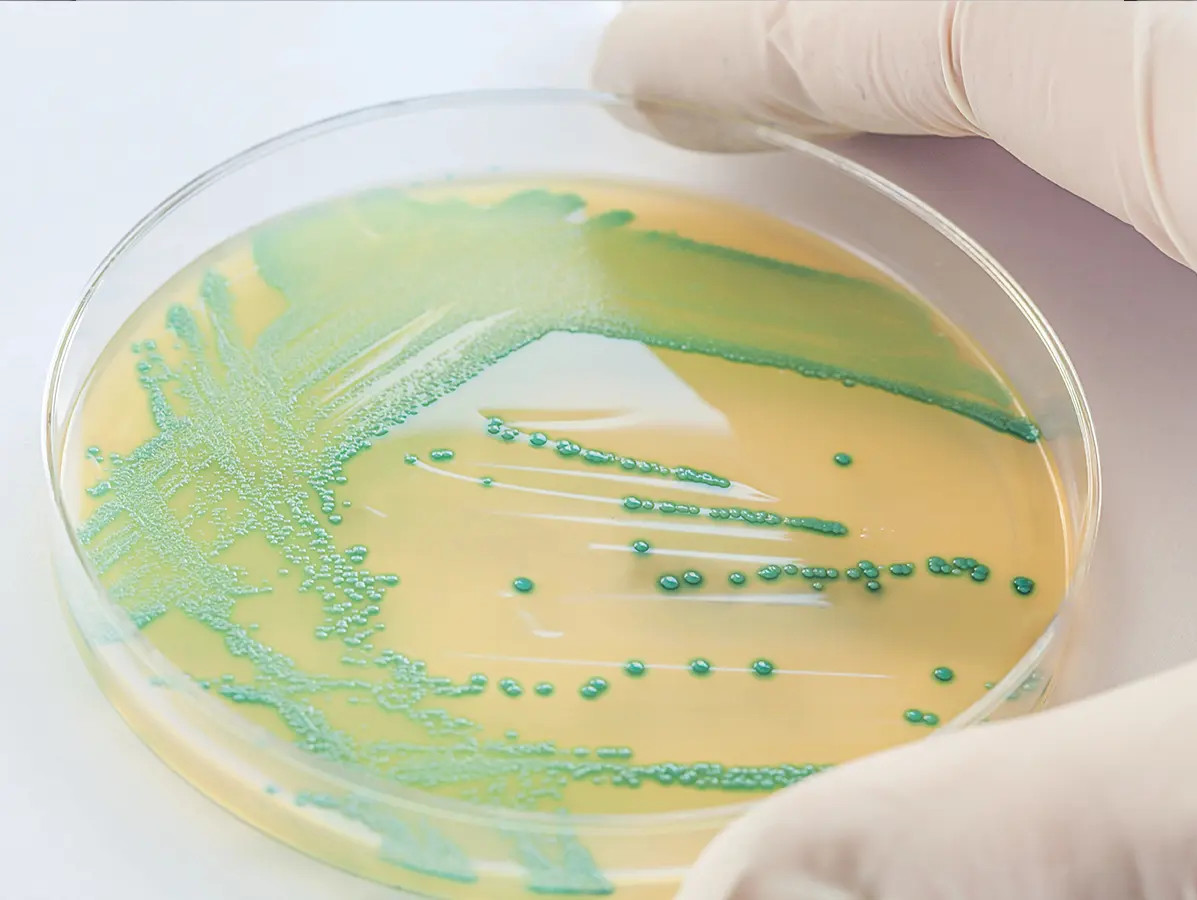
At one company, it was established that a specific raw material supplier was responsible for the continuous contamination problem. Because this supplier showed no willingness to take action, the company decided to end the partnership. Another participant discovered that several of its suppliers delivered contaminated raw materials containing the same bacterial strain. The contamination therefore turned out to be more widespread across the entire sector. Thanks to this knowledge, the company can now demonstrate that a case identified by the RIVM cannot be directly linked to its own production, but likely originates from a broader source within the chain — a source for which not all samples were available.
“This is an important breakthrough for the food industry. Companies can now trace the causes of pathogenic contamination far more accurately and quickly,” says Gert. “Another great development is that Hogeschool Leiden now offers all food companies the opportunity to have their samples sequenced — in other words, compared with other samples. Because they have consciously chosen not to use a commercial laboratory, they can provide this at relatively low cost.”
“This project enables food companies to work much more targeted and systematically on improving food safety — a development we strongly support,” Gert concludes. “We can help companies translate the research results into practical solutions on the production floor.” Eco2Clean and Hogeschool Leiden will now set up follow-up research on a larger scale. Among other things, this research will examine how other biofilm-forming bacteria, such as Pseudomonas, influence the strength of the biofilm.
Source: Vakblad Voedingsindustrie 2025
Magazine Voedingsindustrie has been made possible in part by:



© COPYRIGHT 2026 VOEDINGSINDUSTRIE | ALLE RECHTEN VOORBEHOUDEN
Powered by Wallbrink Crossmedia © 2026