
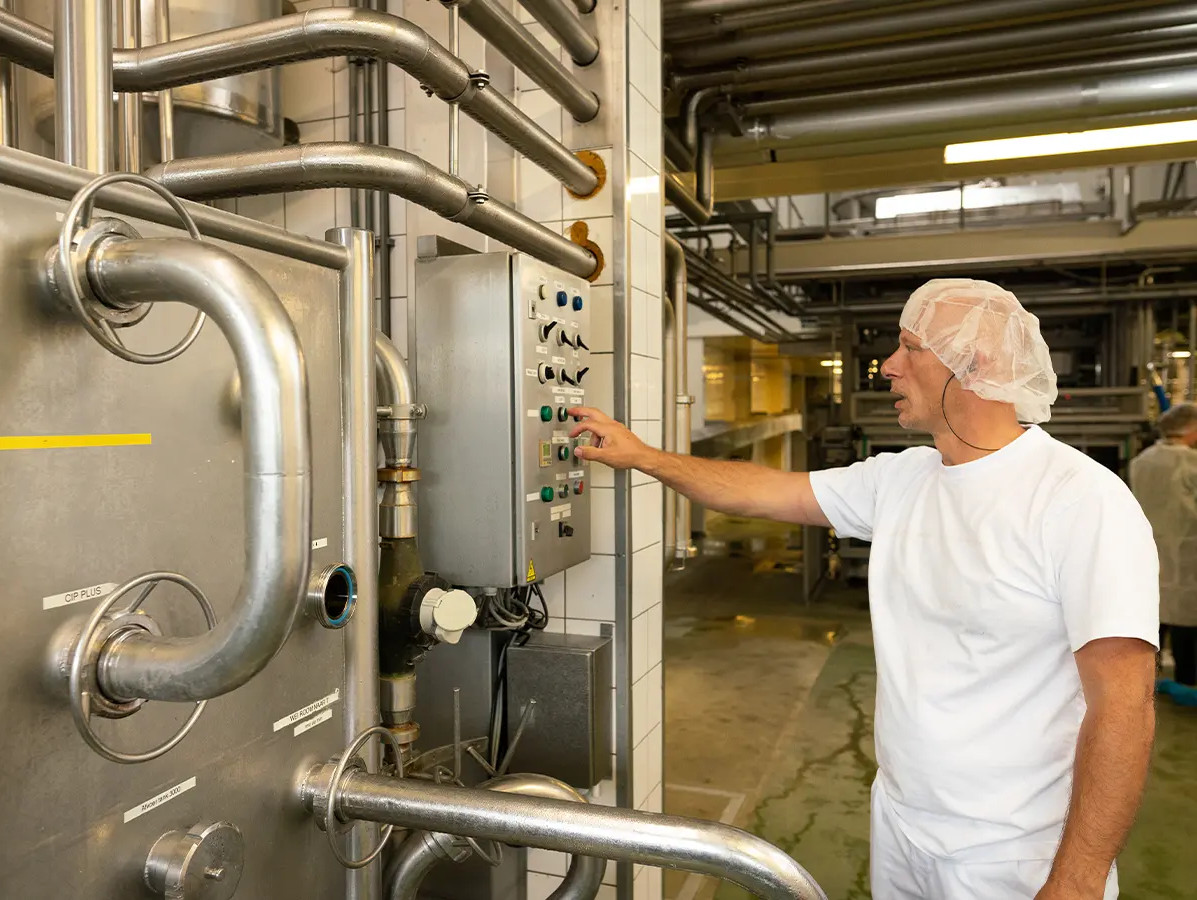
A well-functioning Cleaning in Place (CIP) system is essential for hygiene, product quality and business continuity. Yet many producers do not know how efficient their cleaning process truly is. There is room for improvement.
“Every day, money quietly washes away in production. Not because of inefficiencies in the production process, but in the cleaning process. Inaccurate settings make the Cleaning in Place system unnecessarily costly.” These are the words of Jaco Dorenbos, Product Manager Chemistry at In2Food. With 120 years of experience, In2Food is firmly rooted in the food industry—from local dairy producers and breweries to major multinationals. “We understand the challenges and actively contribute to solutions,” Jaco continues. “Every production line is different. Product types, hygiene standards, materials and human behavior all require a tailored approach. The same applies to how CIP is used. We often see that settings and protocols have grown historically or have gradually been adjusted to daily practice.”
With a CIP assessment from In2Food, your entire CIP system is mapped out. Jaco: “This assessment shows how the CIP system actually performs: from flow rate, pump capacity and temperature settings to rinse duration, recovery and dosing. By analyzing all this data, you gain a clear understanding of cleaning efficiency and where improvements can be made. This often leads to surprising insights, such as excessive water use, unnecessarily long rinse times or overdosing of chemicals. An assessment reveals where savings are possible, and where the process can be made even smarter. The result: a cleaner system, less waste and lower costs per cleaning cycle—without compromising cleaning quality or product safety.”
Based on the assessment, In2Food develops a concrete improvement plan. This plan looks not only at chemistry but at the full picture of the cleaning process. The strength lies in balancing time, temperature, concentration and mechanical action. By realigning these factors, cleaning can often be done faster, more efficiently and with fewer resources. This can lead to:

Jaco Dorenbos
For many companies, the payback period of a CIP assessment turns out to be surprisingly short. Small adjustments—such as a better calibrated rinse phase or optimized cleaning temperature—can already lead to significant water and energy savings. But the benefits of CIP optimization extend beyond cost reduction. A properly configured CIP system provides greater security in the production process, reducing the risk of contamination, residue or product loss.
While some parties offer extensive and costly optimization programs, In2Food deliberately opts for an accessible and practical approach. “Our specialists combine chemical and technical expertise with hands-on experience on the factory floor,” Jaco explains. “Together with operators, technicians and the quality department, we look at what can be improved as early as tomorrow.” The strength of a CIP assessment lies in the insights it provides, he emphasizes again: “It highlights what you are already doing well and where gains can still be made. This makes the step from optimization to sustainability much smaller. A well-structured CIP process not only saves costs, but also valuable resources. Less water, less energy and fewer chemicals. That is efficient cleaning with greater control over the process.”
Would you like to know what a CIP assessment can mean for your process? Contact the In2Food specialists.
Foto's: © Thomas Fasting
Source: Vakblad Voedingsindustrie 2025
Magazine Voedingsindustrie has been made possible in part by:



© COPYRIGHT 2026 VOEDINGSINDUSTRIE | ALLE RECHTEN VOORBEHOUDEN
Powered by Wallbrink Crossmedia © 2026