
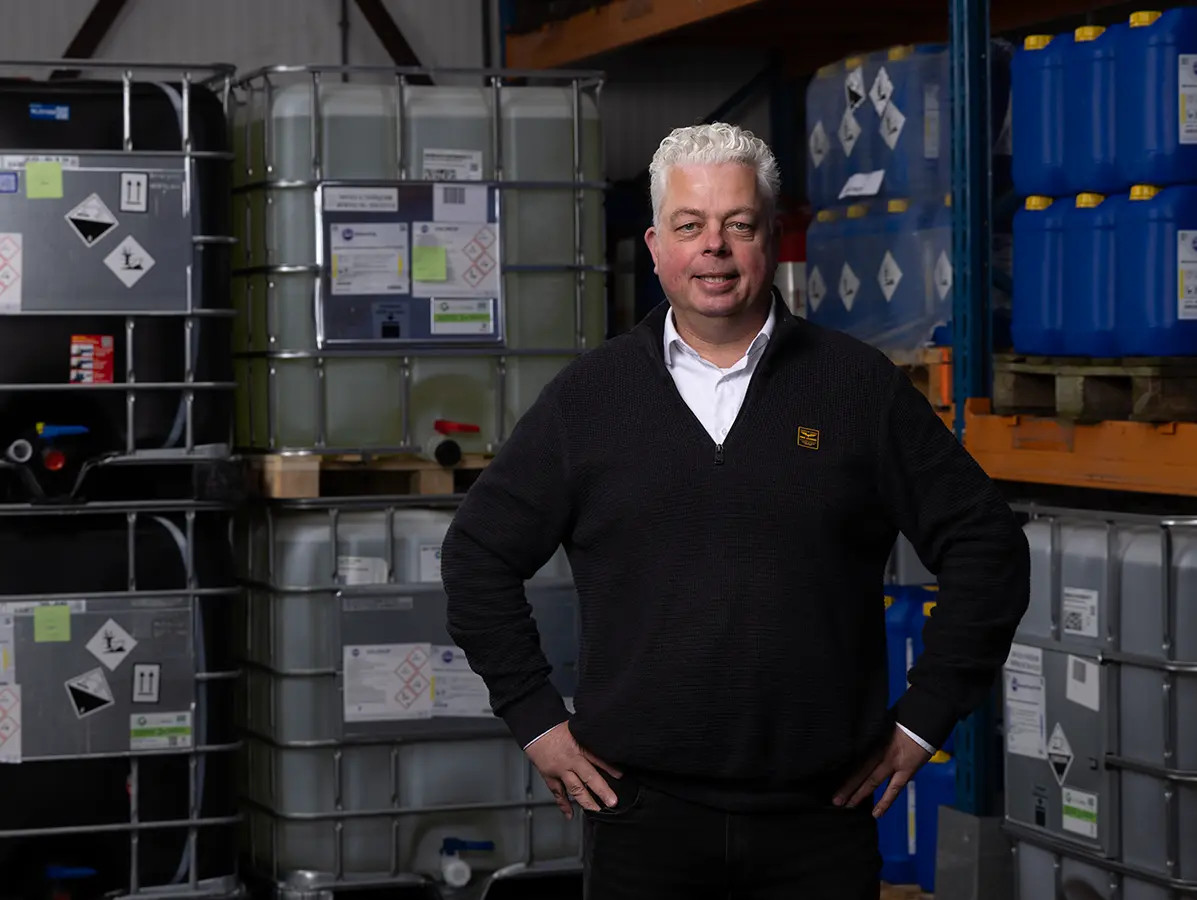
Food safety is the foundation of the food industry. That should be the starting point for everyone involved: suppliers, customers, auditors, the Dutch Food and Consumer Product Safety Authority (NVWA) and the government. Rob Kamphuis of Labaz Hygiëne Concepts is frank about it: “In practice, we see some strange things happen.”
“In the food industry, we work with legal user and hygiene regulations to ensure food safety. Unfortunately, things don’t always turn out well in real-life situations; regulations, guidelines and/or auditors even contradict one another.” Usually cheerful, Rob continues in a serious tone: “And that is when food safety can be at risk. That concerns us deeply. At Labaz, we sell food safety first and foremost, not products.”
To illustrate how difficult this can be in practice, he gives an example. “At a client — a meat processing company — I measure the concentration of a disinfectant. I prepare a calibration report and reflect on it. The NVWA then claims the measurement was not carried out correctly. I wonder whether something might have gone wrong and run a verification test with a 1% titration; there can always be a one-tenth deviation. That turns out not to be the case. I inform the client and the NVWA that the dosage is correct and that I disagree with the NVWA’s statement. In a rare exception, I receive a counter-sample of the disinfectant, which I also titrate. My findings remain unchanged. I have not heard back from the NVWA.”
Because Rob hears nothing back from the NVWA, he contacts the Board for the Authorization of Plant Protection Products and Biocides (Ctgb). He presents the case to them but does not receive a clear answer either. He does, however, receive an explanation. Rob: “They state that, ‘If you claim that you disinfect, you must comply with the legal user instructions.’ That’s correct. The applicable rules are stated on the product manual. But we often see that the prescribed contact times for disinfection are not met. In my experience, food-processing companies in the Netherlands are audited and inspected constantly. But surely it can’t be the case that an audit or inspection is carried out on something that doesn’t fit within — or simply can’t meet — the legal user instructions?”
Rob shares a second example. “Take cleaning and disinfecting of the soles of shoes or boots. The contact time between the brush and the agent is likely less than a second. Can a sole really be disinfected under those conditions? In my opinion, no. I fear that if an audit takes place — regardless of which organization performs it — this will result in a violation. The contact time for shoe and agent is listed, but it isn’t achieved. According to the instructions, you can’t claim disinfection in that case.”
Usually, a combined product is prescribed for cleaning — one that is suitable for lightly contaminated items. “Yet, such a sole is usually not ‘lightly’ contaminated,” Rob points out. “In the worst cases, there are even bits of meat stuck underneath. It would be far more effective to use only a cleaning agent. But that’s not allowed. Both cleaning and disinfection are required. That doesn’t sit right with me. I’m not going to sell an N-number for something where the user instructions aren’t being followed and enforcement isn’t possible. I find that very difficult. In quotations from competitors, I regularly notice the (profit)motive. But that should never be the starting point.”
“When a client asks me, ‘Do I need to disinfect?’, I say: ‘No; if you can demonstrate that you’ve cleaned bacteriologically, disinfection adds no real value — at most, a bit of extra safety… But you must do it, because if something goes wrong, you are required to show that you disinfected and complied with the law.’ If we disinfect just for the sake of disinfecting, then food safety is no longer at the core. I understand that experts emphasize that there can always be airborne infections that disinfection can help manage. Before a product touches a surface, that surface must be demonstrably clean — including bacteriologically clean. Treating a surface with steam results in a bacteriologically clean outcome, but I can’t find any registration (N-number) for steam at the Ctgb. I think the government, the NVWA and auditors are missing the point — safeguarding food safety — by focusing on controlling and enforcing something that doesn’t add up as a whole.”
This is why Rob is calling on his colleagues, customers, the government, the NVWA, auditors and others, summarized in five key points: “First: put food safety first. Second: work with realistic guidelines. Remove the discrepancy. Ensure regulations align with what is actually possible in practice. Third: apply disinfection only where it truly adds value. Let hygienic and/or bacteriological results guide you. Fourth: be transparent in quotations and in advice to customers. And finally: Don’t sell nonsense! Only by working together can we guarantee food safety in a realistic way.”
Photo: © Koos Groenewold
Source: Vakblad Voedingsindustrie 2025
Magazine Voedingsindustrie has been made possible in part by:



© COPYRIGHT 2026 VOEDINGSINDUSTRIE | ALLE RECHTEN VOORBEHOUDEN
Powered by Wallbrink Crossmedia © 2026





