
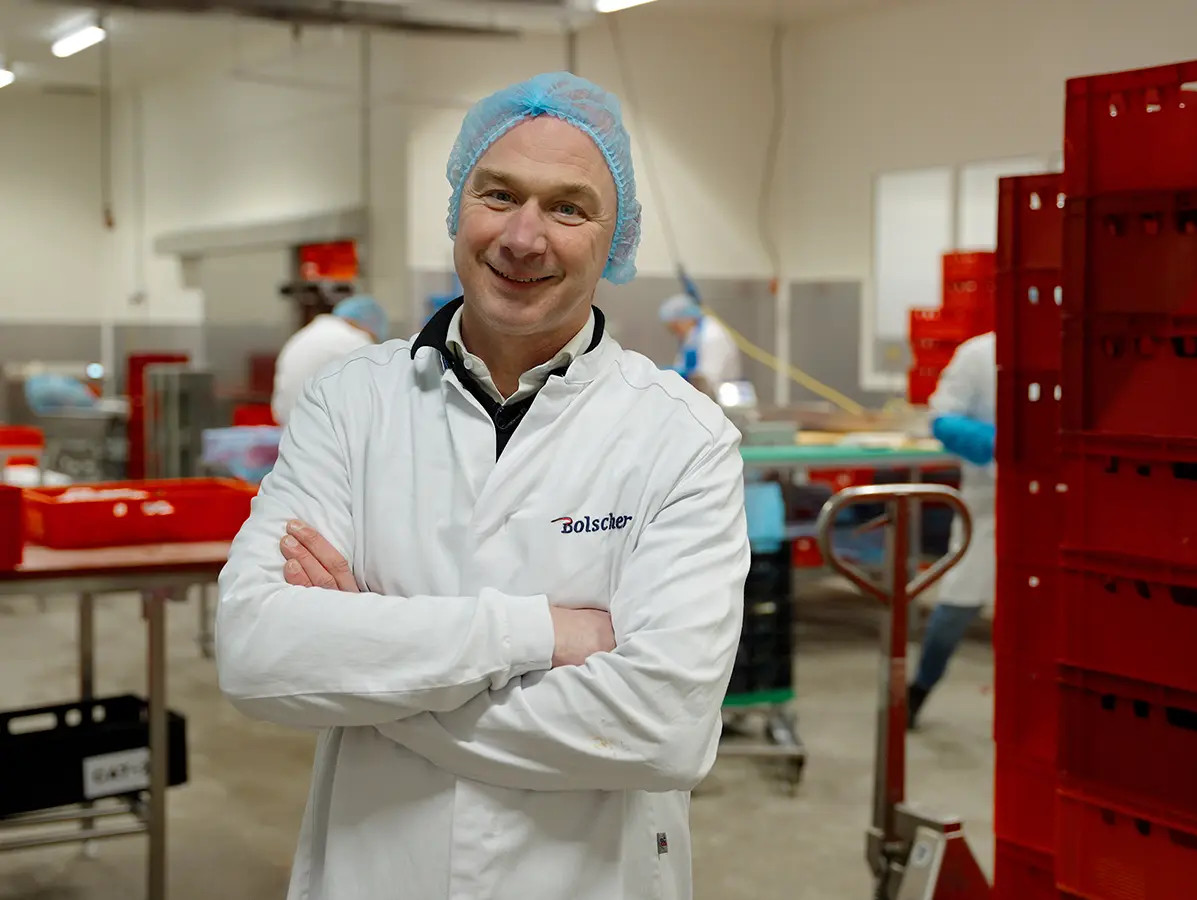
What if, as a meat producer, you decide to look at your own impact in a completely different way? Not starting with solar panels or electric cars because that is what is expected, but with a fundamental question: are we doing things today that we can still sustain ten years from now? That is exactly the approach taken by Roy Bolscher, managing director of meat processor Bolscher in Enschede.
Meat processor Bolscher does not aim to be the largest, but rather the most progressive in the way it interacts with its surroundings. Roy puts it accurately: “When people think of sustainability, they think of expensive. Here, we don’t really use the word sustainability. We believe in doing things today that you will still be able to do in ten years' time. Otherwise, we simply won't start.” This approach not only brings appreciation and insights, but also delivers impressive results: a 92% reduction in CO₂ emissions over seven years. While many companies start with the product, Bolscher reversed the perspective. First assess what the building consumes, emits and discards, and only then optimise what happens inside it. Heat in a meat processing company? That is precisely what should not be there. “As a meat business, we need to keep everything as cold as possible,” the managing director emphasises.
Bolscher approached the balance between cold and heat like an engineer. In cooling processes, heat is typically removed from the building and released via the roof, even though that heat could also be put to use. In other words: why blow warm air outside while a boiler is burning gas to heat water? Why evaporate water using energy-intensive installations when it can also be removed mechanically by centrifuging? By making these simple but meaningful choices, processes are turned around, stripped of waste and set up logically.
Heat released from blast chillers is now used to preheat the water in the boiler, resulting in 30 to 40% lower gas consumption. The crate washer was modified so that drying with hot air is no longer required. Instead, the crates are spun at high speed, slinging off the water so they come out of the machine cold and ready for immediate use. There are no big words or glossy certificates involved. It is mainly a series of small decisions that add up. Roy Bolscher smiles when he explains that there is deliberately grass instead of gravel on the site: “It may contribute 0.000001% to CO₂ reduction, but it makes me happy.” That sense of enjoyment turns out to be the driving force behind all these steps.
While many companies struggle to reduce emissions by a few percentage points, Bolscher achieved something that borders on the remarkable. “We went from 1,260 tonnes of CO₂ emissions per year down to 91 tonnes, a reduction of 92% in seven years.” Not thanks to one single breakthrough investment, but by counting everything, comparing everything and repeatedly asking the same question: can this be done more intelligently, more quietly, on a smaller scale? “How many kilowatts of electricity do I need? How many litres of diesel do I use per year? How many cubic metres of gas do I consume annually? We recalculated all of that into kilowatts and CO₂, knowing that anything that runs on electricity can be made greener. That is much harder for gas and diesel. So each time, we tackled a portion of diesel or gas consumption and converted it to electricity. Then you purchase green electricity and tick it off.”
Of course, this does not happen without friction. Change affects people, especially when it becomes personal. Switching from combustion-engine cars to electric vehicles was one of the most challenging topics. Employees take pride in their cars, the colour, the brand. But those who lead the way simply have fewer options. Sometimes you have to push through before support develops. In the meantime, the market has changed, and no one is surprised by electric driving anymore.
That persistence pays off. Only once you have your own operations fully in order can you expect something from suppliers. Bolscher does not want to impose sustainability requirements without setting the example first.
CO₂ has been addressed almost completely; only the final few percentage points remain a challenge. As a result, attention is now shifting to the next major issue: nitrogen. “As a meat producer, we are part of the nitrogen challenge the Netherlands is facing,” says Roy. At the same time, the company is looking more broadly at other ways to further reduce its impact, including smarter and more recyclable packaging. For the coming ten years, the bar is once again set high. For Bolscher, it is not a checklist, but a mindset.
One striking statement from Roy is one you might not expect from a butcher: “We need to eat less meat.” Not because the business model is under pressure, he says, “but because quality will always outweigh quantity.” That honesty strengthens the message: the meat industry is changing. Smaller portions, a shift towards on-the-move consumption, regulation and CO₂ targets are shaping the future. Roy mainly sees sustainability as something companies need to do together. “It is a chain performance. As an industry, we should not make the same mistake as politics. Make a choice in time. If you keep going back and forth, you will not get anyone on board; not in the Netherlands, and not here within the company either. It has to be very clear: this is where we are now, and that is where we are going.”
Source: Vakblad Voedingsindustrie 2026
Magazine Voedingsindustrie has been made possible in part by:



© COPYRIGHT 2026 VOEDINGSINDUSTRIE | ALLE RECHTEN VOORBEHOUDEN
Powered by Wallbrink Crossmedia © 2026





