Listeria, Salmonella, Campylobacter, E. Coli, Clostridium Perfringens, moulds… If these uninvited guests make their way into your food production facility, you’re facing a horror scenario that makes Halloween look mild. Not only because of the financial blow and the hassle of recalls, but also because lives can literally be lost. Fortunately, there’s a solution.
Nocotech disinfection is a technology that uses a dry mist to disinfect an entire room, including all machines, surfaces (and undersides) within it. Too good to be true? To find out, we take a closer look and talk to internationally renowned chemical technologist Thierry Rouleau, a Frenchman, inventor, and developer of the Nocotech disinfection method.
The origins of this method lie in the dental industry. “Don’t be mistaken,” Thierry begins. “The worlds of dental practices and the food industry are much closer than you might think.” And he’s not referring to the fact that food usually meets a set of teeth before it reaches the stomach, but to the major risk of cross-contamination. “Practice rooms, operating rooms, and production areas are breeding grounds for bacteria. Poor disinfection in these environments can make people ill, sometimes with fatal consequences. The big difference? In a dental practice or hospital, contamination usually affects one or a few people. In the food industry, the consequences of poor hygiene can be far more severe, potentially affecting hundreds. That’s why preventing cross-contamination is absolutely essential in this sector. You can’t afford to say, even for one day: ‘oh well…’ You need to be preventive!”
In 2003, Thierry and his brother Arnaud founded Oxy’Pharm, the company that developed and now produces the Nocotech disinfection method. The venture grew out of their father’s earlier company ‘Airel’, where the brothers also worked. The focus there was on technology for dental practices in the broadest sense of the word. They made and supplied everything, from dental chairs to, indeed, disinfection equipment. And that’s where it all began.

Thierry Rouleau
“Necessary disinfection often relied, and still relies, on sprays,” Thierry explains. “Proper use requires spraying the product onto the surfaces to be cleaned, allowing it to act for the prescribed amount of time, and then removing it thoroughly with water. That way, no residue remains. But in daily practice, the contact time isn’t always respected. That’s how bacterial resistance develops. Many antibiotics are already ineffective because of the growing number of resistant bacteria. A big problem!”
A common method in dental clinics was to disinfect with hydrogen peroxide, he continues. “It’s extremely effective against bacteria and viruses, but also highly corrosive. Not exactly ideal in a room full of stainless steel.” Thierry therefore went in search of an alternative: a non-corrosive disinfection method that kills bacteria quickly and effectively without allowing them to develop resistance. “My research showed that by heating the liquid, H₂O₂, to a maximum of 40 degrees Celsius, it transforms into a gas. In that gaseous form, the bactericidal properties of H₂O₂ are fully preserved, while the oxidative ones are completely neutralized. That discovery changed everything!”
The current Nocotech machine produces static air, resulting in the ionization of the gas. These ions, also known as dry mist, have the ability to rapidly attach to bacteria through an electrostatic process. “They basically stab them in the back,” Thierry explains. “That’s enough to destroy them extremely fast. This principle works for all bacteria, spores, and fungi, in other words, for all microorganisms found in the food industry. The H₂O₂ eventually breaks down into water (H₂O) and oxygen (O₂). No residue remains, so there’s no need to rinse the area with water afterwards.”
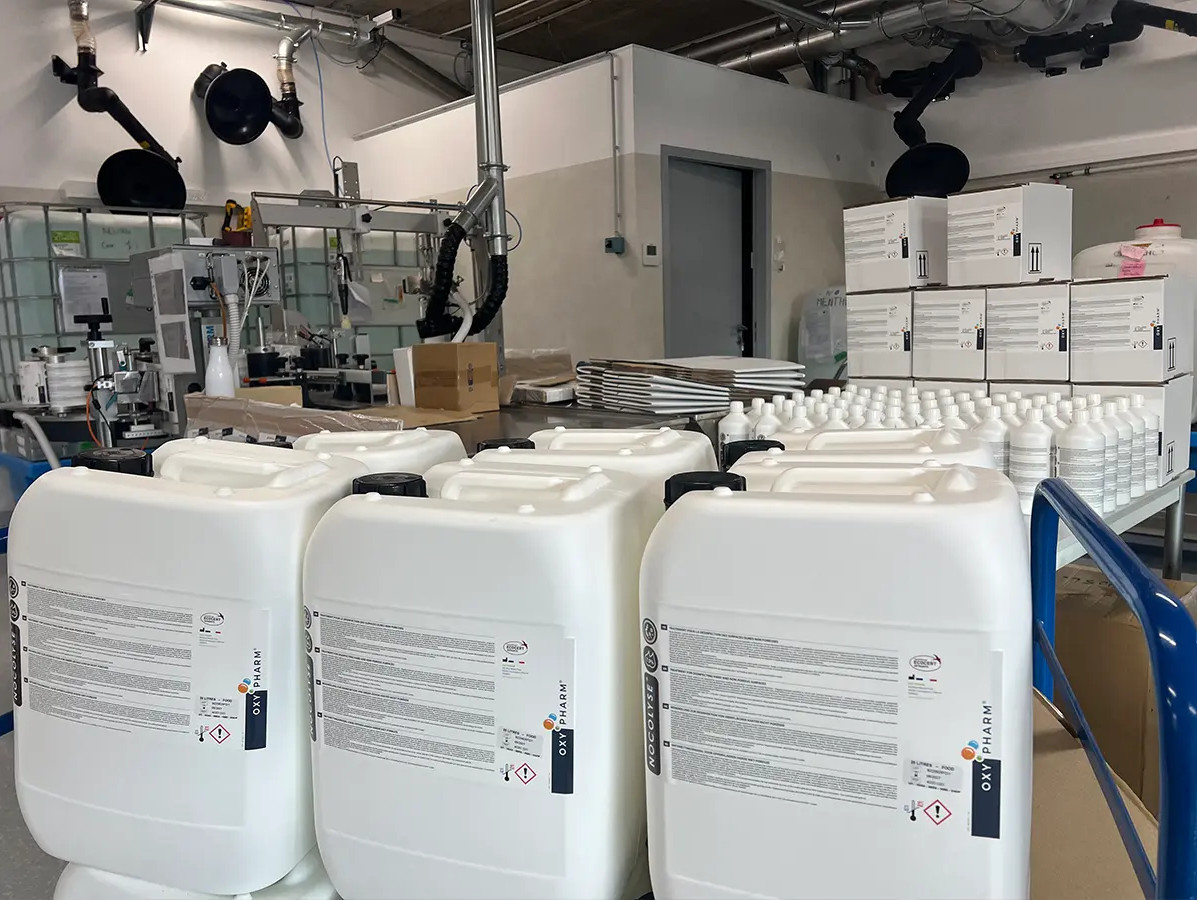
Initially, Nocotech was sold only to the (para)medical sector. That had to do with the tiny amount of silver the liquid contained. Silver is highly effective against bacteria, spores, and viruses, but even the smallest trace of silver is prohibited in the food industry. The silver ions were therefore replaced with ascorbic and citric acid, which offer the same functionality and efficiency. In December 2015, the Ctgb approval for use in the food industry was obtained. “Biodes/Simpeldesinfecteren from the Netherlands was the first to see an opportunity for this disinfection method,” Thierry recalls. “I already knew Robert Kostrubiec from my time in the dental world. Later, I also met Hugo ter Hoeve, the company’s other owner. We make a good team,” he says with a smile. “In the food industry, hygiene challenges differ from company to company, and so do the solutions. Only by analyzing the entire process can you offer a tailor-made solution. Hugo and Robert are very smart in that. By now, more than 200 companies in the Dutch food industry have embraced Nocotech. They are the best.”
Before the official approval in December 2015, Simpeldesinfecteren carried out several business cases at fruit & vegetable, fish, and meat processing companies. “Disinfection in the food industry does indeed work a bit differently than in the medical sector. That had to be tested in the early stages. The pilot setups resulted in clear application guidelines, and conclusive proof that the method works perfectly and safely in food production. You only need a very low dose if you use it daily. Just 1 ml/m³ is already highly effective. The dry mist of ions reduces microbiological pressure and thus the risks, protecting the consumer. For the food industry, there is now a fully automated solution.”
Today, the product carries an EU authorization instead of a Ctgb one. Is there a difference? “No,” Thierry explains, “at the end of the day, it’s exactly the same. A Ctgb approval has to be applied for and substantiated separately in each individual country. A single overarching European authorization automatically grants access to all EU countries. We’re the first company in Europe to receive this approval. That makes us very proud.”
www.oxypharm.net/nl
www.simpeldesinfecteren.nl
Main Photo: © Emilie Goa
Source: Vakblad Voedingsindustrie 2025
Magazine Voedingsindustrie has been made possible in part by:



© COPYRIGHT 2026 VOEDINGSINDUSTRIE | ALLE RECHTEN VOORBEHOUDEN
Powered by Wallbrink Crossmedia © 2026