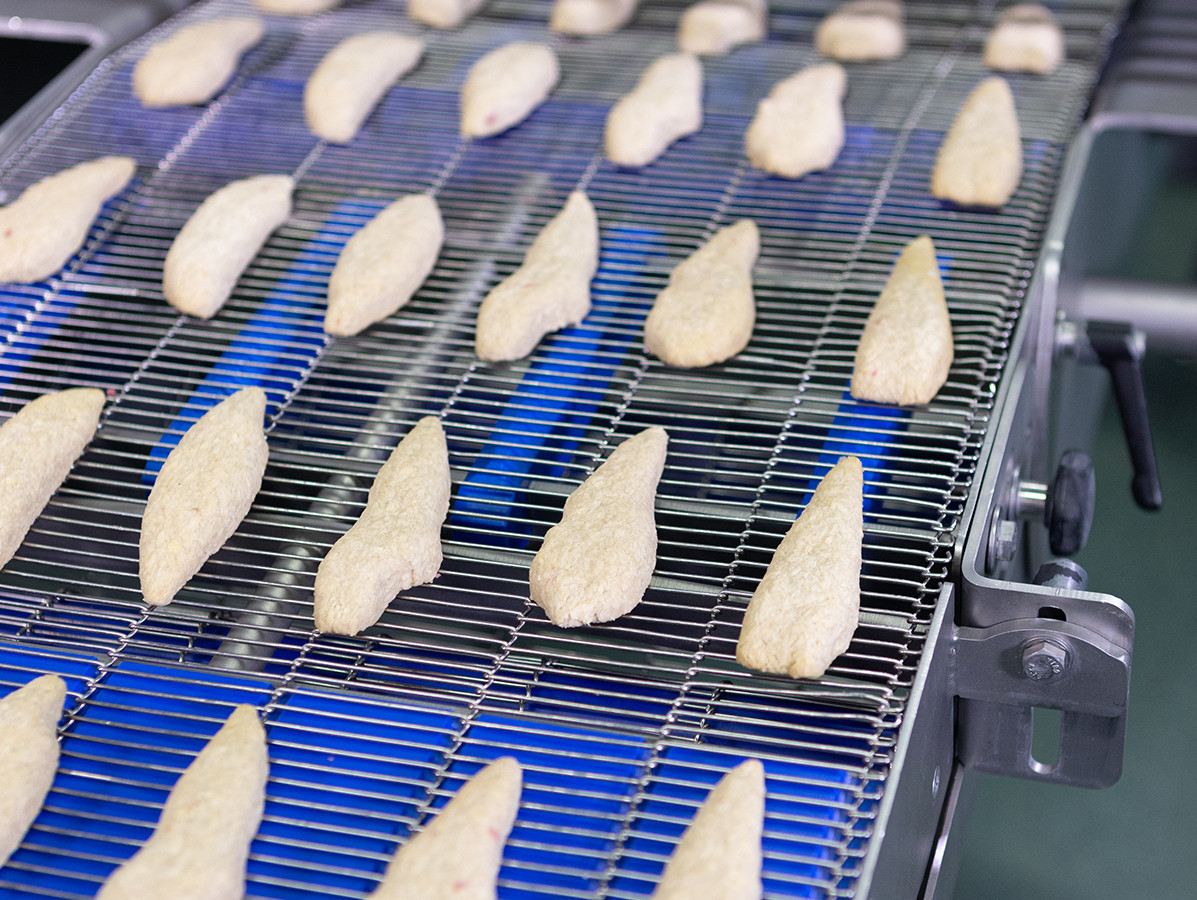
One of the biggest challenges in developing plant-based meat products is replicating the fibrous, ‘anisotropic’ texture of muscle tissue. Protein structuring technologies already offer a wide range of possibilities. Numerous new and emerging technologies are under development, drawing in part on ideas and techniques from other industries. What can they do, how do they work, and what results do they deliver? An overview.
For now, extrusion technologies are the dominant commercial solution for replicating the fibrous structure of meat and fish because of their scalability, robustness, and affordability. Other shear-induced technologies, such as shear cell technology and the PowerHeater, are also highly promising. At the same time, emerging approaches such as fiber spinning, freeze structuring, and hierarchical assembly offer good control over texture, but these techniques require further scale-up. Meanwhile, established technologies from bakery, dairy, and confectionery processing demonstrate that layered and anisotropic structures can also be achieved through mechanisms other than extrusion, providing inspiration for future developments in meat alternatives.
This article provides an overview of available technological developments for structuring plant proteins into anisotropic textures for whole-cut meat alternatives, such as whole pieces or sliced meat, chicken pieces, beef strips, or fish. Emulsified and ground meat alternatives, such as ground meat, burgers, and sausages, are outside the scope of this article.
Anisotropy means that the properties of a material or product change depending on the angle or direction in which they are measured. The opposite is isotropy, where the properties are exactly the same in every direction. Anisotropy strongly influences consumer perception during biting, chewing, and/or cutting. It can occur at multiple ‘length scales’, from molecular structures to the entire finished product. At the molecular scale, anisotropy arises from the orientation of molecules such as proteins, starch chains, and cellulose fibers. At scales ranging from micrometers to millimeters, plant and animal cells often have a preferred orientation, as seen in muscle fibers organized into bundles. In fish, the lamellae (the ‘flakes’) are naturally anisotropic. Meat is anisotropic at every length scale, whereas cheese has a low degree of anisotropy.
High-moisture extrusion (HME) is the most widely used technology for producing fibrous, plant-based meat pieces. HME can produce chunks, strips, pieces, and pulled meat alternatives with a good meaty bite and chewiness at a relatively high production capacity (>500 kg/h). Protein powders are mixed with water in a twin-screw extruder, where the mixture is cooked through heat and mechanical shear. The mixture then flows through a cooling die, where oriented protein networks form elongated structures that can subsequently be cut or pulled into pieces, chunks, or strips. Cutting is followed by a marinating step. Planted Foods recently combined extrusion technology with fermentation to produce larger, more flavorful pieces and enrich them with micronutrients such as vitamin B12 (eatplanted.com). Dry extrusion, or low-moisture extrusion (LME), is used to make texturized vegetable protein (TVP). TVP is mainly used as an ingredient in ground meat alternatives, but TVP chunks and strips are also hydrated and packaged as products such as shawarma-style pieces.
Shear cell technology can produce thicker structures resembling whole-muscle cuts than conventional extrusion. Plant protein doughs are placed in a shear cell in batches and subjected to heat and shear. This aligns the proteins, after which the shear cell is cooled to set the texture. The resulting structure more closely resembles muscle bundles than that produced by conventional extrusion. As far as is known, the current batch size is still relatively small. Rival Foods is working to commercialize this technology.
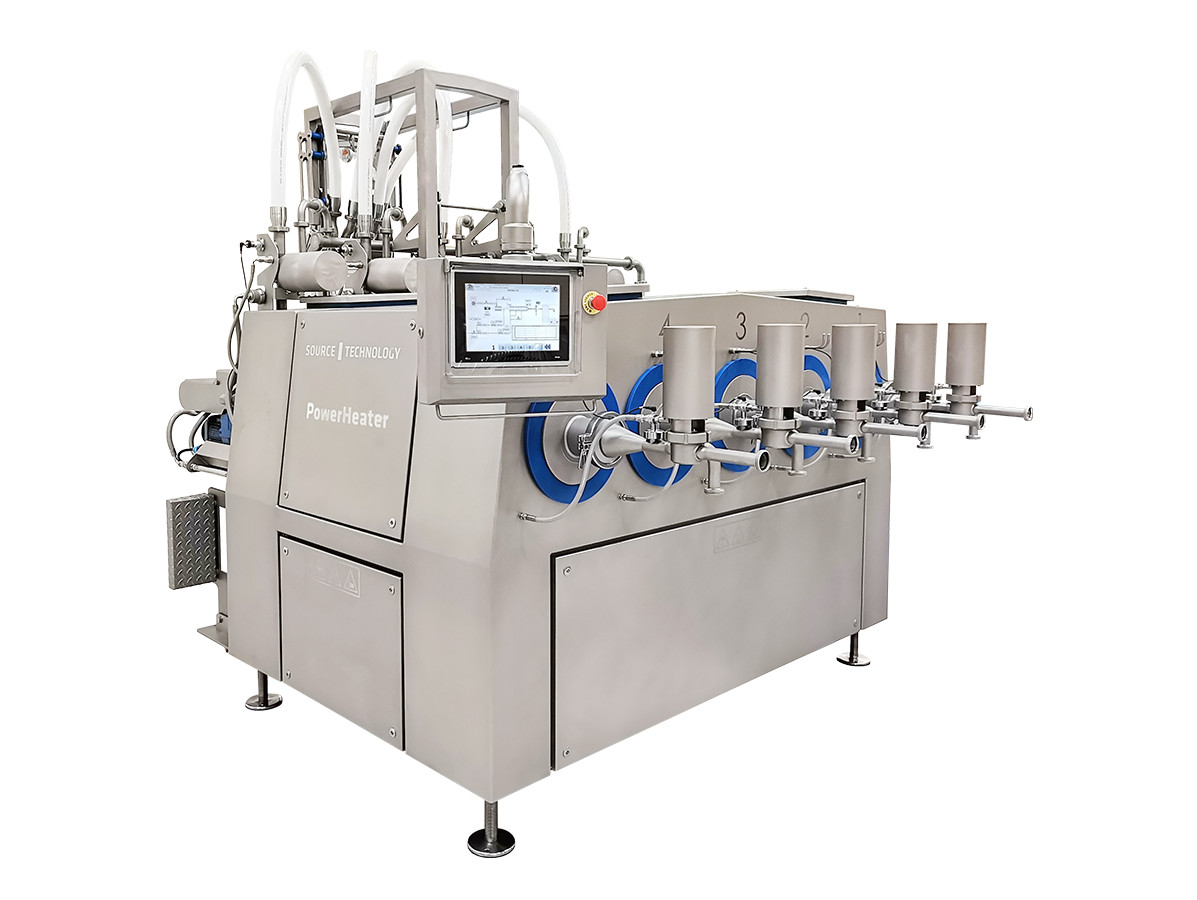
Another commercialized technology is the PowerHeater (Wenger Manufacturing, LLC, US). Raw materials are mixed into an emulsion or dough-like mass and then pumped into the PowerHeater. There, they enter an extrusion chamber containing a screw. The chamber is heated with pressurized steam; as the screw rotates, it moves the material forward and compresses the mass. The combination of heat, shear, and pressure creates fibrous textures. As the material leaves the extrusion chamber, it can be cut to shape. Typical capacity ranges from 75 to 300 kg/h. Higher capacities are possible by increasing the number of screws.
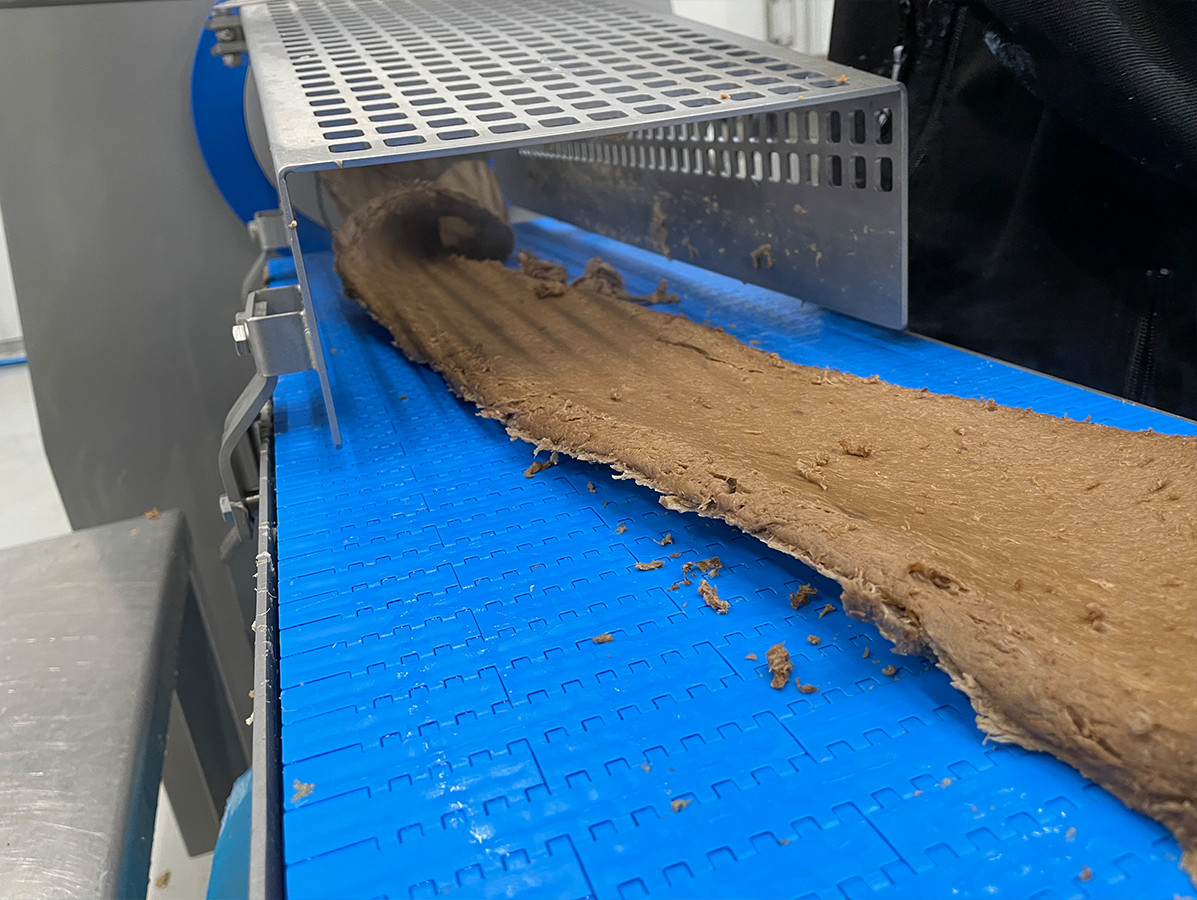
ShearTex is a technology (Dutch Structuring Technologies, the Netherlands) based on a rotating shaft fitted with additional rotating shafts. This allows independent control of shear, throughput, temperature, and residence time. The shaft is connected to a cooling die that can vary in length, shape, and dimensions, accommodating product thicknesses of up to 30 mm and capacities of up to 500 kg/h.
JuicyMarbles (Slovenia) produces thick plant-based whole-muscle-cuts using a combination of technologies. High-temperature texturization through extrusion or shear cell processing creates a parallel, muscle-like fiber structure. These fibers are then physically separated in part, restructured, marinated, and bound together into larger structures. Fat and marbling zones are incorporated to replicate the structure of whole cuts of meat.
Offbeast (Mooji Meats, US) is based on a patented ‘cross-fibre assembly’ technology: texturization at different length scales, analogous to real meat. Plant-based “muscle fibers,” produced through extrusion or fiber spinning, are used to build secondary structures. The fibers are combined with inclusions to create marbling, connective tissue, irregular (heterogeneous) fiber orientation, and fat zones.
In depositing technologies, relatively fluid, semi-solid doughs are deposited, set, and then scored. Fluid doughs or batters can also be poured into a mold and cooked to set before another layer is added. This process is repeated until enough layers have been built up, similar to making spekkoek, the Indonesian layered cake. Although this technology is not yet widely used for meat alternatives, patents exist for applications including fish alternatives (Nestlé). Revo Foods combines extrusion with precision depositing for fish alternatives, and NovaMeat does the same for meat alternatives.
To stabilize a layered structure, warm gelling solutions can be applied to existing layers, as is done with cookies or chocolate bars. Cold setting is another option, for example through dipping or enrobing. These depositing technologies are widely used in the confectionery and bakery industries. As a result, they are already readily scalable and affordable. As far as is known, they are not yet used for meat alternatives.
3D food printing builds meat alternatives layer by layer. The plant-based “inks” are formulated and dispensed separately, after which the printed structure is cooked. Advantages include precise control over geometry, the ability to replicate marbling, and the creation of highly complex structures, with or without supports or scaffolds. However, production speed is low. Redefine Meat uses additive manufacturing to create separate muscle, fat, and juice juices, which it then combines into products such as steak.
Biological structuring uses fermentation to grow fungal biomass (mycelium), which naturally forms long, microscopic fibers called hyphae. Further processing, including shaping, heating, and freezing, turns this fibrous biomass into meat-like structures. The advantage of mycelium-based meat alternatives is their natural fiber structure, which reduces the amount of processing required. Production capacity is limited by its dependence on fermentation infrastructure. Chunk Foods ferments soy flour with food-safe microorganisms using a solid-state fermentation process. This produces anisotropic textures that differ fundamentally from tempeh. Companies such as MyForestFoods, Libre Foods, and Meati also focus on mycelium-based whole muscle cuts.
Freeze texturization, also known as freeze structuring or ice-induced texturization, uses ice crystal formation to create a more fibrous, porous, and meat-like texture in plant proteins. During freezing, the water crystallizes, pushing the proteins apart. After thawing, channels and pores remain that replicate the bite and juiciness of meat. Freezing tofu is one example. After thawing, a sponge-like, porous structure remains.
A more advanced technique is directional freezing. When matrices are frozen from one direction, water droplets and pockets within the matrix become elongated in that direction. This forces the proteins into parallel layers. After thawing, a fibrous structure remains. One example is New School Foods, which uses directional freezing to create fiber structures that replicate fish muscle tissue. YonderFonder (TeaJin GnS Co Ltd.) uses a combination of freezing (coagulation) and heating to create layered, anisotropic textures from soybeans.
Project Eaden and Tender Foods/Lasso use fiber spinning technology to make fibrous meat alternatives. Project Eaden based its concept on the textile industry and uses spinning machines that force protein mixtures through numerous small openings. This produces thin fibers that subsequently solidify. Lasso uses centrifugal forces to texturize protein and fibers into nanofibers. Very little heat is involved.
Dough extrusion and lamination are already widely used in the food industry for products such as puff pastry and croissants. Dough is fed into a hopper and passed through rollers to form a sheet, which can then be laminated. Lamination involves folding, horizontal stacking, and/or cutting and stacking. Although there are no known commercial applications for meat alternatives yet, large laminating lines have throughputs of 1 to 3 metric tons per hour, substantially higher than HME.
Another technique uses an attachment developed for Handtmann’s filling and portioning systems, combined with formulations from Planteneers, including TVPs and fat, to create asymmetric fat marbling. ProFillet combines layers of plant protein with advanced fermentation layers to replicate fish.
Strands can be made using pasta and noodle production processes. Ingredients are mixed into a dough and shaped through extrusion, rolling, and cutting. In the confectionery industry, doughs are rolled and extruded using a distribution head to divide pumpable, viscous masses, such as cake batter, jelly, marshmallow, or chocolate, into continuous layers or parallel strands. Binders, such as gelatin or alternatives, hold the structure together. The mixture is extruded hot and sets as it cools, without requiring a additional stabilization step. As far as is known, these technologies, which offer high throughputs and low production costs, are not yet used for meat alternatives.
Surimi is a food with a fibrous structure at the macroscopic scale that is made using stretching-based technology. Surimi is fish that is processed into a moldable protein paste, mixed with salt and other ingredients, and then heated to form a strong, elastic gel network. The gel is rolled into a sheet and stretched while warm. This creates elongated protein strands that replicate the natural muscle fibers of crab or fish. Fish proteins naturally offer a good balance of elasticity, plasticity, and fiber separation; plant protein doughs require formulation optimization. A stretching method is also used to make mozzarella. Traditional preparation involves cutting, kneading with salt, and working the curd with hot water. On an industrial scale, cheese curd is stretched under warm conditions in a cooker/stretcher. This technology is specific to cheese-like matrices and, as far as is known, is not yet used in meat alternatives.
Molding and hot pressing are deformation and stabilization techniques widely used to make products such as tortillas and meat burgers. Forming and portioning technologies can also be used to shape plant-based chicken tenders, nuggets, and other meat analogs from materials produced using one of the processing technologies described above. The RevoPortioner (JBT Marel) uses a low-pressure forming process to create a wide range of product shapes. The machine can be integrated into a conventional processing line. This enables cost-efficient, high-capacity production.
These new technological insights provide inspiration for the STRUCTURED project (1). STRUCTURED focuses on creating scalable and affordable meat alternatives using existing ingredients and standard processing technologies. Within this public-private partnership (PPP), technology suppliers, ingredient suppliers, food producers, and research institutions work together to develop knowledge of protein and other ingredients and technologies for structured plant-based concepts.
View a table summarizing the different technologies: scalability, benefits, and limitations.
Note: (1) PPP Structured, ‘Plant based products with scalable and economic technologies’ (LWV22135), receives financial support from Topsector Agri & Food Nederland under the Knowledge and Innovation Agenda for Agriculture, Water and Food. The project is partly funded by John Bean Technologies AB, Marlow Foods Limited, Rademaker B.V., Rügenwalder Mühle Carl Müller GmbH & Co KG, V2 Food PTY Ltd., Wenger Manufacturing LLC., and Archer Daniels Midland Europe B.V.
Source: Vakblad Voedingsindustrie 2026
Magazine Voedingsindustrie has been made possible in part by:



© COPYRIGHT 2026 VOEDINGSINDUSTRIE | ALLE RECHTEN VOORBEHOUDEN
Powered by Wallbrink Crossmedia © 2026