
In food products, countless harmful substances can be present; including MOAH, which stands for Mineral Oil Aromatic Hydrocarbon. These are chemical compounds originating from mineral oil. Wageningen Food Safety Research and Wageningen Food and Biobased Research are developing methods that can detect the presence of MOAH in food more quickly.
MOAH is a broad group of substances which, according to the most recent EFSA risk assessment, are highly harmful to health, potentially genotoxic and, in some cases, carcinogenic. They therefore should not end up in food products. Yet they are still being detected. Since January 1, 2024, the Dutch Food and Consumer Product Safety Authority (NVWA) has been monitoring the presence of these substances in food products. Products that do not comply with the established action limits must be removed from the market. Within the EU, the presence of MOAH in food is strictly enforced, but legislation and/or enforcement in countries outside the EU is not on the agenda for now.
Even if the risk is understood, preventing MOAH in the food chain remains a challenging issue. How do you know whether a batch of oil is contaminated? Can MOAH still be removed from the product? Can recalls of contaminated products be prevented? And is it possible to intervene earlier in the chain? For example, by developing methods that make it possible to detect the presence of MOAH more quickly? Wageningen Food Safety Research and Wageningen Food and Biobased Research are looking for exactly that. Within the AMOQ project (Analysing MOAHs Quickly), two methods are being investigated: an antibody test and a spectroscopic technique.
First, it is important to understand how MOAH can enter our food. The harmful components discussed here can be found in products such as ink, cosmetics, lubricants and engine oil. Contamination of food with MOAH can therefore occur at any step in the food chain. At the farm: through the use of old machinery that may leak lubricants. During distribution: for example through hydraulic pumps used to transfer food ingredients in shipping containers. During production processes in the food-processing industry: when machines use (food-grade) lubricants that contain MOAH. And also in packaging: printing inks and packaging materials (such as recycled cardboard and jute bags) may contain these harmful substances. Often, people are not aware of the impact of the packaging or the risks associated with lubricants used for pumping. The fact that food-grade lubricants can also contain MOAH only complicates matters further. This enormous diversity of contamination sources and routes presents major challenges to the food sector. By better understanding where contamination occurs in the chain, and by making contamination more transparent, preventing MOAH in food products will hopefully become easier.
A large part of the solution lies in raising awareness among all players in the chain. If the impact of a small lubricant leak on food safety is unclear or underestimated, it's not likely to be prevented. Major players in the food sector are often aware of the risk of MOAH in food. They know the possible contamination sources and routes and understand the associated risks. Unfortunately, this knowledge is not shared by every player in the sector.
A second part of the solution lies in timely analysis. For analyzing the amount of MOAH in food products, a chromatographic method is usually applied. This analysis comes with several limitations. Chromatography can quantify a single component well, but a complex mixture can be challenging. And MOAH is complex: it is a collective term for a broad group of components. The analysis becomes even more complicated due to the presence of non-MOAH components in the same analytical region. To perform the measurement and analysis properly, highly trained personnel and expensive equipment are required, and even then the margin of error remains large. Moreover, the analysis takes a great deal of time — samples are gone for days to weeks before results are available. This makes rapid intervention impossible.
Faster measurement methods, even if they are slightly less precise, would be extremely helpful for an initial screening of critical food products such as oils or cocoa products. A rapid test would be a valuable addition (though certainly not a replacement) to conventional methods. A quick analysis at the source (on the plantation, or during the first processing steps such as the pressing mill) makes timely intervention much easier and can prevent contamination of a larger batch. Less waste, in other words. Screening batches later in the chain, for example in the harbor before raw materials are shipped, can also prevent later recalls. A rapid screening shortens waiting times for processing batches. Players in the food sector can therefore anticipate potentially contaminated batches much earlier. The most important goal is to prevent food products containing MOAH from entering the market — and being recalled later.
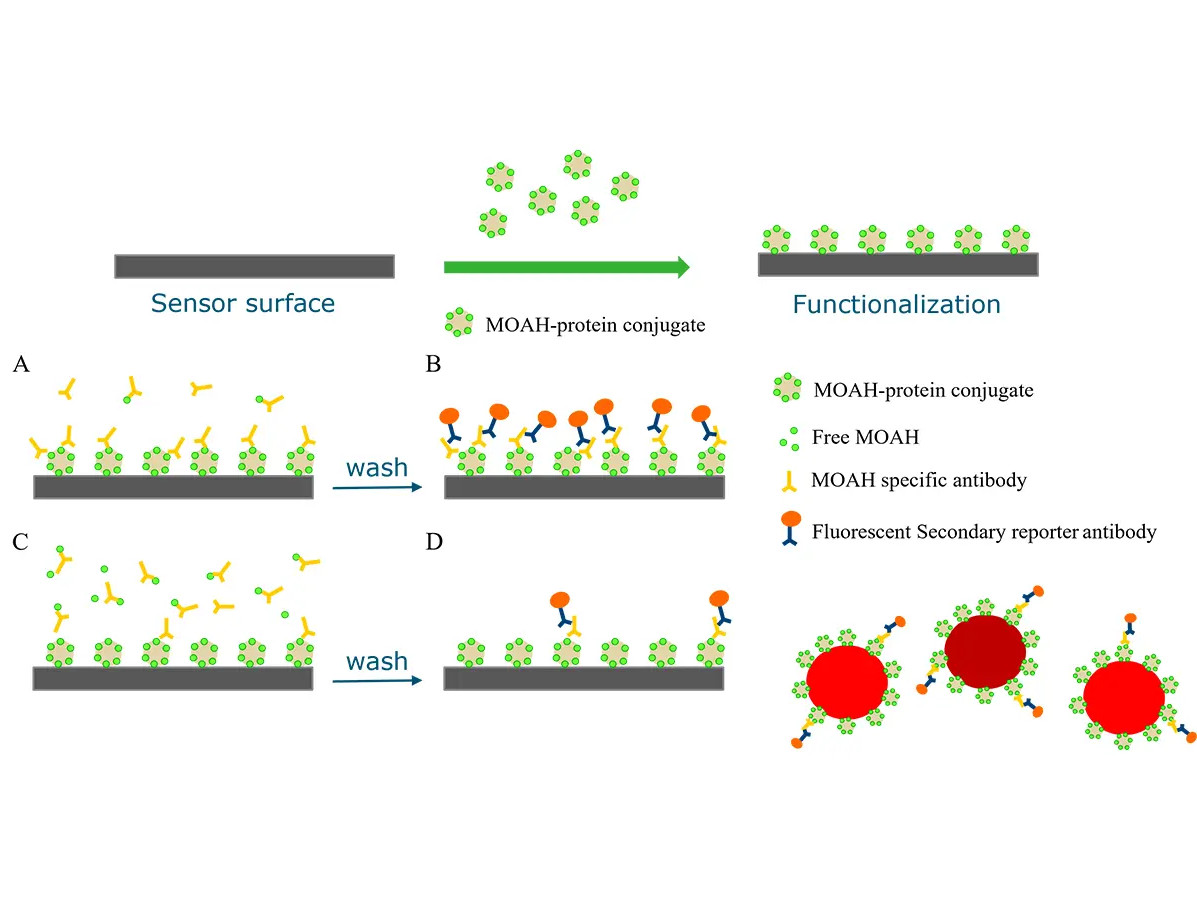
An antibody test is based on the binding of an antibody to a specific substance — in this case MOAH. In the test, fluorescent microbeads are used on which MOAH are fixed (see figure). When the antibodies are added, they bind to the MOAH on the surface (A). All MOAH that are not attached to a surface are washed away. A fluorescent antibody is then added, which binds to the antibody attached to the MOAH (B). This produces a fluorescent signal. When MOAH are added to this system, part of the MOAH-specific antibodies do not bind to the MOAH on the surface but instead to the MOAH in solution (C). These are then washed away, resulting in a surface with fewer antibodies. The fluorescent antibody then has fewer binding sites, and the fluorescent signal decreases (D).
Antibodies specific to MOAH do not exist. Therefore, antibodies against polycyclic aromatic hydrocarbons (PAHs) are tested. These have the basic structure of a MOAH, but without the alkyl side chains. To detect a large variety of components, antibodies are used against both a small PAH (naphthalene, 2 rings) and a larger PAH (benzo(a)pyrene, 5 rings).
Using this approach with these two antibodies, the researchers can already show that not only a wide range of PAHs can be detected, but MOAH as well. To test this, jute bags were “rinsed” and the rinse solution was analyzed using both the rapid test and the conventional lab test. The results of both measurements are comparable. From this we can conclude that this antibody screening is very promising. In the future, the screening could even be converted into a COVID-style rapid test.

Spectroscopic techniques were also examined. Spectroscopic techniques include all measurement methods that determine how molecules interact with light. Think of UV-Vis absorption, Raman spectroscopy, surface-enhanced Raman spectroscopy (SERS), fluorescence, mid-infrared (MIR) and far-infrared (FIR) spectroscopy. Initial tests show fluorescence to be the most promising for detecting MOAH. Adding a (MOAH-rich) engine oil to palm oil produces a clear additional peak. The jute bags from the antibody tests were also analyzed using this technique. The first tests are promising; fluorescence yields a similar result to the conventional method, indicating that a MOAH screening based on fluorescence could also be developed. One challenge for the spectroscopic method is that oils also contain several other fluorescent components, such as beta-carotene and vitamins A and E. These components can be separated from MOAH using chromatography, but for a rapid screening, exposure to high-intensity UV light may be a better option: the natural components degrade at a different rate (likely faster) than MOAH. By monitoring the signal over time, a clear picture of the MOAH concentration in the sample can be obtained.
If this rapid screening (or the conventional slower tests) shows that your sample contains a high amount of MOAH, you may decide to remove the MOAH. Removing MOAH was another part of the research program.
To begin with, the focus was on removing MOAH from oil. This can be done through both physical and chemical absorption. For physical absorption, the absorbent must bind strongly to the MOAH but not to the oil. This requires a material that binds well to the aromatic core and less well to fatty acid tails of the compounds. Since MOAH consist of an aromatic core with long aliphatic tails, this balance is difficult to achieve: is the binding mainly caused by the aromatic group, or by the attached tails? An activated carbon optimized for PAHs and several resins were tested. The resins (synthetic absorption resins, two variants of Sepabeads) showed almost no reduction of MOAH. Activated carbon showed a reduction of up to 20%, working somewhat more efficiently at lower MOAH concentrations. Since high MOAH concentrations were used to simplify analysis, the removal rate is likely somewhat better for samples from industry.
For chemical absorption, a specific reaction of MOAH with n-phenyl maleimide was tested. Aromatic compounds can react with this substance in a so-called Diels–Alder reaction. If this would work, the maleimide could be linked to a resin, creating a covalent trap for MOAH molecules. Unfortunately, this research line stalled at the first experiment: the maleimide did not react with the MOAH.
Prevention — especially when it comes to MOAH — is truly better than cure. With the rapid screening methods now being developed, preventing MOAH in the chain will become easier and faster to achieve.
Source: Vakblad Voedingsindustrie 2025
Magazine Voedingsindustrie has been made possible in part by:



© COPYRIGHT 2026 VOEDINGSINDUSTRIE | ALLE RECHTEN VOORBEHOUDEN
Powered by Wallbrink Crossmedia © 2026