‘How can we increase our output, improve efficiency, and lower costs at the same time?' That’s the question many managers in food production companies are grappling with. Which smart gadgets are currently being developed? Are they futuristic dreams—or genuinely viable in practice? Three experts weigh in on the trends and strategic choices in smart manufacturing within the food sector.
‘Alone you go faster, together you go further.’ This familiar quote seems tailor-made for the theme of Smart Food Manufacturing. Reinventing the wheel again and again, in different places, only slows down progress. Paul Goethals knows this better than anyone. He’s Business Development Manager Vision+Robotics at Wageningen University & Research (WUR). The program brings together over 50 experts from across WUR, covering computer vision, robotics, AI, and spectral imaging. But the brainpower doesn’t stop at the university gates. Through various Public-Private Partnerships (PPPs), the university, businesses, and governments collaborate in consortia on current challenges, building a direct bridge to real-world applications. One company frequently involved in these consortia is Vision Partners—a specialist in customized machine vision integration for production automation. Their technology covers the full (hyper)spectral vision spectrum: from visible light to NIR, SWIR, and even thermal infrared. We talk to Managing Director Jeroen Keunen. Also joining the conversation is Coenraad Deetman, Operations and Development Manager at Handtmann. He and his colleagues are working on innovative technologies to deliver smart machinery solutions for the food processing industry.
Unsurprisingly, the main driver for automation and robotization in the food sector is the growing shortage of workers. It’s becoming increasingly difficult to find people willing to work in cold and damp—or very hot—environments. And the problem is only getting worse. The “Labor Provision Authorization Act,” intended to improve the position of workers—particularly migrant workers—hasn’t made things any easier. But labor shortages aren’t the only reason the industry is investing in advanced technologies.
Coenraad: “Another major driver is the consumer demand for convenience and variety—both in products and packaging. Stuffed olives: with anchovies, and with nuts, dates filled with cream cheese or herb cheese; sausage and cheese pre-sliced in both small and larger portions. Vegetables are pre-washed, peeled, or chopped in the chilled section. And it’s up to the food industry to deliver all those options. Bulk and line production benefit from standardization. A machine built for a specific product type will always offer maximum output. But batch sizes are getting smaller. Operators need to reconfigure production lines more frequently. And that has its downsides. Flexibility always comes at a cost—usually simplicity and productivity.”
Paul adds: “At the same time, the industry has to deal with increasing demands around food quality—whether driven by legislation or beyond it. Sometimes it’s because a company wants to stand out with sustainable practices, or because a retailer requires it. These above-legal standards are playing an increasingly important role.”

Jeroen Keunen
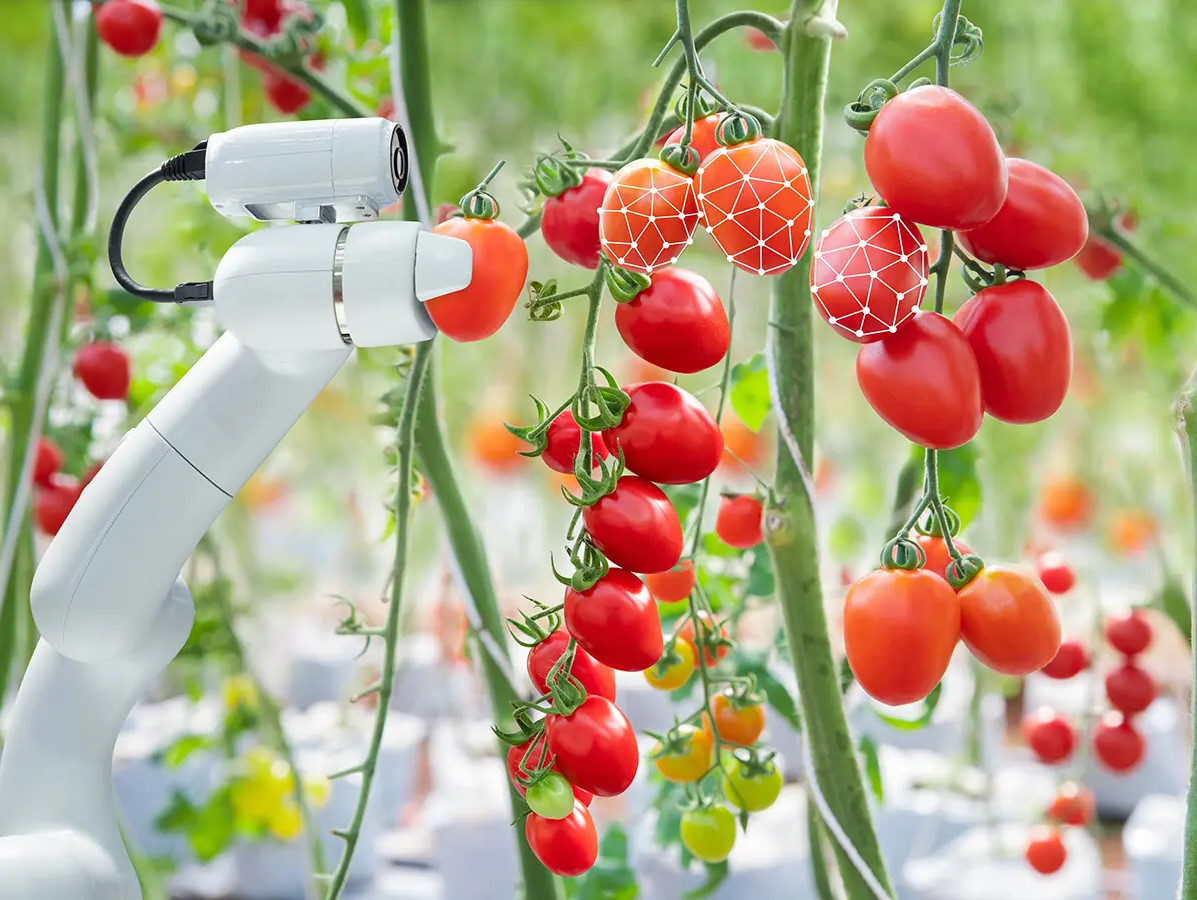
Jeroen agrees: “Margins are under pressure across the sector. That creates a strong drive to increase efficiency. Data can help optimize processes—whether it's quality control, traceability, output analysis across shifts and production lines, you name it.” And to gather that data, you need the right technology. Like vision sensors. “Vision sensors can ‘see’ far more than the human eye,” he explains. “They can not only detect whether an apple is red or green but also how sweet it is.” Over the past few years, advances in AI-powered vision systems, combined with more powerful computers, have opened up countless new opportunities. 3D vision can determine a product’s exact position. Thanks to vision technology, a robot can pick up that product with precision and determine its quality at the same time. Is the fruit ripe? Are there any rotten spots? “It can even evaluate the quality of the pulp beneath a skin that looks fine to the human eye,” Jeroen says enthusiastically. “Based on those findings, the robot can decide whether to place the item in one tray or another. And thanks to new technologuy, it’s now possible to measure a product’s chemical composition without touching it. In the past, you’d need to take a sample from the production line and send it to a laboratory—then wait days or weeks for results. Today, you can do that inline and have results almost instantly.”
Coenraad frowns: “Not quite as much as we’d like,” he admits. He shares an example from a recent project. “This client makes stuffed party snacks for supermarket chillers. Previously, around twenty people stood on the line each day, manually filling and packing every snack. Demand surged over the past five years, so capacity had to grow. But hiring more staff wasn’t realistic—new people were nearly impossible to find. So, alongside a conveyor belt solution, we explored the use of robotic arms. That’s where it got tricky. When combined with vision technology and the product’s variable shape, the robotic solution turned out to be too costly compared to a more mechanical alternative. A robot arm can only pick up, scan, and fill one item at a time, before placing it neatly into a tray. Our mechanical system works differently: it runs 24 lanes with preformed cavities side by side. Only six operators are needed to position the products correctly. Then, one pump fills all 24 snacks simultaneously through 24 channels. This solution is currently more robust, efficient, and cost-effective than deploying the same number of robot arms. For many food processors, the cost-benefit ratio still tips in favor of more traditional mechanical systems.”
Paul: “Still, I believe the sector is heading toward flexible workstations, where robots can perform multiple tasks and switch can easily be switched to another task without requiring the entire line to be reconfigured. Not even a push of a button, but automatically because the robot recognizes that a new batch is coming.”

Coenraad Deetman
Coenraad: “Of course, ROI is a big factor—how many people can a new machine replace and how long does it takes to recoup the investment? And does it save space or improve quality? A major challenge in robot design is that we’re dealing with natural products that don’t conform to standards,” he states. “Factors such as moisture, cold, heat, and the acidity we deal with in the food industry are big issues. Any machine, even a robot, must be food-safe and able to handle all of these elements. Plus, it needs to withstand high-pressure cleaning. There’s a real fear of breakdowns. With extensive robotization and automation, the ability to solve problems yourself at the site is also shifting to outside expertise. Traditional mechanics are still within the skillset of a typical maintenance team. But complex robots demand more from operators, and onboarding a new robot system takes time.”
“That’s definitely one of the bottlenecks slowing down automation and robotization,” Jeroen acknowledges. “Flexibility and product variety require new training sets.” Still, he sees reasons for optimism. “The software keeps improving. In the past, training a robot took ages. Nowadays, we use so-called synthetic data. A powerful computer simulates endless positions and scenarios, speeding up training significantly.”
Paul: “At the university, we do a lot in virtual environments—running scenarios repeatedly, tweaking variables. Building generic models has really only taken off in the past two years, and it’s set to accelerate. Still, every innovation ultimately has to be tested in the real world.”
Smart food manufacturing isn’t just about robots and vision technology. There are plenty of other ways to make production smarter, more efficient, and more sustainable. Our experts have no shortage of good examples. Paul begins: “We’re developing new technologies to manage water and energy costs. For example, we’re exploring less energy-intensive food preservation methods. The mild preservation method Pulsed Electric Fields (PEF) is a good example. There’s also a consortium researching whether the standard freezing temperature in the supply chain—currently -20°C—could be increased by a few degrees. Given today’s high energy costs and limited supply, shifting to -18°C could save a lot of money. But before we can make that change, we need to fully understand the impact on product quality and shelf life throughout the supply chain. That’s why in the Coalition we’re working with the entire chain—from farmer to retailer, and everything in between.” Another great example of innovation and collaboration, Paul continues, involves a robot presented at the Vision, Robotics & Motion fair last spring. Developed by Wageningen and machine builder Van Wees Waalwijk under the NXTGen-HighTech program. “The robot fills ready-made salads with various ingredients—grabbing items, placing them directly into packaging, and performing quality checks in one go. One of the advantages is that there is much less handling of the product.“ Such solutions are not just useful in the fresh produce sector. “In bakeries, shaped dough can go straight into baking tins, and later directly into packaging—shortening the production line considerably.”
Paul Goethals
Jeroen shares a project at a fresh meal producer. “We measure the temperature of mashed potatoes, cooked vegetables, and meat with great precision during filling. Overcooking leads to loss of flavor—you want to avoid that. But if the temperature’s too low, the risk of bacterial growth increases. Which also needs to be avoided. We developed a thermal vision system that allows the product to move forward only once it hits the right temperature—not too hot, not too cold. And it’s all done without contact.”
“Another practical example,” he adds, “involves measuring fat saturation in pigs, again, contactless. This research is part of the ‘Smart Pig Chain’ consortium, co-funded by the government and supported by Wageningen. Farmers can influence fat saturation by adjusting feed—say, more wheat or less corn. By feeding his pigs different feed, he can deliver a healthier, more valuable product. The goal is to factor in meat or fat quality when calculating payouts to farmers, making the food chain more sustainable, with less waste and less spoilage.”
Coenraad: “Another innovation with a lot of promise is software that tracks machine condition and measures deviations in patterns using smart sensors. The main drivers here are sustainability and cost savings. Clients buy a license, then continuously collect and compare data. This provides relevant information; whether it’s duller blades, worn bearings, or rotor degradation. A struggling motor uses more energy. Preventive maintenance avoids that. Handtmann’s head office in Germany is heavily investing in this. But in practice, adoption of this technology in the food sector is still slow.” In a way he gets why: “Uncertainty about the future plays a big role. Supermarkets rarely commit to long-term contracts, so sales volumes are unpredictable. With ongoing geopolitical tensions, people are holding back. Major projects are often postponed until the path ahead becomes clearer.”
Although Jeroen sees growing interest in vision technology and robotization among food companies, he also adds a note of caution: “Adoption is slow. Manufacturers focus on cost per unit, and as Coenraad mentioned, price remains a bottleneck. Plus, you’re often dealing with multiple stakeholders and conflicting interests. Major changes require cultural shifts. And the robot software, the eyes and brains, needs training. These are long processes. Change happens faster when there’s pressure from key players like regulators or retailers.”
Paul: “To move faster, we need more room to experiment and test prototypes. That’s hard to do on the production floor—runs are large, planning is tight, and any disruption costs money. That’s where the government can step in.”
Coenraad agrees that change is slow: “It’ll take at least five years before the food sector is truly ready for big transformations,” he predicts. Still, he remains optimistic: “Sixty to seventy percent of all global food innovations come from the Netherlands,” he says proudly. “We’re leading in so many areas. The Dutch have a solution-driven mindset—and I find that incredibly refreshing. Innovation isn’t just about ideas. The Dutch are assertive, we actually make them happen.”
Source: Vakblad Voedingsindustrie 2025
Magazine Voedingsindustrie has been made possible in part by:



© COPYRIGHT 2026 VOEDINGSINDUSTRIE | ALLE RECHTEN VOORBEHOUDEN
Powered by Wallbrink Crossmedia © 2026