
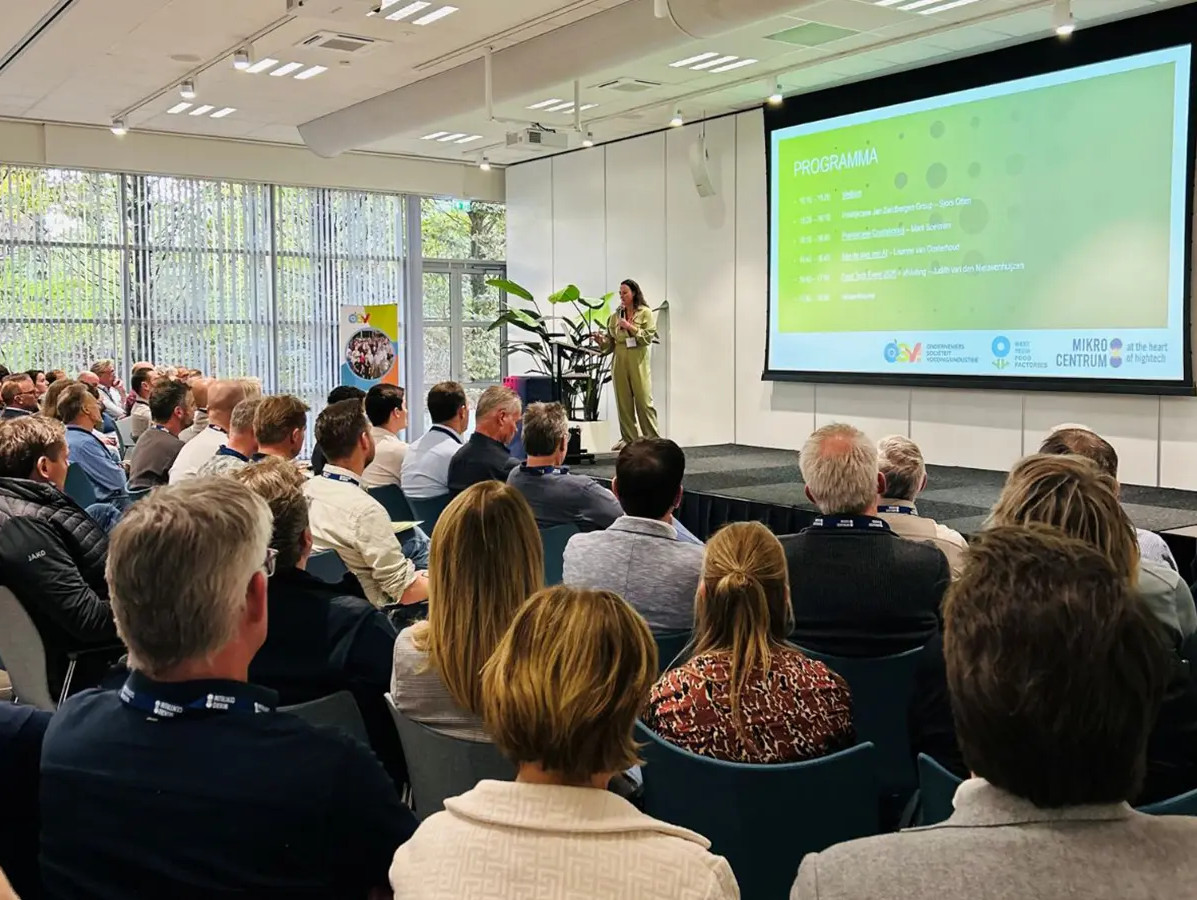
Artificial intelligence and automation are reshaping day-to-day practice in the food industry. During a joint mini-conference on 6 November 2025, organized by Mikrocentrum, OSV and Next Tech Food Factories, professionals were given a clear and up-to-date picture of what is already happening across the sector.
Inspiring real-world examples showed that AI is no longer an experiment but a strategic tool. With ongoing staff shortages, companies increasingly rely on technology to improve their processes. The organizers mainly wanted to demonstrate how businesses are already applying AI successfully to work smarter, more efficiently and in a more sustainable way.
Sjors Otten from Food For Analytics presented the first case: Jan Zandbergen Group uses the AI assistant Ask Titan to speed up and improve production planning. Where planners previously spent hours on manual analysis, the tool now calculates various scenarios within seconds. “Every employee loses around two hours a day due to data chaos. On a monthly basis, that amounts to €1,000 per person,” Sjors explained. The solution saves time, makes the planning process more manageable and increases predictability. However, this only works if the data is in order and the right context is provided. “Without context, AI doesn’t understand your business. Every company has its own jargon and agreements.”
Mark Soetman from Crustalicious demonstrated how his company turns an ecological issue into a commercial opportunity. Worldwide, there are roughly 8,600 crab species, several of which are harmful to local ecosystems and fisheries. Crustalicious processes these invasive species into high-quality crab meat, contributing to the protein transition. “We turn that pest into an opportunity. Instead of destroying them, we ensure that the crab meat becomes available more quickly and easily for the food industry.” The company developed an automated slaughter process and received advice from Art-IE students on how to further apply AI. The combination of technology and entrepreneurship enables cleaner, faster and more efficient production processes.
In addition to practical examples, the conference offered space for knowledge exchange and discussion. Companies received concrete tips on how to get started with AI. The day ended with a networking reception, where people spoke extensively about the opportunities and limitations of automation. There was also a look ahead to the Food Tech Event 2026, which will focus on advancing towards smarter food production. AI is broad in scope, yet basic in its nature. You can gain a great deal from it if your organization’s data is in order and you have a clear purpose for using it.
This mini-conference is a joint initiative of:
www.mikrocentrum.nl
www.nexttechfoodfactories.nl
www.OSVnetwerk.com
Source: Vakblad Voedingsindustrie 2025
Magazine Voedingsindustrie has been made possible in part by:



© COPYRIGHT 2026 VOEDINGSINDUSTRIE | ALLE RECHTEN VOORBEHOUDEN
Powered by Wallbrink Crossmedia © 2026