
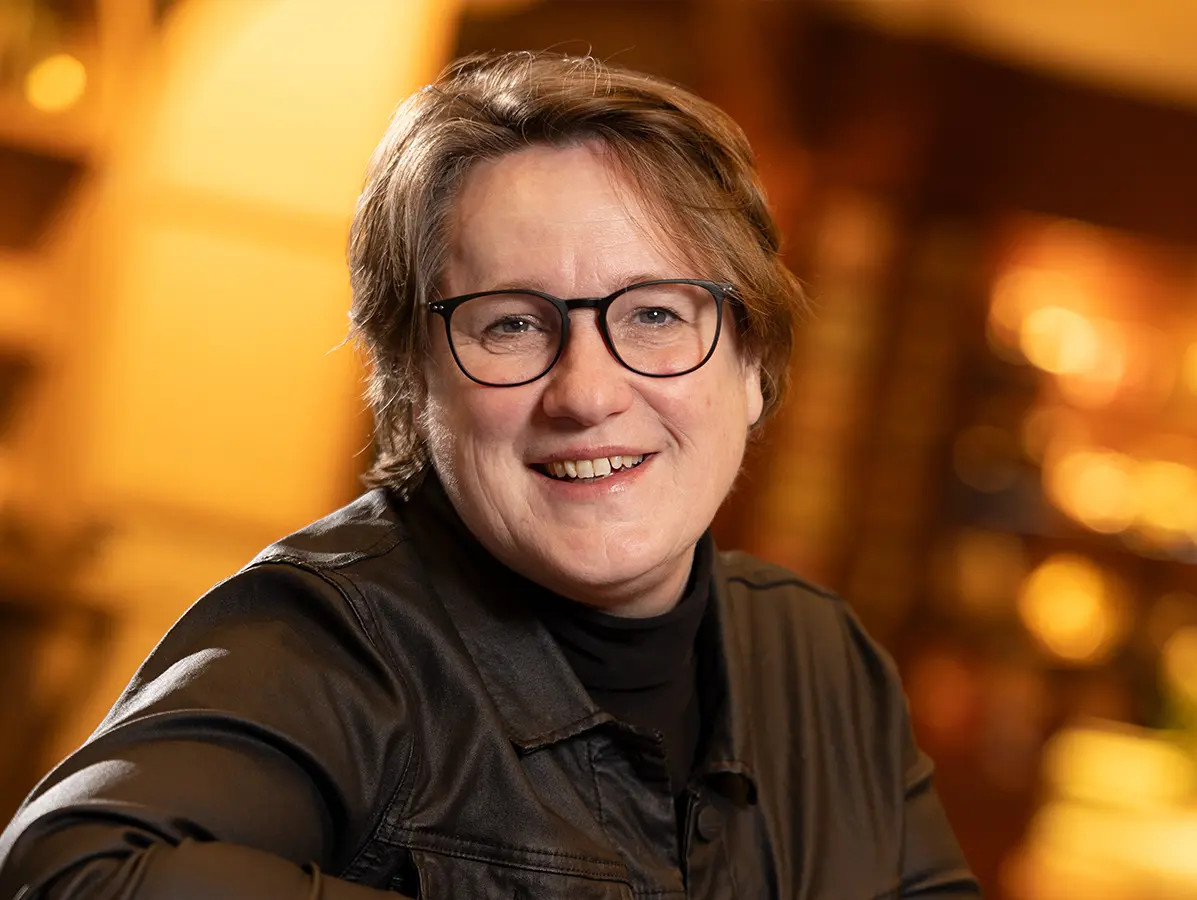
Manon Houben, chair of VleesNL, is proud of her sector. “As chair of VleesNL, I advocate for the people who work hard every day to bring a quality piece of meat to the consumer’s plate, as well as for greater appreciation of the product itself.” One year after her appointment, how does she view the opportunities and challenges ahead? What follows is a lively conversation with a woman who has a clear and outspoken vision.
Manon Houben is someone who speaks openly, honestly, and without embellishment about what she stands for and what she aims to achieve. In today’s turbulent world, that is no easy task. We start close to home, with the new cabinet and the coalition agreement.
“The coalition agreement is no more than directional. That’s how I read it. Three key points stood out to me. First, the word ‘food’ appears only five times, and only in the context of innovation and food security. It is mentioned in the same sentence as ‘cultivated meat.’ Cultivated meat is promising, but I don’t see it as a realistic alternative to meat. Food safety, a far more important topic, receives no attention at all in the agreement. The second thing I noticed is that the chain as a whole—from farm to fork—is not mentioned in the document. The role of the farmer at the Ministry of Agriculture is reduced to nitrogen and nature restoration.”
“I find that unfortunate, because I believe there are bigger issues we need to address than nitrogen alone. When it comes to climate—especially in relation to food—it’s about the entire picture. In my view, the focus should be much more on questions like: ‘How can we produce good, healthy food with the lowest possible climate impact?’ We need to stop portraying farmers as the problem and instead reach out to them. They supply our food and are part of the solution to challenges the government is facing, such as biodiversity. Just look at what they do to protect meadow birds. If we buy out farmers only to build on that land, I know one thing for sure: biodiversity won’t benefit from that. What concerns me is that there are now two people at the Ministry of Agriculture who are both young and do not come from the agricultural sector. There is a major task ahead to properly inform them. We need to bring them into the full story and avoid constant discussions about isolated parts of the chain.”
“In the Agrifood sector, everything is interconnected. That’s what makes our sector fundamentally different from others. You can’t approach the meat sector with a standard business model. We’re not dealing with bottles of soda or cans of beer where you can simply pause or scale production when the market changes. We work with perishable products—and above all, with livestock. The ‘production’ of a pig starts roughly a year before slaughter, on the farm, at the moment the sow is inseminated. From that point on, the clock starts ticking, piglets are born after 115 days, and the animal grows at a predictable daily rate. When the animal reaches slaughter weight, you can’t say, ‘Sorry, now’s not a good time. Just put it on the shelf…’
“That’s the labor issue. That’s something this government is paying more attention to, but unfortunately mostly in a negative sense. The reality is that the labor challenge is becoming increasingly difficult to solve. In the coming years, it will become even harder to find people in the Netherlands—and even across Europe—willing to do unskilled, lower-paid work. Robotization, automation, and AI offer potential solutions, but they also present major challenges. For now, people are still needed on the production line.”
Manon explains that labor is therefore the main theme of the members’ meeting in April, and that an action plan with concrete steps was presented to the minister late last year. “Our focus is on promoting healthy, safe, and fair work in the meat sector. In the plan, we incorporated how society views our sector, what demographic developments we can expect, and which actions we will take in response. During the members’ meeting, we will provide an update on our action program: what has been achieved and what hasn’t? Where do we stand now? What are our goals for the near future? It’s clear that we need to employ more people in sustainable employment relationships, with extra attention to a safe working environment. At the same time, we must actively invest in automation and robotization to reduce our future labor demand.”
“In our sector, everything is tailored. Animals are not comparable to uniform cans or bottles; they are all different. As a result, solutions are rarely transferable one-to-one to other companies. In pig slaughtering, for example, the line speed is much higher than what is possible for calves and certainly for cattle, because pigs—despite their individual differences—are more uniform in size. That’s why the pig sector is further advanced in robotization than the veal and beef sectors. In cattle slaughterhouses, it’s even more complex; they mainly process dual-purpose cows from the dairy sector, but occasionally also beef bulls or suckler cows, and the differences between individual animals can be significant. Food safety also presents different challenges. A pig carcass has been through the scalding tank and burners; it is clean on the outside. That’s not the case with cattle, they have a hide that must first be removed. Thus, each sector has its own challenges and solutions. Of course, there are similarities too: issues around animal diseases are comparable, as are export systems. It always comes down to chain systems—the entire process, from farm to fork. And of course, we are talking about animal proteins.”
“Well, what can I say…” she begins, followed by a pause. She takes a moment to think carefully before formulating her answer. “The Health Council’s advice has been revised from 300 grams to 200 grams. If you read it closely, that refers to 200 grams of prepared product; that’s about 250 grams of raw product. That is not clearly stated in the summary, and that bothers me. But what frustrates me most is that this adjusted recommendation is based on research into the supposed climate impact. The Health Council is therefore mixing its dietary advice with climate advice. At the same time, eating meat also offers health benefits; there is scientific evidence for that as well. How much you need naturally varies from person to person. Athletes and people recovering from illness need more. Others can cut back. The fact is that 95% of Dutch people enjoy eating meat regularly. It certainly doesn’t have to be every day for me. What matters more is that consumers ensure that what they eat is of good quality. And that it is prepared properly, so they can truly enjoy it.”
“Within the protein transition, I think the hybrid products some of our members are developing are a great solution. Partially replacing meat in minced products with plant-based proteins results in very tasty products. In that case, the protein transition is embedded in the product itself, I really like that. However, this is not a solution for all products and producers. The image that has developed around the meat sector in our society concerns me, but I do not want to engage in the ongoing ‘us-versus-them / for-or-against / good-or-bad’ debate. We are not deaf to what is happening in society, we need to keep listening. If something is not right, we should acknowledge it and look for solutions. But let’s have fair discussions, based on facts, not opinions.” It is clearly a topic that affects her deeply.
“What I also find so contradictory,” she continues, slightly agitated, “is the argument that in the Netherlands we only produce meat for export. As far as I know, we are a trading nation; we thrive on the ability to exchange goods. Meat exports give us a strong negotiating position. The export of ASML chips alone is not enough to maintain that position. We need to realize that what we dismantle now will not easily be rebuilt. We are already losing ground in the global market. Before long, we may no longer be strategically relevant, and that could have a major impact.”
“I would really like to see nuance return. More understanding for one another. Many people appreciate meat; they eat it regularly and enjoy it. That’s perfectly fine, isn’t it? And yes, we should be critical about how it is produced. Great, we are. But no longer producing it in the Netherlands at all is, in my view, greenwashing. If Dutch consumption patterns don’t change, we are simply shifting production elsewhere. In the past, I traveled abroad frequently for work and have seen how things are done there. It is not necessarily better. In terms of animal welfare, food safety, and sustainability, we are absolutely on the right track in the Netherlands. It’s fine to work together on a different dietary pattern, and it’s also good that the Health Council provides guidance. But let’s be honest. Base decisions on scientific knowledge and facts, not on opinions.”
“These companies, often family businesses with a long history, are run by outstanding entrepreneurs. They are smart people who manage their businesses with great passion and commitment. They don’t need me to hold their hand. We have strong veal farming thanks to a strong dairy sector, after all, without calves there is no milk. On land where cows could not graze, pigs were raised; that is the Dutch entrepreneurial spirit. The strength of our pig sector is partly due to our excellent ports. We live in a fertile delta with an ideal logistical setup. In short, we are in a fantastic location on this planet. And the Dutch meat sector does many things well. As a sector, we could communicate that more confidently. I am proud of it!”
Manon Houben studied veterinary medicine in Utrecht and then worked as a practicing veterinarian for four years. From 2001 to 2007, she worked as a lecturer in Pig Health Care at the Faculty of Veterinary Medicine at Utrecht University. Throughout her career, she also held positions at Royal GD as Head of Pig Health and at Van Loon Group as Program Manager Chain Concepts.
Since April 1, 2025, she has been chair of VleesNL (formerly COV-Central Organization for the Meat Sector/Association for the Dutch Meat Products Industry).
Source: Vakblad Voedingsindustrie 2026
Magazine Voedingsindustrie has been made possible in part by:


© COPYRIGHT 2026 VOEDINGSINDUSTRIE | ALLE RECHTEN VOORBEHOUDEN
Powered by Wallbrink Crossmedia © 2026