
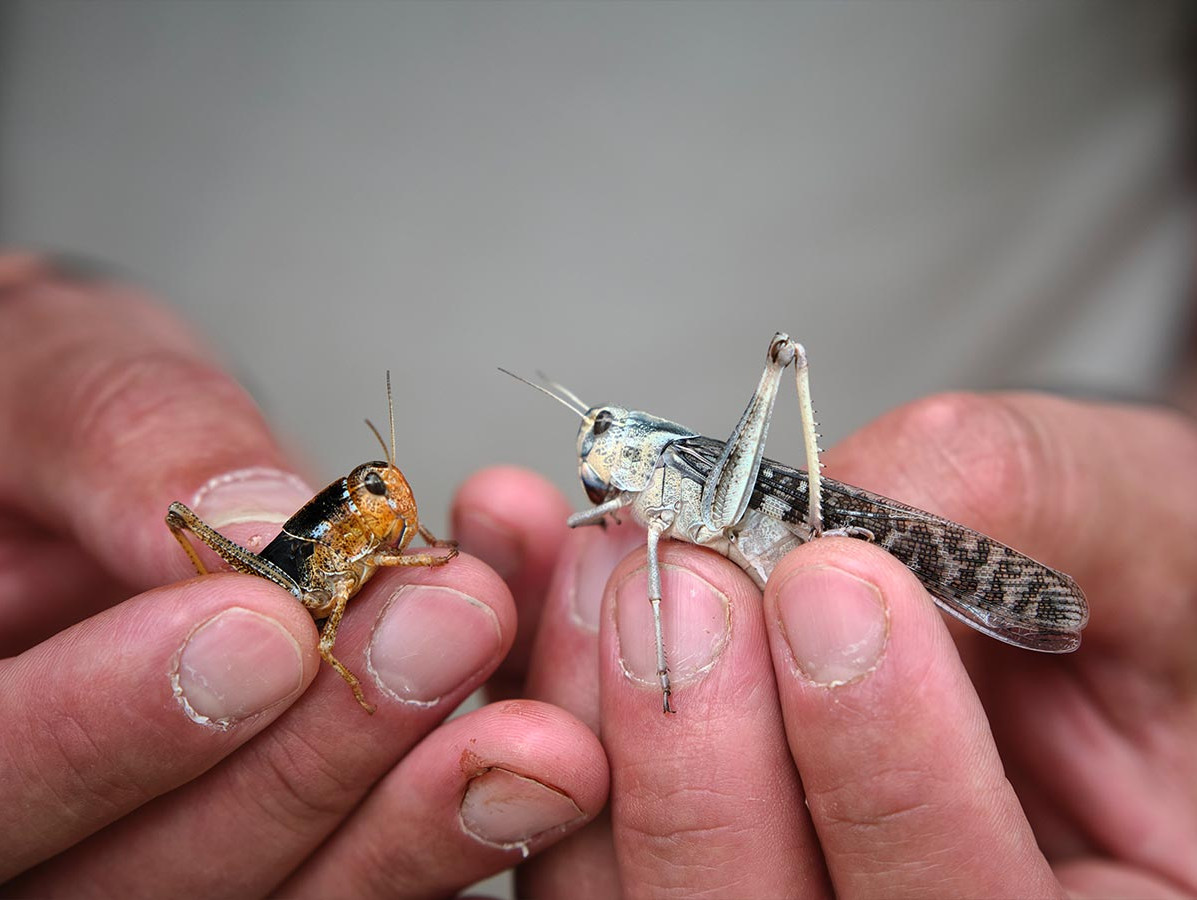
In South Holland, Eysbrand Rozendaal and Peter Stam – founders of Lokus – work among the fluttering wings of migratory locusts. Their focus is the European migratory locust, a species that’s difficult to breed but uniquely valuable in terms of nutrition. Lokus is the only Dutch farm currently authorised to supply this insect for human consumption under the EU’s Novel Food regulation.
From the start, Eysbrand and Peter chose controlled growth over fast scaling, guided by a practical mindset: only produce what can actually be sold. Subsidised expansion was tempting, but also risky in a market still in its early stages. Instead, they’ve chosen to grow gradually, building stable sales channels and long-term partnerships. One of those partners is food entrepreneur Ferdy Molenaar. Known as the ‘Bugman’, he runs workshops and tasting sessions to help chefs and consumers see insects as more than just a novelty. They’re protein-rich, sustainable to farm and – above all – surprisingly versatile in the kitchen. The European migratory locust stands out in particular, says Ferdy. “It contains all essential amino acids, healthy omega fats and dietary fibre, while the chitin content is lower than in mealworms or crickets. That makes locust meat easier to digest and more appealing as an ingredient.”
Farming locusts, however, is hard to automate. The insects are fed fresh grass and bran four to five times a day, and missing even one feed can affect their growth. “They need fresh food at all times, otherwise things go wrong,” says Eysbrand. Inside the 40-foot container, rows of open crates hold thousands of animals. Locusts are social creatures and thrive in crowded environments. But the separation into different crates also serves a practical purpose, Eysbrand explains. “They go through seven moults as they grow, so we keep each stage separate to ensure every group gets the right feed.” At the same time, temperature, humidity and lighting are constantly monitored inside the container.
The transformation from nymph to harvestable locust takes just over two weeks. Around ninety percent of the insect can be used as an ingredient. In this facility, that means a maximum yield of 250 kilos per month – enough to make around 40,000 spring rolls. Harvesting is done by lowering the temperature, which sends the locusts into hibernation before they’re frozen – a process that mirrors their natural life cycle. “It’s essentially a natural death,” says Eysbrand.
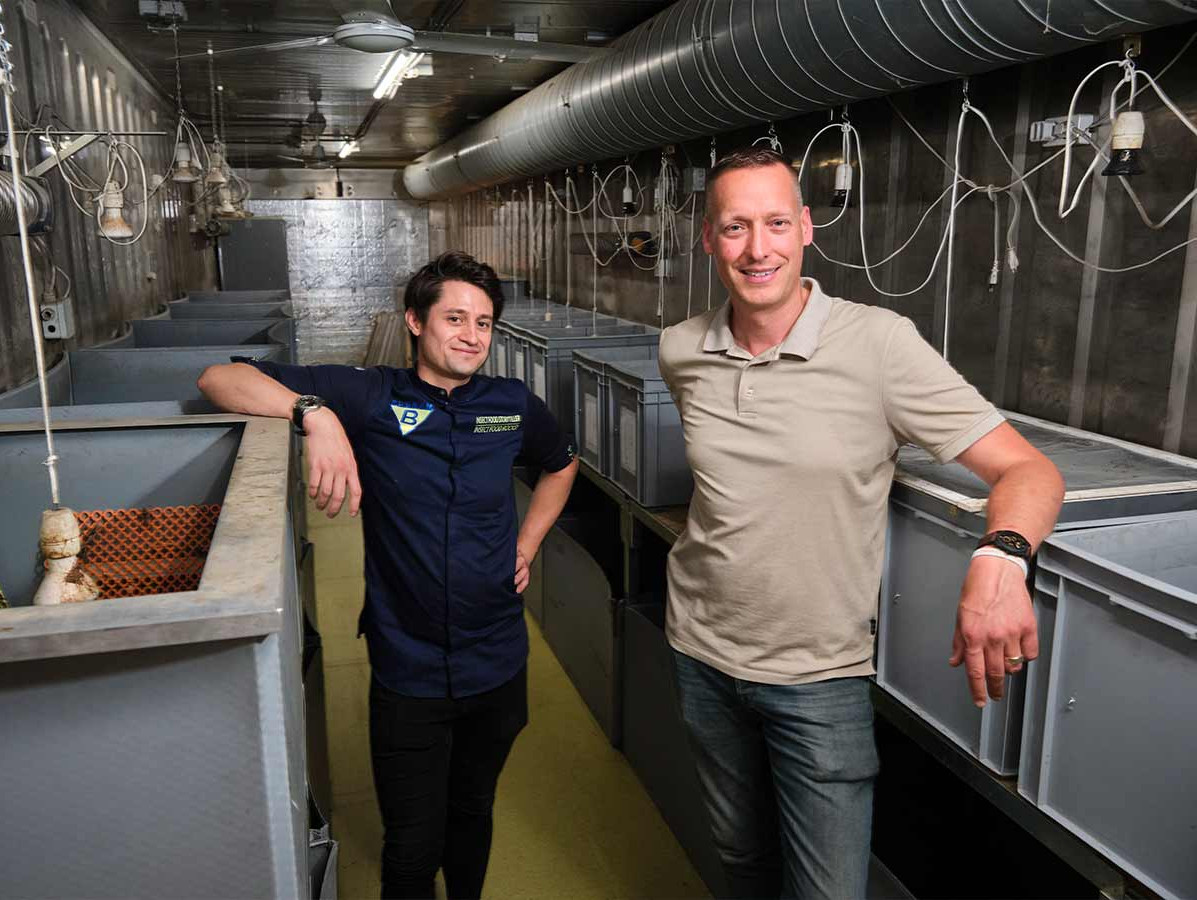
After harvesting, the processing phase begins. Ferdy keeps things simple: let people taste the product, share the story, and encourage them to pass it on. “You need to spark people’s curiosity,” he says with a smile. “Once the yuk factor is gone, what’s left is a pure and tasty product.” That energy drives his workshops and tasting events, where flavour and story go hand in hand. The first seed was planted in 2013, when he served insects during a culinary internship. Since then, his mission has been clear: to make edible insects accessible to a wide audience. Eysbrand and Peter share that goal. “A credible story helps build acceptance. That’s why we always welcome visitors to our farm – to let them see how we breed the locusts. The more people understand what we do, the lower the barrier becomes.”
Although the European migratory locust is authorised under the Novel Food regulation, gaining access to the market remains a complex process. In 2018, Eysbrand and Peter joined the Belgian Insect Industry Federation, which coordinates the EU’s application process. “We started with ten parties,” says Eysbrand, “but we’re the only Dutch farm that made it through to the end.” There are still no specific rules for insects, so the Dutch Food and Consumer Product Safety Authority often falls back on general food regulations. At the same time, buyers are cautious. “They ask for volumes we don’t yet have, but without market demand we can’t scale up to offer those volumes. It’s a classic chicken-and-egg situation.”
Their focus is on the B2B market. Burgers and spring rolls are their key products. “Once people taste the meat, they’re usually pleasantly surprised,” says Eysbrand. But the supermarket isn’t their immediate target. First, they want to gain traction with chefs and foodservice wholesalers. That’s where products can be tested and introduced. “We’d rather build from the ground up,” says Eysbrand. “Once chefs work with locusts and wholesalers start stocking them, the retail market will follow. That’s when consumers will be ready too.”
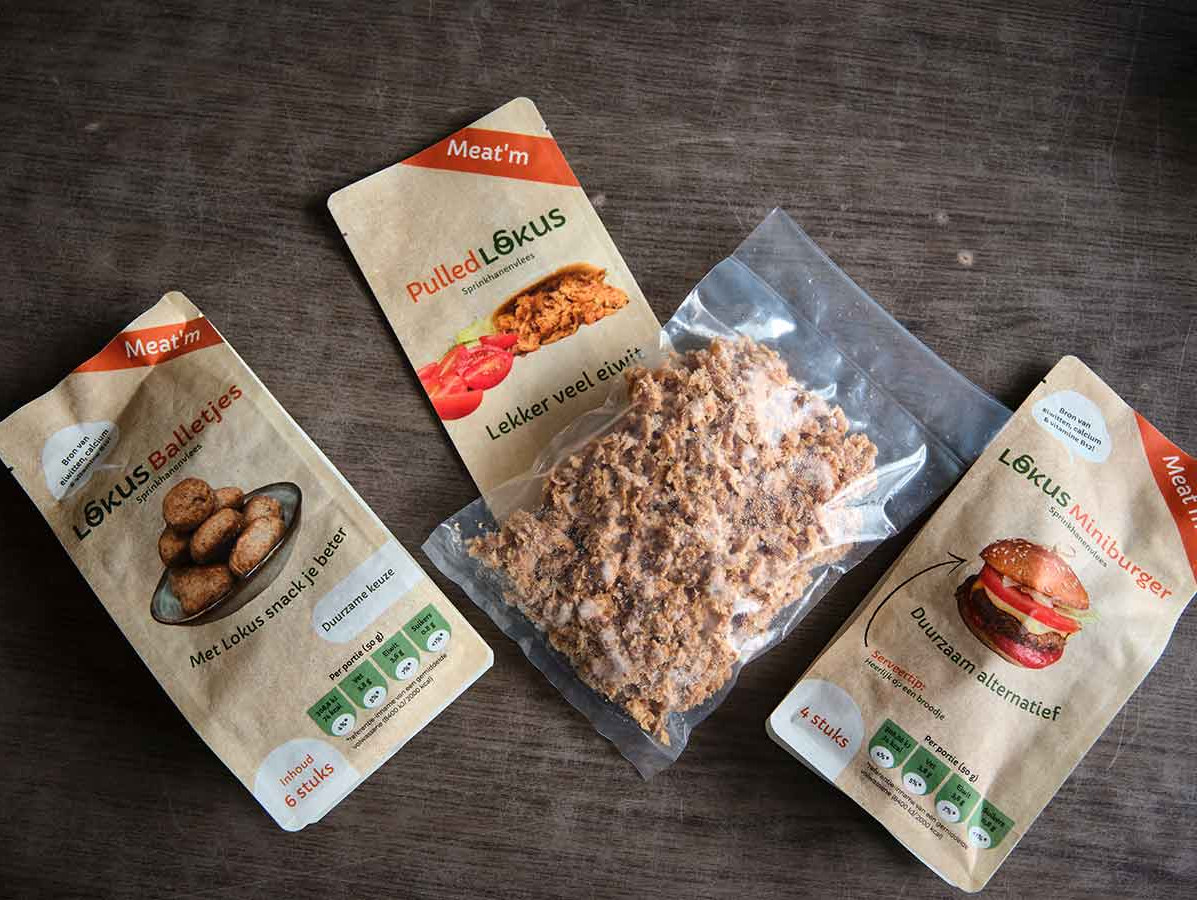
For the Lokus team, collaboration is key to growth. That could mean working with caterers on new products, or developing blends that combine insect protein with meat or fish. “It’s not about competition. Different proteins can actually complement each other,” Eysbrand emphasises. Scaling up is possible – but only when demand becomes structural. “It will take at least a generation before insects are fully accepted,” he predicts. “Until then, we’re investing in people like Ferdy. That’s how we build a market for the future.”
Photos ©Fred Libouchant
Source: Vakblad Voedingsindustrie 2025
Magazine Voedingsindustrie has been made possible in part by:



© COPYRIGHT 2026 VOEDINGSINDUSTRIE | ALLE RECHTEN VOORBEHOUDEN
Powered by Wallbrink Crossmedia © 2026