
Within four years it will be 2030. And yes, the alarm bells should be ringing, because by then food companies must already start using recycled content in their packaging under the Packaging and Packaging Waste Regulation (PPWR). The bottlenecks and challenges are substantial. What is clear is that successful processing into food-safe recycled materials starts with good packaging design.
Most foods (butter, frozen fries, candy, cookies, ice cream, desserts, sauce, bread, cut vegetables, potatoes, rice, pasta) are currently packaged in polyethylene (PE) or polypropylene (PP). The PPWR states that packaging for these foods will need to contain 10% recycled material. That is difficult, because at the moment not a single recycler has formal approval to place food-safe PP or PE recycled material on the European market. Time is running out.
A number of food companies are planning to switch to polyethylene terephthalate (PET), for which food-safe recycled material is already available on the market. Other companies are participating in research projects to clean plastic waste using new decontamination technologies. Unfortunately, most companies are still waiting, while a proactive approach to preparing their packaging for food-safe (mechanical) recycling would make far more sense. Only when sufficient suitable packaging ends up in PMD waste streams will it become attractive for recyclers to invest in recycling processes capable of producing food-safe recycled material.
Recyclers that want to place food-safe PE or PP recycled material on the European market must submit a novel technology application to the European Food Safety Authority (EFSA). If EFSA issues a positive opinion, the recycler receives permission from the European Commission to sell the recycled material as food-safe. A positive opinion is therefore crucial. However, EFSA’s assessment methodology has not yet been formally established. There are guidelines for PET, but it is not yet known what an application for PE and PP should look like. What we do know from earlier decisions is that EFSA generally takes a conservative and risk-averse approach. So if you want to have a chance of receiving a positive opinion from EFSA, you will need to submit extensive analytical results for both the raw material and the cleaned recycled material. In addition, you must demonstrate that migration of substances from packaging made partly of recycled material into food complies with food contact materials legislation. These analyses and migration tests are complex and expensive, especially at the level of detail EFSA expects. A recycler will therefore only start such a process if there is a strong chance of success. The recycler must understand the risks and be able to demonstrate that they are under control. That is why it is essential to use only packaging designed for food-safe recycling as raw material, because only those can actually be recycled in that way.
This means that—apart from any product residues or other contamination—two types of materials should ideally be present in a package: the target material (1), which remains during the recycling process, and the non-target materials (2) (labels, caps, top films, etc.), which are completely removed. Unfortunately, reality is more complicated and both non-target materials and additives are present in the target material that cannot be fully removed. In both cases, they must not reduce the quality of the recycled material and must not break down into potentially risky substances during the recycling process.
After many years of research into the mechanical recycling of packaging plastics, we now have a fairly good understanding of which processes can remove which packaging components, and with what efficiency. The best separation technologies for metals are magnets and eddy current separators. For polymers with strongly different densities, float-sink separation is the most effective technique. Sieving works well for rigid packaging that does not deform or shatter. The most common sorting technology is based on near-infrared (NIR). Its effectiveness reaches up to 90%. Optical sorting machines that separate by color, code or marking, or that operate using image recognition, are newer sorting technologies. Combined with conventional separation techniques, they make it possible to selectively separate well-designed food packaging. This is important because we expect EFSA to use a very high level of object purity in the raw material as an assessment criterion.
Food packaging is required to display information about ingredients, possible allergens, origin, and more. In addition, producers want to promote their product through the packaging. As a result, every food package includes some form of printing. Yet that very printing is also a source of chemicals and substances of concern. For food-safe recycling, it is therefore crucial that all printing is removed during the recycling process. Three types of strategies have been developed for this purpose: detachable shrink sleeves, washable labels, and washable inks.
With shrink sleeves, packaging is ground in the usual way. Most of the label material is removed using an air separator, after which the remainder is removed with a flake sorting machine. This can work effectively. There are also washable self-adhesive labels. Some variants do indeed wash off completely, but others only partially wash off or leave behind some the adhesive. If labels are not fully removed during washing, a flake sorter can still serve as a second filter, but if only adhesive remains on the flakes this is unfortunately no longer possible. In addition, so-called washable inks are available. With these inks, most of the printing can indeed be washed off packaging using friction washers. The ink must then clump together into a powder with a high density and be removed through float-sink separation. The key requirement is that both the washing and the separation of the ink take place completely, and in practice that remains challenging with all three strategies.
During the recycling process, substances absorbed into the plastic—either from the packaging itself or from other packaging—must be removed. This process is called decontamination. In mechanical recycling, washing is often the first decontamination step. This mainly removes polar substances. Contaminants that are located deep in the core of the flakes are not always removed in recycling practice, where times in friction washers are short. The substances that are least effectively washed out of PE and PP flakes are non-polar or have high molecular weights (heavier molecules diffuse more slowly). During extrusion of the recycled material, volatile substances are removed through degassing. In addition, recycled material is often degassed for longer periods at elevated temperatures in silos. These thermal treatments remove most of the most volatile substances, while the least volatile substances remain behind. On top of this, several companies are developing new decontamination technologies, such as dissolution and supercritical carbon dioxide extraction. These technologies are capable of removing non-polar and heavy molecules from PE and PP. The main challenge is carrying this out in a way that is cost-effective, reliable, and safe. By combining multiple complementary separation and decontamination technologies, it becomes possible to remove most substances. Whether this will be sufficient to qualify as ‘food-safe’ remains to be seen.
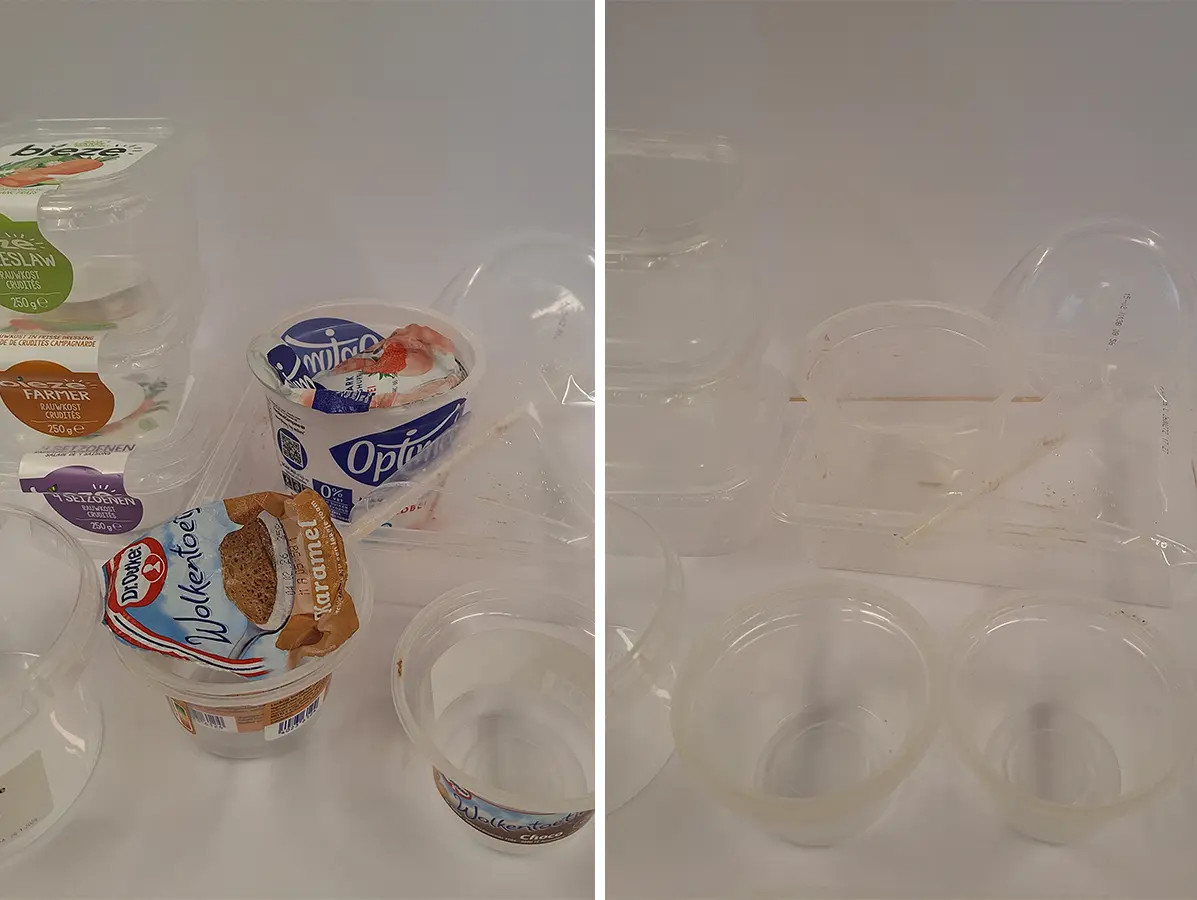
PP trays with easily removable labels and PP trays without labels
When assessing PET bottle recycling processes, EFSA assumes that among all potential food safety risks, the greatest risk is consumer misuse. This refers to the possibility that someone might use a PET bottle at home, for example to mix pesticides, store motor oil, or clean paint brushes with turpentine, and then still return the bottle for recycling. In the recycling of PE and PP packaging, however, other risks appear to be more significant. One realistic risk is that printed labels are not fully removed, leaving ink chemicals in the recycled material. Another possibility is that ink binders in washed flakes are converted into harmful nitrosamines after extrusion. It may also occur that thin adhesive layers of aromatic polyurethanes are used in packaging that cannot be washed away and form carcinogenic substances after extrusion. Another risk—greater for PP and PE packaging than for PET bottles—is that labels can be removed effectively, but small amounts of chemicals from the label may already migrate into the packaging during use. This could include plasticizers from the printed label migrating into the bottle, tray, or jar. This risk can be managed by selecting a different type of plasticizer in the printing. All of this shows that the chances of successful processing into food-safe recycled material begin with good packaging design. As long as too few packages on the market can potentially be recycled into food-safe material, it makes little sense for recyclers to develop recycling processes.
From 2030 onward, a partially closed material loop must therefore also be achieved for PE and PP packaging, with at least 10% recycled material reintroduced during each cycle. For such a circular system to function properly, central coordination and alignment are needed at all critical points in the loop. In addition to the critical aspect of decontamination by the recycler, close attention must also be paid to the sorting purity of the raw material and to the correct input of new plastics.
Packaging that is designed from the outset for food-safe recycling must be selectively sorted from PMD streams with a high level of purity. Several approaches are possible: coding, marking, or sorting using image recognition. The latter technique in particular is advancing rapidly. Even so, combinations of image recognition with codes or markings appear necessary to achieve both effective and highly pure sorting. There must also be policies on which new plastics and which additives are allowed within the circular system. Close cooperation with a plastics supplier therefore seems essential, so that the quality of the new plastic can be controlled and monitored.
It is time to look beyond the chicken-and-egg situation. By deliberately designing packaging for food-safe recycling so that it contains as few potential contaminants as possible, and by effectively decontaminating the recycled material produced from it, it should be possible to produce highly pure recycled material. Our research with several packaging manufacturers already shows that very promising opportunities exist here. Hopefully this can convince EFSA that, in this way, the risks can be adequately controlled. The first step now needed is for more packaging to enter the market that is suitable for food-safe recycling. The first well-designed examples are already on the market: PE milk jugs are a good example. Who will follow?
Source: Vakblad Voedingsindustrie 2026
Magazine Voedingsindustrie has been made possible in part by:



© COPYRIGHT 2026 VOEDINGSINDUSTRIE | ALLE RECHTEN VOORBEHOUDEN
Powered by Wallbrink Crossmedia © 2026