
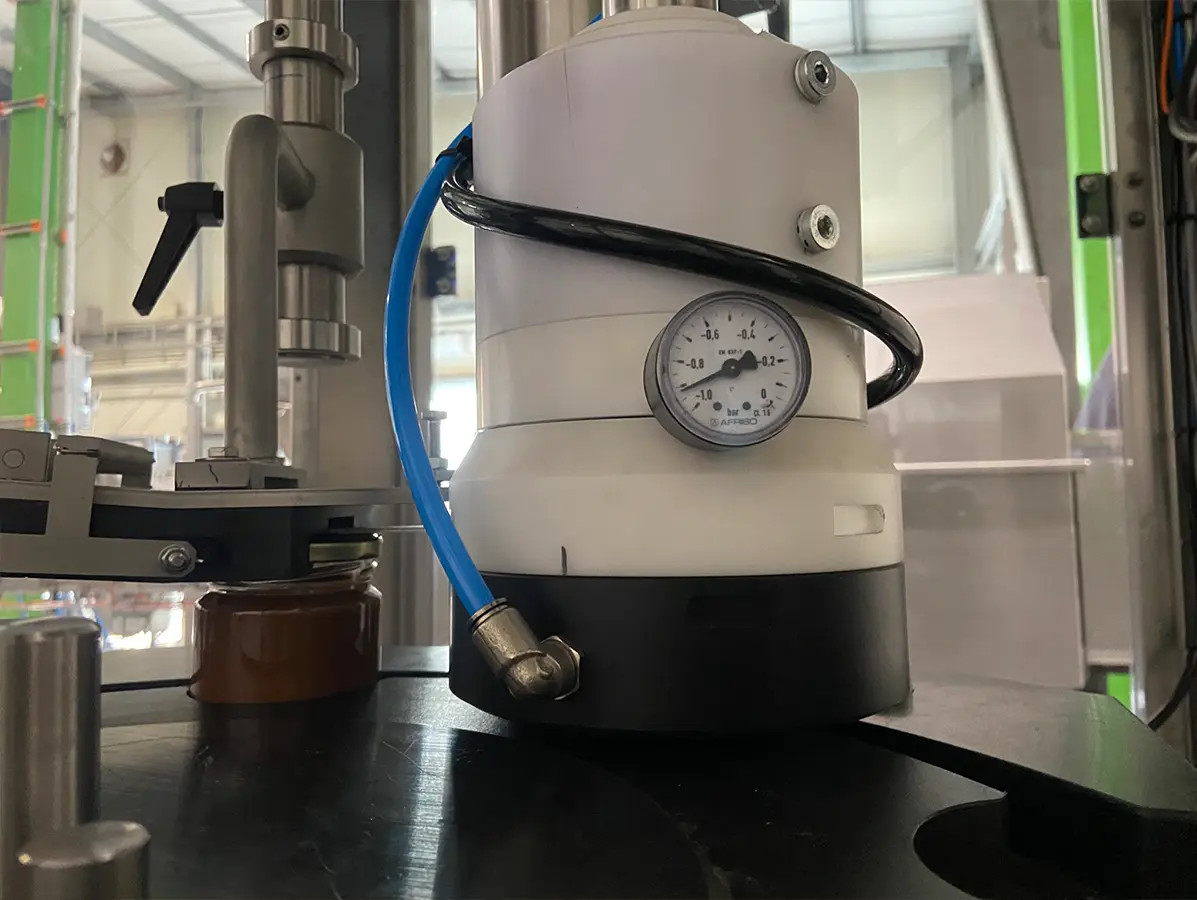
New closing head + pre-heat for greater sealing reliability. Cold vacuum closing is gaining ground, especially as producers look to reduce steam usage and switch to PVC-free lids. LVS therefore introduces a new closing head for cold vacuum closing, optionally combined with a compact pre-heat unit. Together, they increase sealing reliability for glass jars in the food sector, with less changeover time and lower line complexity.
The new closing head has been designed with a wider operating range. This allows you to process multiple jar sizes with a single head. That reduces changeovers, spare parts and batch-specific adjustments. Operators benefit from a clearer overview, the line remains available for longer, and you reduce the risk of errors that typically arise from frequent changes. In practice, this means higher utilisation of existing capacity and lower indirect costs, without compromises.
PVC-free lids require tighter temperature control. Our pre-heat brings each lid precisely to the right temperature in advance, allowing the compound to flow optimally and the sealing edge to make uniform contact. The result is a demonstrably better seal. You reduce the risk of leaks, faulty closures and complaints afterwards, and you avoid batches being returned later due to insufficient vacuum. The pre-heat unit is compact, easy to integrate into existing lines, and now also works seamlessly with the new closing head.
We will present the cold vacuum closing machine with the new closing head and optional pre-heat for the first time at Empack. Would you prefer to test calmly with your own jars and lids? By appointment, you are welcome at LVS for a demonstration at our factory. Together we review your jar sizes, lid types and objectives, and show how the solution fits into your line and improves your production process.
Visit us at Empack at stand J18 or contact us to schedule an appointment or a test with your own products. You will immediately see the gains in reliability and continuity—quickly implemented in your existing line.
Source: Vakblad Voedingsindustrie 2026
Magazine Voedingsindustrie has been made possible in part by:



© COPYRIGHT 2026 VOEDINGSINDUSTRIE | ALLE RECHTEN VOORBEHOUDEN
Powered by Wallbrink Crossmedia © 2026