They want to be surprised time and again, those demanding consumers: with new flavors, textures, products and packaging. At the same time, labor, certain raw materials and energy are becoming scarcer—and therefore more expensive. The solution lies in innovation, but it is anything but easy. During an inspiring Round Table session, we discuss the challenging journeys surrounding innovation processes in food.
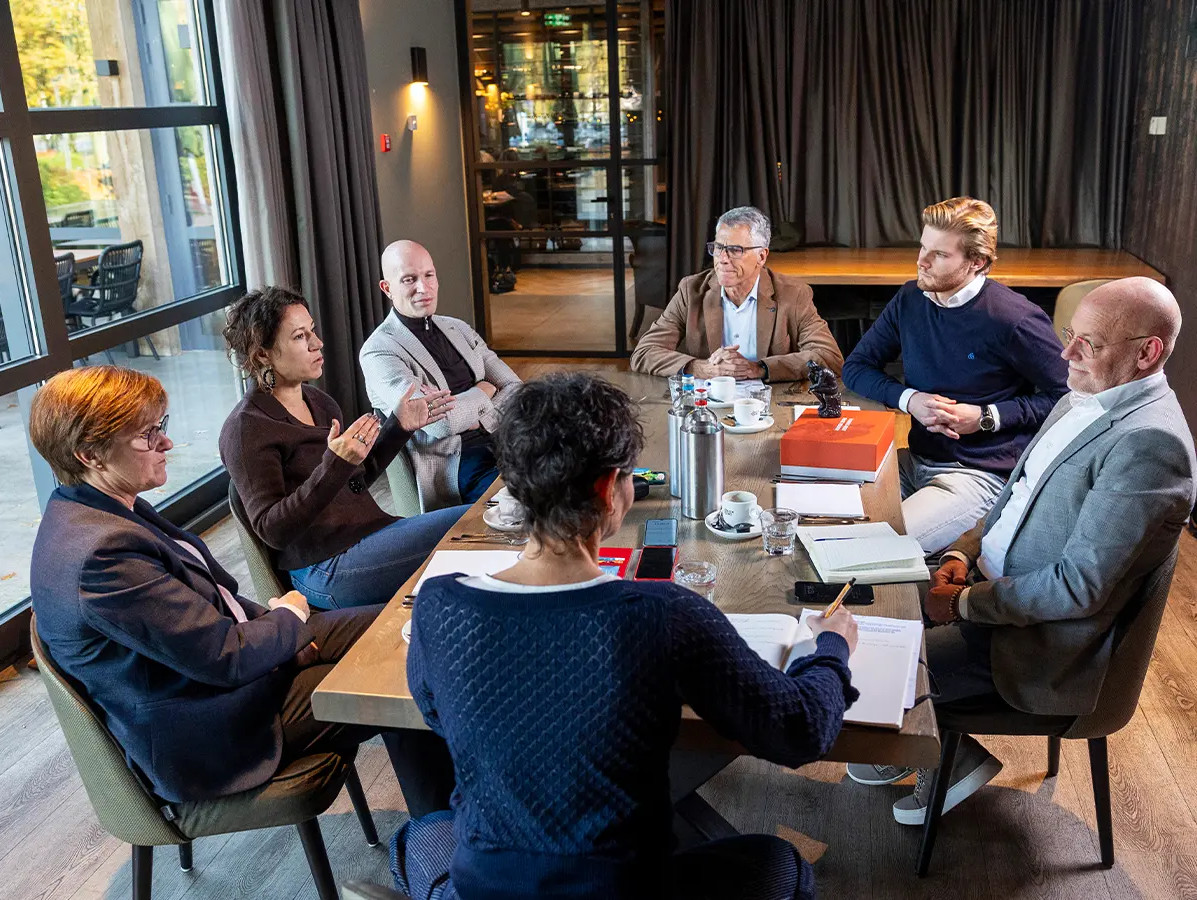
That neither product nor process innovation always goes smoothly becomes abundantly clear from the stories the participants share at this Round Table. Joining the discussion are Emiel Boogaard, Managing Director of Goedhart Bakery Kitchen Group; Jantine Heemskerk, Managing Director of Heemskerk fresh & easy; Philip Lutke Veldhuis, future owner of VIT – Vleesvee Integratie Twente; and Gerard Ramaker, Business Development Manager at AWL. The discussion is organised by ING in collaboration with Vakblad Voedingsindustrie. Representing ING at the table are Henriëtte Hoogstad-Bakker, Director Food & Agri South-West region, and Ceel Elemans, Sector Banker Food.
Soon after the introductions, stories and anecdotes start flowing. Successes and setbacks are shared, and although the sectors differ, the sense of mutual recognition is often strong. There is a lot to learn from one another.
Goedhart Bakery Kitchen Group supplies thousands of stores and to-go locations every day from multiple sites, delivering bread-related convenience products with a passion for perfection and a sharp eye for innovation across the Netherlands, Belgium and Scandinavia.
Heemskerk fresh & easy cuts, washes and packages vegetables and produces meal salads and fresh meal kits. The company supplies these products to major retail and fast-food chains, primarily in the Netherlands, Belgium and Germany, working closely with growers and other partners in the chain.
VIT (Vleesvee Integratie Twente) operates its own slaughterhouse, deboning facility and transport operations in Oldenzaal. With multiple farms and an integration of 30 beef cattle farmers who fatten livestock for them, VIT controls the entire chain. This enables the company to guarantee animal welfare and deliver quality and customisation to premium butchers in the Netherlands.
AWL is an innovation-driven automation partner supporting a wide range of industries with smart robotics solutions. Its broad expertise in vision/AI and gripper technology, combined with strong engineering capacity, opens up new possibilities for the food industry. The dedicated Food Engineering entity specialises in developing hygienically designed machines for production environments with high demands on stability, cleanability and flexibility.
“Innovation is not only costly; it also involves a lot of pioneering,” Jantine believes. “The development of our robotic order-picking installation, for example, took a great deal of time and quite literally blood, sweat and tears. It was often ‘plug and pray’ rather than ‘plug and play’. But we didn’t give up, because we believed in it. Now it works, and I’m genuinely proud of it. It delivers better labor productivity as well as a higher service level.”
When asked what is needed—besides perseverance—to innovate successfully, Philip is the first to respond. “Intrinsic motivation is a major driver,” he says. “And courage!” Jantine adds. “When you invest in innovation, you never know in advance whether it will succeed.”
“What you definitely don’t want are perfectionists,” Emiel emphasises. “You need to be able—and willing—to make mistakes, and to be given the space to try something new, even when success is not guaranteed. Management has to provide that space. What matters is that the total number of successes outweighs the total number of failures.”
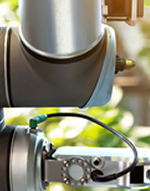
Gerard puts the creative mindset center stage. For the participants, he has brought small replicas of The Thinker by Rodin. For him, the sculpture symbolises free, creative thinking. “Innovation means looking at a process or product in a different way, to make a difference or solve a problem,” he explains. “That can be through more conventional innovation—improving products and processes—but also through disruptive innovation: entirely new products and technologies. It can also occur by connecting existing technologies in a different way, creating something completely new. We are seeing that happen right now.” His eyes light up; this is clearly his favorite territory. “Robots are no longer limited to repetitive tasks—they can see, smell, feel and collaborate with one another,” he continues enthusiastically. “All thanks to advanced vision and gripper technology, smartly combined with artificial intelligence. Teaching robots to think and anticipate what they encounter—something humans are very good at—is the next step. Humanoids are still in their infancy, but developments are moving fast!”
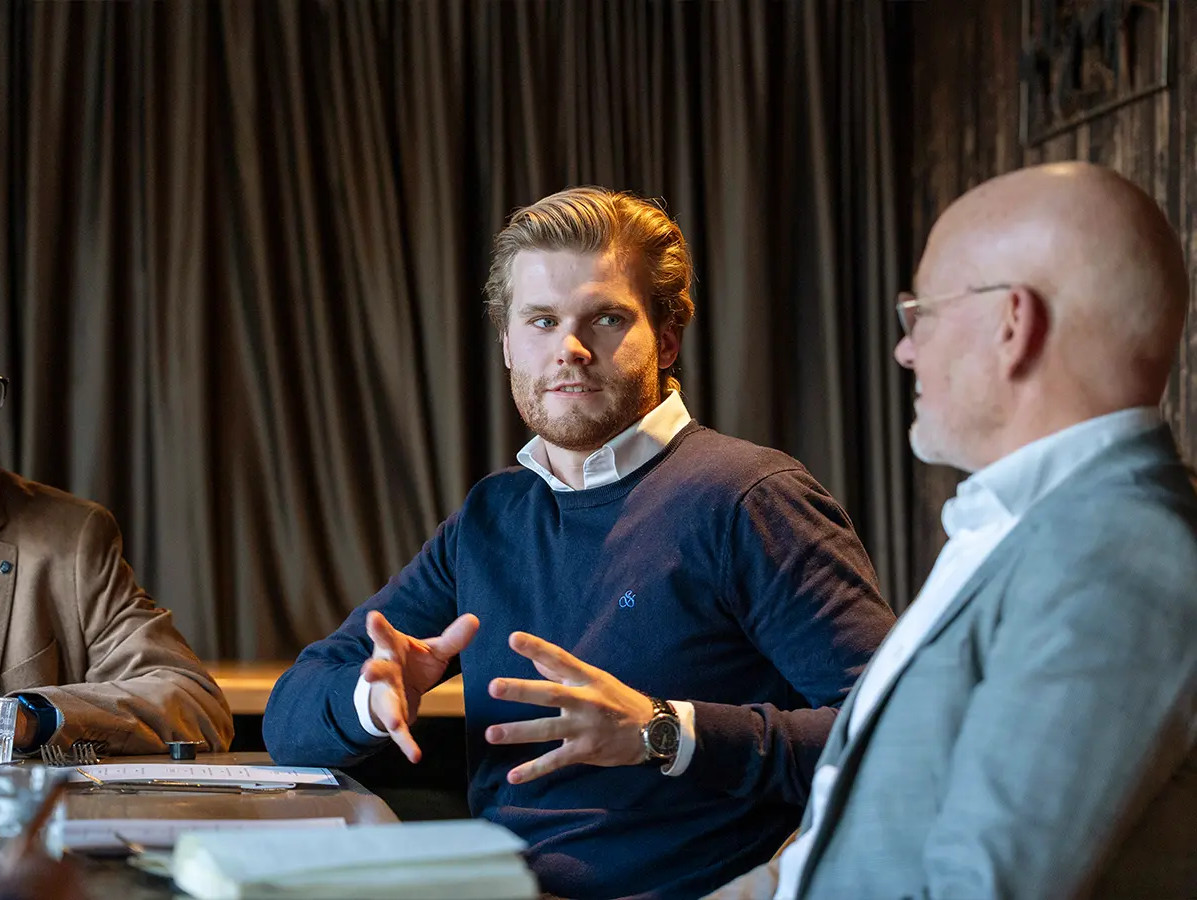
Philip: “We are not large enough to take on high-risk innovative projects.”
Philip responds pragmatically to the science-fiction-like future Gerard sketches. “We are a small slaughterhouse and therefore not at the forefront of process innovation. Within our company, innovation mainly focuses on easing and simplifying the production process.” Yet, as his story reveals, continuous improvement is very much part of daily practice—both to reduce the physical burden on employees and to achieve and maintain the highest possible meat quality. “Our slaughtering speed is not excessively high. That allows us to work neatly and hygienically. For meat quality, temperature reduction, humidity and ventilation during the process are crucial. These variables are continuously monitored. Having our cutting room in the same building as the slaughterhouse is a major advantage, as it prevents interruptions in the cold chain.” Above all, having full control over the entire chain contributes to guaranteeing the desired quality. He is visibly proud of their Blonde d’Aquitainers cattle: “They are truly beautiful, large and elegant animals, with good musculature.”
Jantine also describes their product innovations as ‘not necessarily revolutionary’. “Often, it’s about line extensions. Or we build on what already exists from a different angle, such as fresh meal kits specifically for children.” She is proud of the high speed at which new products are brought to market and of her ability to get everyone within the organisation on the same page. “Innovation in our sector is not always easy. Robotising the cutting and distribution of vegetables is complex. We are constantly searching for the balance between necessary flexibility and desired standardisation. Looking ahead—to increasing price pressure in retail and demographic developments, including in Eastern Europe—you know that investing in robotics and automation is not a question, but a necessity. We involve our people as much as possible in every innovation step. When you make them part of the problems and challenges, they actually enjoy thinking along.”
“Even if that could potentially cost them their jobs?” Henriëtte asks.
“A fair consideration,” Jantine replies. “We have a large flexible workforce, which makes scaling down easier. In practice, though, resistance is rare. On the contrary, I notice that innovation makes us a more attractive employer.”
“Still, I find this a difficult issue,” Philip responds. “As production processes become more technically complex and product ranges broader, the job content of the employees on the production floor is changing. We are going to demand much more from our colleagues. That’s why our investments in renewal focus on making processes easier and clearer for employees. At the moment, for example, we are working on a new packaging line where meat no longer needs to be lifted manually. We are also exploring new deboning techniques that make greater use of gravity for lifting tasks.”
Emiel adds: “As a food company, we also invest heavily in our people. Like you, Philip, particularly in tools and innovations that make work in the production environment safer and physically less demanding. At every level, we offer internal training and knowledge development. Many of our employees have grown internally into new roles.”
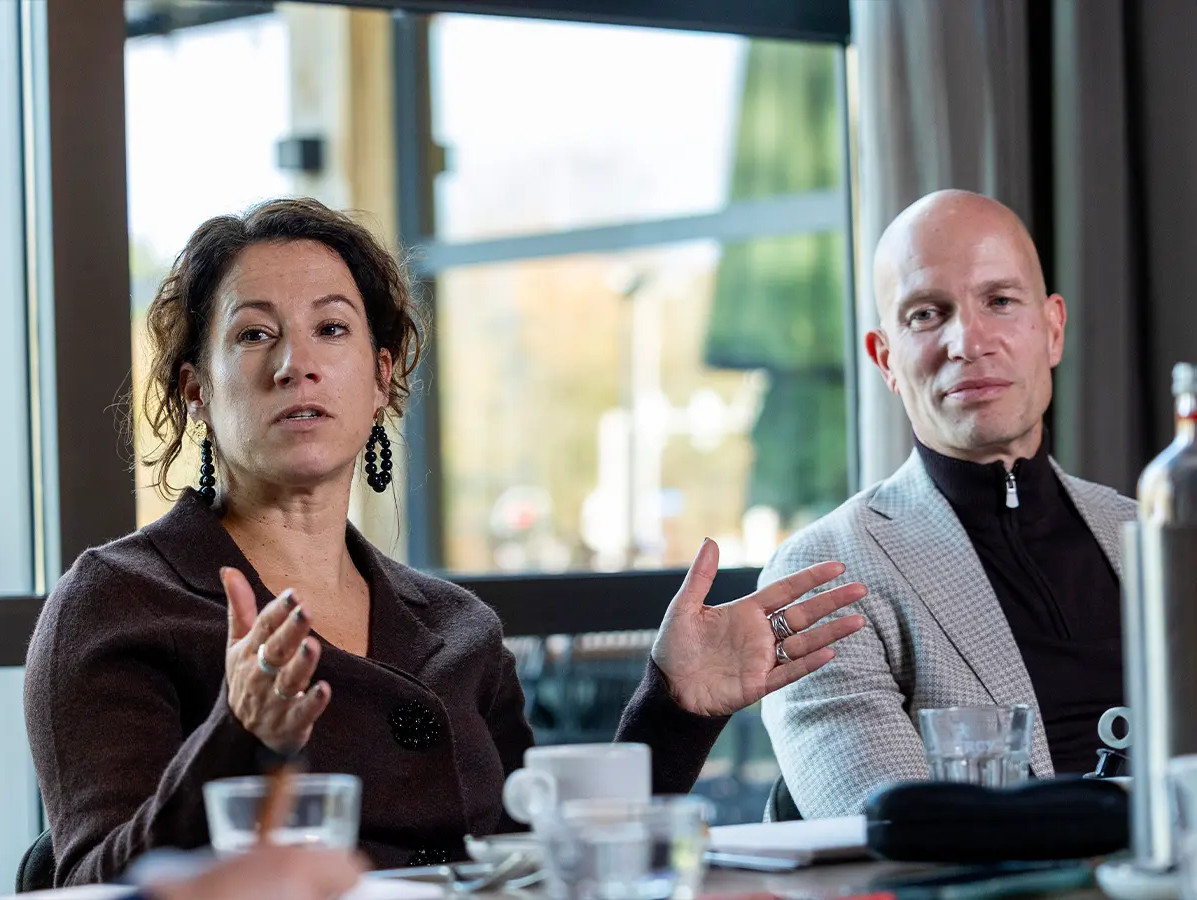
Jantine: “Innovation is not only costly; it also involves a great deal of pioneering.”
Many product and process innovations arise from anticipating customer and consumer demands—this applies to everyone at the table. Jantine explains: “Changing requirements, both from legislation and from critical consumers and customers, force us to keep thinking about how to improve our processes. For example, stricter demands to prevent foreign objects such as stones in lettuce have led us to implement vision technology throughout our operations.”
Retail demand is also a major driver. Emiel explains: “Retailers have several fixed moments each year for introducing new products. Our development process used to be fully geared towards that. Operational management would decide at which location an innovation would be produced, and the innovation process would then start at that specific site. We have completely overhauled that system, which has led to a huge acceleration. By deploying multidisciplinary teams and a cross-site process flow, we now go from idea to launch in eight weeks. Previously, that took several months. The speed comes from running the necessary steps in parallel. Production, for instance, already starts testing, even if the exact flavor profile is not yet final. The occasional rework does not outweigh the speed we gain with this new system. I am genuinely proud of our time to market. If retailers didn’t need so much time to rearrange their shelves, our latest products would already be available,” he laughs. Goedhart Bakery Kitchen has also defined so-called ‘development domains’ in its strategic five-year plans. “Innovations within these domains are assessed by building a business case for each specific innovation. Key questions are whether the innovation strengthens our customers’ business models and whether it delivers added value and returns for us. These development domains help us maintain a proactive approach to innovation and prevent us from being completely consumed by day-to-day operations.”
At Heemskerk, product innovation is also approached in a multidisciplinary way. “We have a team working on this continuously,” Jantine says. “In addition, a dedicated projects department focuses full-time on process innovation. The emphasis there is on improving labor productivity. Reducing labor costs and headcount plays a decisive role, and payback time is crucial.”
Philip says: “We are not large enough to carry high-risk innovation projects on our own. That’s why I collaborate with a large slaughterhouse and the University of Twente on process innovation. With twenty robotics master’s students, we will work next year in a challenge-based innovation program to develop our own robotic process for the deboning facility. This already exists in the poultry and pork sectors, where a certain level of uniformity can be achieved. With beef, that is not the case—so we will develop it ourselves.”
“We had something similar,” Jantine recalls. “We can automate the coring of iceberg lettuce fairly well, but with endive it doesn’t work; that’s still done by hand. Together with TU Delft, we tried to develop a solution, but it didn’t succeed. But we’re not giving up—we’ll keep searching for a solution. Sometimes you have to accept that you invest time and energy without knowing whether it will pay off. Failures are simply part of the process, I think.”
Philip adds: “But it is frustrating!”
Gerard responds: “You can learn from mistakes—that applies to us as well. Years ago, our R&D department deliberately chose to focus heavily on modular machines to give customers maximum flexibility. In practice, we found that this approach did not deliver the most value for every customer; complexity and costs became too high. That insight made us rethink our approach. We sharpened our approach and put the customer demand back at the center. Today, everything revolves around tailored solutions that truly fit the customer’s process. Innovation therefore always arises in close collaboration with our customers—their expertise, wishes and process knowledge are indispensable. We also connect start-ups to our projects and work with universities of applied sciences and international teams. That combination broadens our technical know-how and keeps us sharp.”
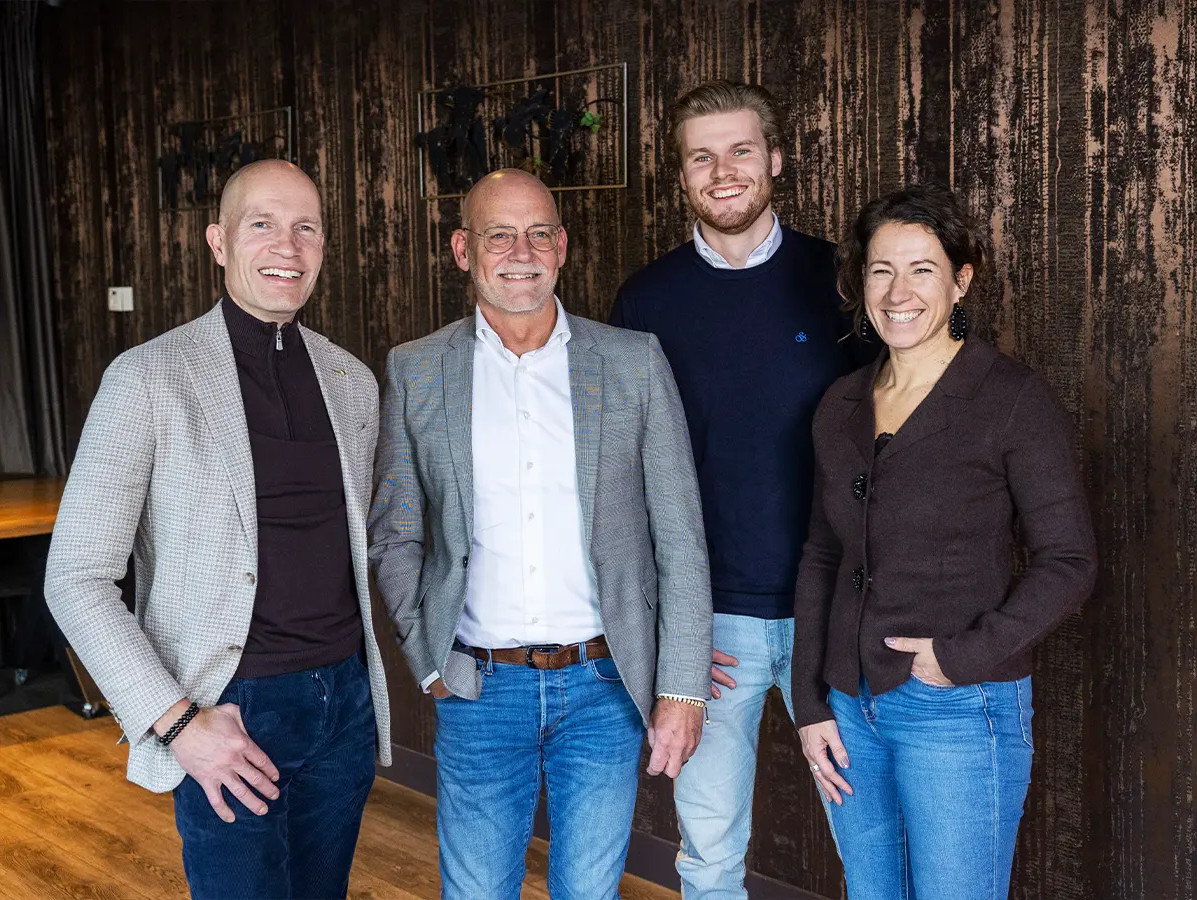
Left to right: Emiel Boogaard, Gerard Ramaker, Philip Lutke Veldhuis, Jantine Heemskerk.
“From a policy perspective, sustainability is becoming less prominent on the political and societal agenda, partly due to geopolitical tensions and pressure on Europe’s competitive position,” Ceel observes. He looks around the table. His question is addressed to all participants: “Do sustainability requirements still play a role for you? And if so, are they drivers for innovation?”
Emiel responds that sustainability requirements do influence their investment decisions. “All investments are assessed on whether they contribute to sustainability targets and align with our ESG strategy. (ESG is a framework used to measure and assess a company’s sustainability and ethical impact beyond financial performance, ed.). We have also committed to the SBTi and aim for B-Corp certification in 2026.”
At Heemskerk, the balance is somewhat different. “The sustainability choices we make must fit within our entrepreneurial strategy,” Jantine says. “I’m not saying sustainability isn’t important to us, but we primarily assess the business case as a whole.”
“We base investment decisions on ROI, not on sustainability requirements,” Philip states. “What we struggle with is that government-imposed sustainability obligations don’t necessarily help us move forward; on the contrary, they are hindering our development. For example, by 2030 we are required to supply our butchers in major cities with electric vehicles, even though we have excellent trucks that are far from depreciated. We are also required to install a different, more sustainable cooling system by 2030. The cooling was cold and will remain cold, but we will end up using more electricity. Meanwhile, the grid is already congested, and the municipality won’t grant us a larger connection. I find that genuinely very regrettable. And how are we supposed to pay for all this?” He directs the question straight to Henriëtte.
“A fair question,” she replies. “As a bank, we have to be prudent—responsible—with our capital. We therefore look first and foremost at figures and forecasts; I’ll be very honest about that. We don’t offer specific innovation loans, but we do have other options, such as sustainability financing. Sustainability, innovation and profitability can work very well together. When assessing an investment application—whether for an innovative or a conventional production line—we always consider several factors. How healthy is the business? Do we have confidence in management? Will the investment help improve the business model? Does it contribute to sustainability, process improvements and positive market developments? These are decisive factors for us when providing financing.”
For Gerard, the link between process innovation and sustainability is clear. “With a growing global population, there is a lasting need for efficient and sustainable technology. Robots are broadly applicable. They enable high production volumes within a small footprint through smart control and high speeds. Robotic production with integrated quality control increases efficiency, reduces waste and improves yield per kilogram. But sustainability, in my opinion, is also about encouraging companies to invest in training and retaining their workforce.”
“A sensitive issue when investing in robotics and other capital-intensive support is that, as a business, you need a future goal.” Emiel continues. “A long-term growth perspective from both government and customers is essential! That doesn’t have to be ten years, but it does need to be more than the one or two years we sometimes face now. Short-term contracts and current wage increases simply don’t align with the capital-intensive moves we are required to make. Category managers in retail want quick wins; they demand low prices and constant change. Just one example: you’ve just set up your automated order-picking system to handle whole carrots and courgettes, and suddenly the retailer wants only pre-cut vegetables in the package. And that’s it…”
“Very recognisable,” Philip agrees. “Stability is essential. We ran into the same short-term thinking from supermarkets. We can’t just press an order button when they suddenly decide to put steak on promotion next week without consultation. It takes months to properly fatten a cow. That’s why we now focus on premium butchers. There, we do find commitment. We operate in a niche, and that’s a good place to be. Here, we can truly make a difference.”
And that, they unanimously conclude, is ultimately what innovation is all about: standing out from the rest and making a difference. But—and this is a key thread throughout this Round Table discussion—no one can do it alone. Gerard sums it up succinctly: “What I’ve learned over the years is that you shouldn’t think you have to do everything yourself. Success is about collaboration—both internally, in multidisciplinary teams, and externally, with the right consortium of partners around you.”
Mainphoto: Left to right, clockwise: Henriëtte, Jantine, Emiel, Ceel, Philip, Gerard and Judith.
Photos: ©Herbert Wiggerman
Source: Vakblad Voedingsindustrie 2026
Magazine Voedingsindustrie has been made possible in part by:


© COPYRIGHT 2026 VOEDINGSINDUSTRIE | ALLE RECHTEN VOORBEHOUDEN
Powered by Wallbrink Crossmedia © 2026