The global olive oil market represents an annual value worth billions of euros. Yet the sector has long struggled with a persistent problem: fraud and misleading claims. A significant share of the olive oil sold as extra virgin does not actually meet the strict quality standards required for that label. A new initiative in the Netherlands aims to change that.
Based in ’s-Hertogenbosch, the Olijfolie Instituut (Olive oil Institute) combines advanced sensor technology with sensory analysis to enable objective quality control throughout the olive oil supply chain. The startup was founded by Arnold Koomans and olive oil expert Wilma van Grinsven-Padberg. Their mission is simple yet ambitious: to make olive oil quality measurable, transparent, and verifiable.
Research conducted by the institute showed that 74 percent of the olive oils sold as extra virgin in Dutch supermarkets fail to meet quality standards. Common defects include fusty (fermentation), rancid (oxidation), and muddy sediment (olive pulp residue). In severe cases, the oil is classified as lampante; a category considered unfit for human consumption.
Arnold’s interest in authenticity and origin verification stems from his background in the wine industry. In the wine sector, chemical analysis of organic compounds is increasingly being used as a kind of digital fingerprint capable of proving a product’s origin. “Supermarkets often cannot verify whether a wine genuinely comes from a specific region,” he explains. “Analytical data can make the geographical origin visible. The same principle can also be applied to olive oil.”
The difference is that olive oil quality has traditionally been determined by human tasting panels. Trained experts smell and taste the oil to detect possible defects. Although these panels are rigorously trained and regulated, their assessments remain subjective to a certain extent.
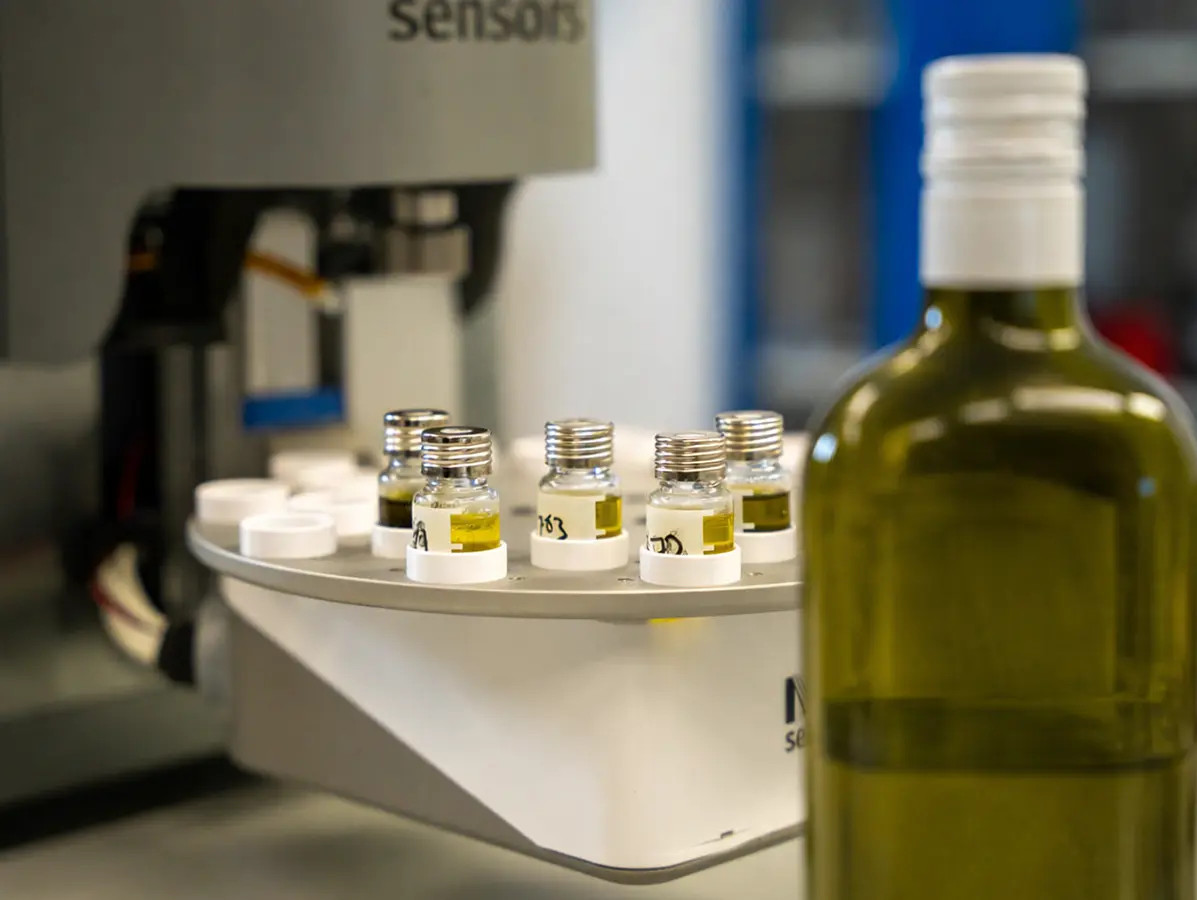
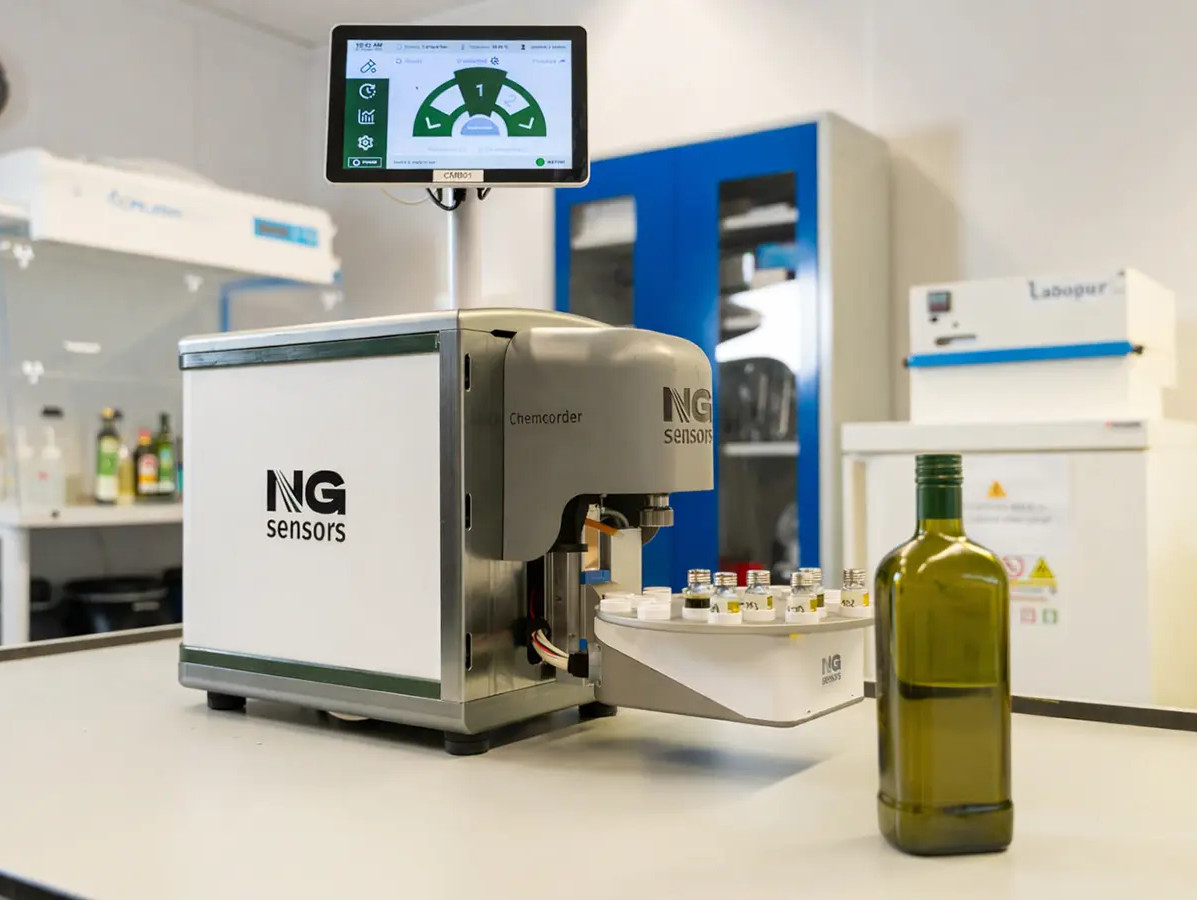
To complement traditional tasting methods, the Olijfolie Instituut uses a so-called electronic nose, or ‘e-nose’: a portable sensor device capable of detecting volatile chemical compounds that indicate quality defects. The technology was developed by Sarfaraz Syed and his company Next Generation Sensors from Maastricht, which specializes in advanced portable detection systems that combine mass spectrometry and infrared technology. The systems can identify hazardous or unwanted substances directly on-site, helping detect harmful compounds in food and beverages and ultimately remove them from the agri-food chain. The Next Tech Food Factories program by AgriFood Capital and Brainport Development provided support during the development of Next Generation Sensors. Sarfaraz says: “We are also working on applications in narcotics detection, where rapid on-site analysis is crucial. By bringing laboratory capabilities directly to the sample, we can guarantee safety and quality regardless of location.” The electronic nose detects chemical signals linked to oxidation, fermentation, and other defects. These results are then verified by a professional sensory panel, which also classifies the oil as extra virgin, virgin, or lampante. By combining objective sensor data with human expertise, the device can identify quality issues throughout the entire distribution chain.
Quality problems in olive oil are partly linked to market pressure. In recent years, olive harvests have been severely impacted by extreme weather conditions. The 2022–2023 and 2023–2024 harvest seasons in particular were exceptionally poor, mainly due to prolonged drought in key production regions around the Mediterranean. The result was a production decline of more than 30 percent. When supply drops while demand remains high, the temptation to stretch quality boundaries increases. Similar issues have also been identified elsewhere in Europe. In Belgium, for example, research into 33 olive oils found that 20 failed to meet the standard for extra virgin, while one product turned out not to be olive oil at all. Olive oil production in the European Union (source: the Dutch Ministry of Agriculture, Fisheries, Food Security and Nature – LVVN) also shows that output has declined in recent years, while demand has remained relatively stable. That combination of lower supply and continued demand creates ideal conditions for fraud and quality issues.
The Dutch Olijfolie Instituut is now gaining recognition within the olive oil sector’s regulatory framework. The Dutch Ministry of LVVN has nominated the institute’s panel leader to the European Union. The EU subsequently submitted the institute for recognition by the International Olive Council (IOC) in Madrid, the global authority on olive oil standards. Until now, the Netherlands Food and Consumer Product Safety Authority (NVWA) had to rely on foreign tasting panels for official testing. Thanks to the new institute, the Netherlands will be able to carry out these analyses independently in the future.
There are shortcomings in olive oil quality control across several European member states. The institute therefore wants to introduce a clear quality label in which extra virgin olive oils are assessed using a 100-point system. The highest-rated products will receive a gold, silver, or bronze classification. In time, an online database will allow consumers and buyers to verify certifications. The platform will also provide extensive information for professional buyers, including the origin of the olives, harvest and pressing dates, and available production volumes. The goal is to create a transparent marketplace for premium olive oil, where producers and retailers can connect and make distribution agreements.
The idea for the electronic nose came from an unexpected source of inspiration. After years of working in the technology sector, Sarfaraz wanted to build something of his own. As a major fan of the science fiction series Star Trek, he drew inspiration from the character Spock, known for his logical and analytical approach. “I wanted to develop a device that can measure things objectively using simple and portable sensors,” he says.
The technology was recently presented during the World Olive Oil Exhibition in Madrid. Reactions from the industry were mixed. “Some people see it as an exciting development,” Arnold says. “Others realize it could also expose issues within the market.” Despite the challenges, the founders are convinced that innovation is necessary in a sector where tradition often dominates. Their advice to other foodtech entrepreneurs is therefore straightforward: fully believe in what you are doing and go for it. Ultimately, the institute hopes its work will not only protect consumers, but also food producers that use olive oil as an ingredient in products such as salads, sauces, and ready meals. Arnold: “Many companies import olive oil for their products. Do they truly know the quality of the oil they are using?”
Next Tech Food Factories is the programmatic partnership between AgriFood Capital and Brainport Development, with one clear goal: preparing the food processing industry for the future. The organization brings together food processing companies, high-tech suppliers (such as Next Generation Sensors), and machine builders to work on innovation in practice. Think of robotics, artificial intelligence, and sensor technology that make production processes smarter, more efficient, and safer. Want to know more?
www.nexttechfoodfactories.nl
Source: Vakblad Voedingsindustrie 2026
Magazine Voedingsindustrie has been made possible in part by:



© COPYRIGHT 2026 VOEDINGSINDUSTRIE | ALLE RECHTEN VOORBEHOUDEN
Powered by Wallbrink Crossmedia © 2026