
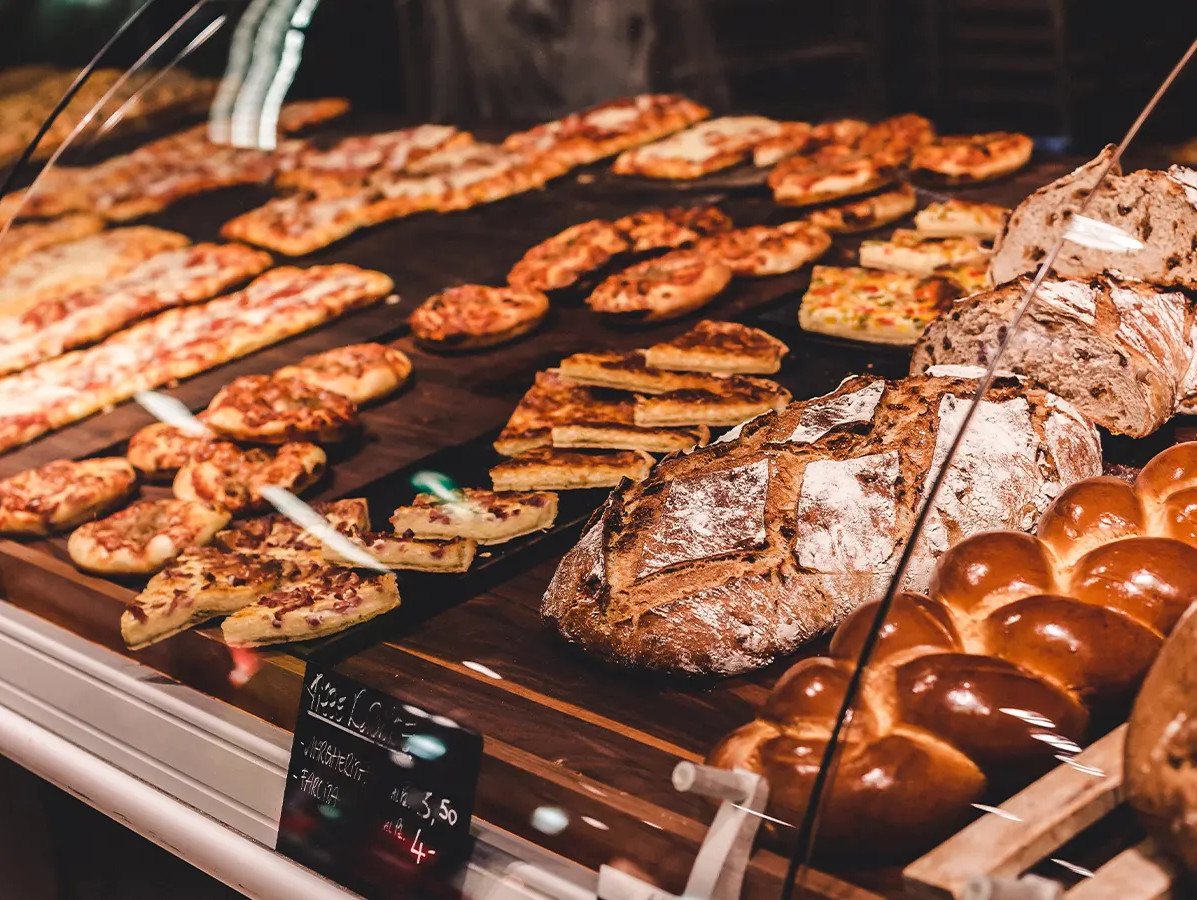
Flour and flour-based products are typically intended to receive a final heat treatment step before consumption, which will inactivate any pathogens that may be present. As a result, these products are generally not associated with microbiological safety hazards. Yet those risks do exist for unheated products. Time to take action.
Although flour has a low water activity that prevents microbial growth, pathogens such as Salmonella and STEC (Shiga-toxin producing E-coli) can survive for extended periods. STEC, for example, has been linked to several outbreaks involving the consumption of products containing raw flour. Examples include an outbreak linked to ready-to-bake cookie dough in the US in 2009 and dough mix in the US in 2016. In Europe, a severe outbreak of STEC, involving 56 confirmed cases of illness, occurred in 2022 that was linked to frozen pizzas contaminated with STEC and led to recalls in several European countries (RASFF 2022.1638). In this context, the milling and baking industries are exploring downstream heat treatment to reduce microbial risks without compromising the functional properties essential for high-quality baked products.
A new study (1) from Wageningen Food & Biobased Research (part of Wageningen University & Research) addressed this challenge. The research was carried out in collaboration with industrial partners within the SAFFYRE project (2). By evaluating three thermal processing technologies, vacuum steam, microwave (MW), and radio frequency (RF). The study examined the potential for their ability to decontaminate wheat flour and grains while maintaining baking performance. Rather than focusing solely on processing parameters such as temperature or time, the researchers used a unifying concept: heat load. A metric derived from temperature–time profiles that enables direct comparison across different technologies.
One of the most important contributions of this work is the demonstration that heat load can serve as a practical and technology-independent indicator of treatment intensity. In industrial settings, comparing processes such as steam, microwave, and radio frequency heating is notoriously difficult because each system operates under different physical principles and equipment settings. By calculating cumulative heat exposure relative to a reference temperature, the study established a common framework that links processing conditions to both microbial inactivation and product quality. This approach allows processors to move beyond equipment-specific settings and instead focus on finding the sweet spot between two outcomes, namely, safety and functionality.
The results clearly showed that microbial inactivation is strongly dependent on heat load, with higher loads leading to greater reductions. However, a key distinction emerged between flour and grain. Flour seemed more responsive to thermal treatments, achieving up to 6-log unit reductions in Enterococcus faecium, a surrogate organism for Salmonella, at relatively moderate heat loads. Grains were more resistant, requiring substantially higher heat loads to achieve similar reductions. Within similar ranges of heat loads, flour treatments consistently achieved 3–6 log unit reductions, while grain treatments achieved only about 1–2.5 log unit reductions under comparable conditions.
This difference is highly relevant for food industry. It suggests that post-milling interventions (treating flour directly) may be more efficient than treating whole grains if the goal is microbial reduction without quality loss.
Among the technologies tested, vacuum steam outperformed microwave and radio frequency heating at equivalent heat loads, particularly in flour. This was attributed to the superior heat transfer properties of steam, even under reduced pressure, and to the ability to achieve more uniform treatments than microwave and radio frequency. Microwave and radio frequency treatments still showed promising results, especially at lower temperatures, but exhibited greater variability, likely due to non-uniform heating, a well-known challenge in electromagnetic processing systems. For industry adoption, this implies that vacuum steam offers robust and predictable performance, particularly for sensitive low-moisture ingredients. Microwave and radio frequency remain promising but may require further optimization, especially in terms of uniformity and process control.
A central concern for milling and bakery industry is maintaining baking performance, particularly gluten functionality and bread volume. In this study, flour functionality was assessed using a mini-bread baking system, which enables rapid and material-efficient screening of flour performance under standardized conditions. This small-scale method requires only a few grams of flour per test while still capturing key dough and bread characteristics. Importantly, the approach has been shown to be representative of large-scale bread production, making it a powerful tool for both research and industrial process optimization.
Using this system, the study identified a critical heat load threshold below which flour functionality is largely preserved. At or below this threshold, bread volume remained comparable to untreated flour and pasting properties stayed stable, indicating no significant degradation of functionality. Above the threshold, bread volume declined sharply due to heat-induced changes in gluten structure that negatively affected dough development. By combining insights from the mini-bread baking tests with microbial reduction data, a clear processing window could be defined in which safety improvements could be achieved without compromising end-product quality. This highlights the value of rapid, small-scale baking assays as predictive tools for industrial performance, enabling efficient screening of processing conditions before scaling up.
The study provided valuable insight into the mechanisms underlying quality changes. The primary driver for quality loss was not starch modification, as starch structure remained largely unaffected, but rather protein aggregation. As heat load increased, free sulfhydryl groups decreased with formation of disulfide bonds that altered gluten functionality. Changes in protein structure resulted in increased paste viscosity and lower bread volume. Importantly, these changes occurred progressively with heat load, reinforcing the value of heat load as a predictive metric for quality outcomes.
A particularly noteworthy finding was the effectiveness of low-temperature, longer-duration treatments (55–60 °C). These conditions achieved meaningful microbial reductions (≥3 log) while maintaining flour functionality when performed within the critical heat load threshold. These results challenge the traditional reliance on high-temperature, short-time treatments and opens the door to milder processing strategies that are better suited to heat-sensitive ingredients like wheat flour. For the food industry, this suggests that process optimization does not necessarily require high temperatures, but rather smart control of cumulative heat exposure.
While treating whole grains may seem attractive from a process integration perspective, the study highlights clear limitations related to lower microbial reduction at comparable heat loads and risks of inhomogeneous heating. Achieving high levels of decontamination in grains may require higher heat loads than in flour, which in turn could negatively impact flour functionality after milling.
The findings of this study have several important implications for food manufacturers, millers, and ingredient suppliers:
As regulatory pressure and consumer awareness around food safety continue to grow, the need for validated, scalable decontamination strategies in low-moisture foods will only increase. The study provides important insights for future adoption by the food industry, by introducing a unifying metric (i.e. heat load) and by identifying practical processing windows. Ultimately, the study shows that microbial safety and product quality do not have to be competing objectives, especially when mild processing conditions and the right operational window are identified.
Call for Partners: let’s connect and innovate in food and biobases | WUR
Interested in collaborating in new research projects with WUR? Join our upcoming calls—there are still opportunities for partners to get involved:
Sources
(1) Stefano Renzetti, Joanne Siccama, Rian Timmermans, Rimmer Woudstra, Louise Nederhoff, Masja Nierop Groot, 2026. Heat-load-guided microbial decontamination of wheat flour and grains: Balancing safety and baking performance across vacuum steam, microwave, and radio-frequency treatments. Innovative Food Science & Emerging Technologies, 111, 104586, https://doi.org/10.1016/j.ifset.2026.104586
(2) The project SAFFYRE ‘Safe and functional dry ingredients’ (LWV22061) receives financial support from the Topsector Agri & Food. Within the Topsector, private partners, knowledge institutes and government collaborate on innovations for safe and healthy food for 9 billion people in a resilient world. The project was partially funded by Société des Produits Nestlé S.A., SAIREM, Imtech-Steri AG, Bühler Group, Koninklijke Euroma B.V., Sabater and Dachverband Schweizerischer Müller (DSM)
Source: Vakblad Voedingsindustrie 2026
Magazine Voedingsindustrie has been made possible in part by:



© COPYRIGHT 2026 VOEDINGSINDUSTRIE | ALLE RECHTEN VOORBEHOUDEN
Powered by Wallbrink Crossmedia © 2026