
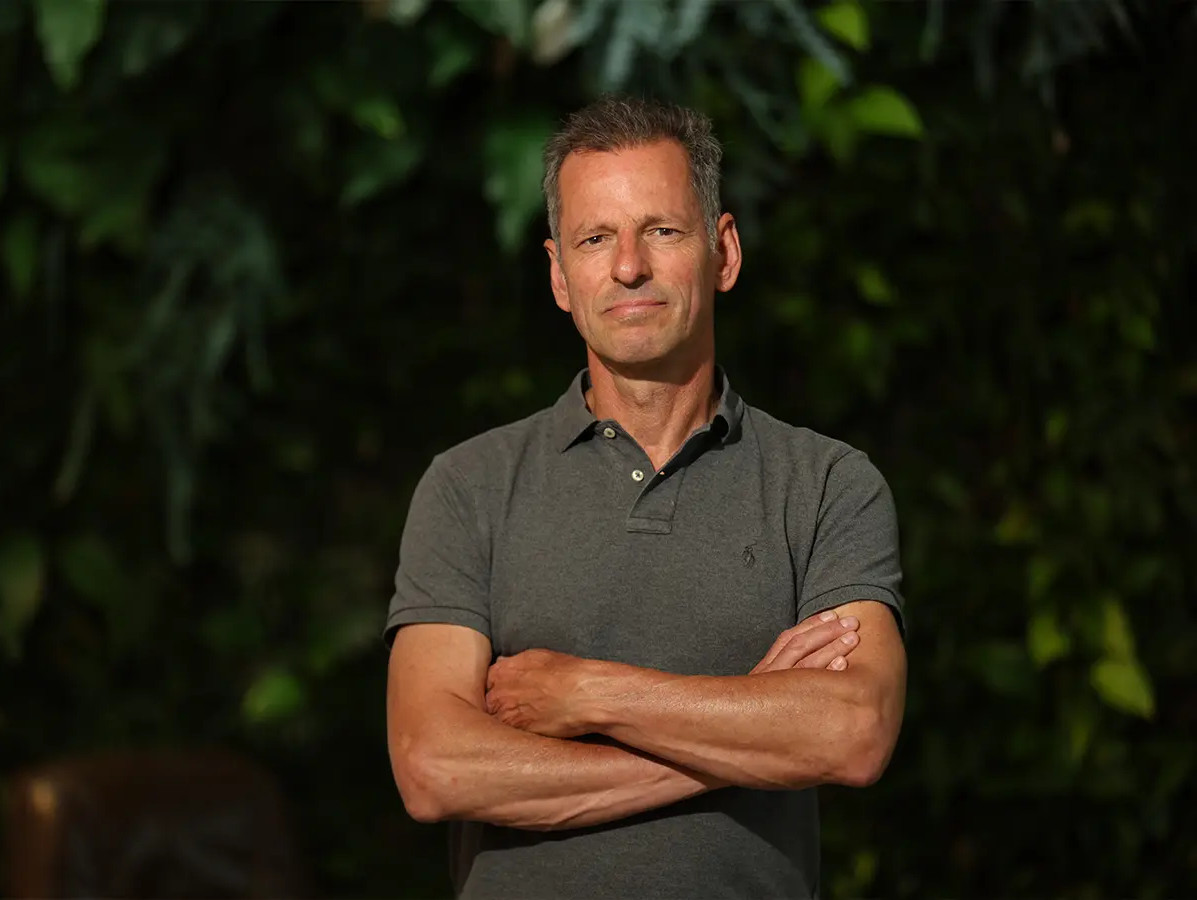
A shortage of building sites and raw materials, long waits for electricity and water connections, the nitrogen issue... anyone looking to build or expand in the food industry faces plenty of obstacles. But there are other ways forward. Andy van den Dobbelsteen, Professor of Climate Design & Sustainability at the Faculty of Architecture and the Built Environment at TU Delft, has no shortage of ideas.
Andy van den Dobbelsteen is known for his enthusiasm when it comes to sustainable construction and sustainable energy systems. Of course, as a professor, it is his job to pass on his scientific and practical knowledge of these topics to the next generation of architects. But it does not stop there. He wants to make an impact. To help safeguard our planet for future generations. To drive change. Driven by that passion, he led TU Delft’s transition—as sustainability coordinator—toward carbon neutrality, climate adaptation, circularity, biodiversity, and quality of life across the university, its buildings, and its activities. Sitting still is simply not an option. “If you want things to change, you have to take action,” is the common thread running through his story.
“We can make major progress in circular construction,” he says. “Bio-based construction, using as few artificial materials as possible, continues to gain ground. The big challenge is: how do we build in a more nature-inclusive way?” According to Andy, that question requires a broad approach. “It involves everything from installing nesting boxes and green roofs to using more sustainable materials and applying biomimetic design.”
“Biomimetic design, or biomimicry, is the practice of imitating biological principles and structures found in nature to solve human problems and develop innovative, sustainable applications. In our case: how can you translate principles from nature into technical applications for buildings? For example, a building envelope that cools itself like skin through evaporation when the sun shines, but closes itself off when temperatures drop.”
“There are countless examples of plant-based crops that can be used as fiber materials. We cultivated these materials in the Netherlands for centuries, but with the rise of concrete and steel—and their low cost—we forgot about them. We are now rediscovering those crops. Think of reeds, rushes, cattails, bamboo, various grasses, and fast-growing wood that may not be suitable as structural timber but can be highly useful as a fiber material. More and more architects and builders want to work with these materials.”
“I believe so. Cold storage and freezer facilities are currently usually steel structures surrounded by a highly insulating plastic shell. It makes sense that companies look for the thinnest possible foam insulation with the lowest possible lambda value: the lower the value, the less heat passes through. That is unlikely to change anytime soon. What will become increasingly important is making those plastics as sustainable as possible. As for the building itself, the entire structure could, in my view, easily be made of wood instead of steel, as could much of the exterior finishing. More sustainable solutions can often be found for office spaces as well.”
“In my opinion, the fear of wood in relation to fire is greatly exaggerated. The material is always pre-treated and impregnated with natural fire retardants. The materials we currently use also have their drawbacks. Wood slows down a fire through the formation of a carbonized layer, while steel can suddenly fail and collapse when exposed to extreme heat. Concrete may seem very safe, but when it starts to fail, there are often few warning signs. It can collapse all at once.”
“That naturally depends in part on the condition of the building,” Andy laughs. “How old is it? What can still be modified or improved? Still, I would argue that renovation is the better option in 90% of cases. The annual Gulden Feniks award, for example, repeatedly shows how successful sustainable renovation projects can be. As long as demolition is not penalized and material reuse is not rewarded, people will continue to reason: ‘Demolition is relatively inexpensive, and new construction allows us to do exactly what we want, so that is what we will do.’ That is why I advocate imposing a penalty on demolition within 50 to 75 years of construction—a penalty on top of the cost of the replacement building. Similar to a carbon tax: because you are destroying environmental capital and creating demand for new materials.”
“Because it is far more efficient and sustainable to prepare building elements in a factory. It is well known that issues frequently arise on construction sites because components do not fit properly. In a factory setting, assembly problems can be addressed much more accurately in advance. Prefabrication also reduces emissions of CO₂ and other harmful substances, meaning there is very little disruption on-site—only the transport and assembly of the components. Unfortunately, prefabricated and demountable construction is still used relatively little in residential and office construction.”
“If you visit a cathedral or an old castle in summer, it feels wonderfully cool inside. Visit in winter, and it is warmer than the outside air. That is due to the enormous thermal mass of the stone. We are going to make greater use of that principle. New phase change materials (PCMs), a form of artificial thermal mass, have the same effect as those thick stone walls. PCMs make it possible to stabilize temperatures effectively using far less material and weight. This technology is already being used in commercial buildings as a buffer to maintain a constant temperature, both for heating and cooling.”
“So there are more sustainable technical solutions available, but they are not being implemented widely enough. In the Netherlands, for example, we could make much greater use of the ground and surface water for climate control in buildings. Ground temperatures in the Netherlands remain fairly constant at around 11 degrees Celsius. That makes it an excellent medium for storing cold energy for summer cooling. Likewise, heat released during cooling processes can often be stored beneath buildings for use during winter. We could also make greater use of geothermal energy; the deeper you go into the earth, the warmer it becomes.”
“No,” he says firmly. “We need to take a much more serious look at where we build and which areas of land we allow nature to reclaim. Take the Zuidplaspolder, for example, located between Rotterdam, Gouda, and Zoetermeer. It is the deepest polder in the Netherlands. Its lowest point is about seven meters below sea level. And that gap is increasing because sea levels are rising. Yet there are once again plans to develop that area. Instead of choosing locations that are inherently safe, architects could design in ways that limit the damage caused by flooding or sea-level rise. Years ago, my colleagues and I developed a plan for a neighborhood that would remain protected through the first 1.6 meters of flooding. It now appears that they are once again opting for a fairly traditional design approach. At most, they are creating some buffer capacity for heavy rainfall.” His astonishment is evident.
“We could be handling something we know, with a high degree of certainty, is going to happen in a much smarter way. I understand that there are multiple factors involved in choosing a location, but we have been warned often enough. I truly believe that if the 2021 floods in South Limburg had occurred in The Hague, different decisions would have been made. If the western part of the country had been underwater, we would already have a far-reaching climate adaptation policy in place. It would also be wise to look further ahead than the next four years.”
“I always tell my students: ‘Design with the lifespan of the building in mind. On average, a building will last at least 50 years. It therefore needs to be suitable for the climate we will have between 2050 and 2080. That means accounting for more extreme temperatures, rainfall arriving in heavier downpours, prolonged droughts, and severe storms.’ At the moment, however, building regulations encourage us to look backward rather than forward—we base our standards on the average climate of the past thirty years.”
“It has to do, among other things, with current laws and regulations, the way we have organized our processes in the Netherlands, and where responsibilities are assigned. Over the past twenty years, the government has privatized a tremendous amount. As a result, it has lost control over essential infrastructure, which is now managed by a variety of commercial network operators. The idea at the time was that commercialization would create competition and lower prices. By now, everyone knows that has not happened.”
“Essential services such as electricity, heating, water, sewage, and similar utilities should once again be brought under government control. The government needs to take the lead. It is the institution responsible for the future of our country and its citizens. Some municipalities have already bought back commercial companies and established municipal energy utilities so they can manage these services themselves again. That needs to happen on a much larger scale. We also need a centralized plan to address the grid congestion challenges we are currently facing.”
“If we truly want to reduce emissions, we will need to eat more plant-based foods and fewer animal products; I am convinced of that. My motto is: ‘practice what you teach and preach.’ As sustainability coordinator, I therefore started working on establishing a vegetarian cafeteria at TU Delft. That caused quite a stir, but it also made people think. I am certainly not saying that all meat and dairy products should disappear, but it would be beneficial to create a better balance between what we produce and what we consume. A large share of the land in our country is currently used for livestock farming. If more of that shifted toward plant-based production, we could grow and produce so many more materials suitable for construction, furniture, and other products. There is truly enormous potential!”
‘We could make much greater use of the ground and surface water for climate control in our buildings’
Photo’s ©Dennis Wisse
Source: Vakblad Voedingsindustrie 2026
Magazine Voedingsindustrie has been made possible in part by:



© COPYRIGHT 2026 VOEDINGSINDUSTRIE | ALLE RECHTEN VOORBEHOUDEN
Powered by Wallbrink Crossmedia © 2026