
In Waalwijk, you will find the only company in the Netherlands that processes frozen meat into powder and granulate. And they do it well. It is therefore not surprising that the list of customers for the ingredients produced here, at Henningsen, is a long one. The large cabinet displaying broth cubes, noodle cups, dried soups, outdoor and military meals, and a wide range of snacks in bacon, chicken and beef flavors is bursting at the seams.
“Preserving meat by drying it is the oldest known way of making meat more sustainable,” says Corné van Loon, Managing Director of Henningsen. “Archaeological finds show that this was already done in prehistoric times, back then using wind and sun. An animal consists on average of 70 to 75 percent water. We remove that moisture from the meat. That is all we do.” When you put it like that, it all sounds very simple. A tour of the factory, however, shows that the current process involves rather more than meets the eye.
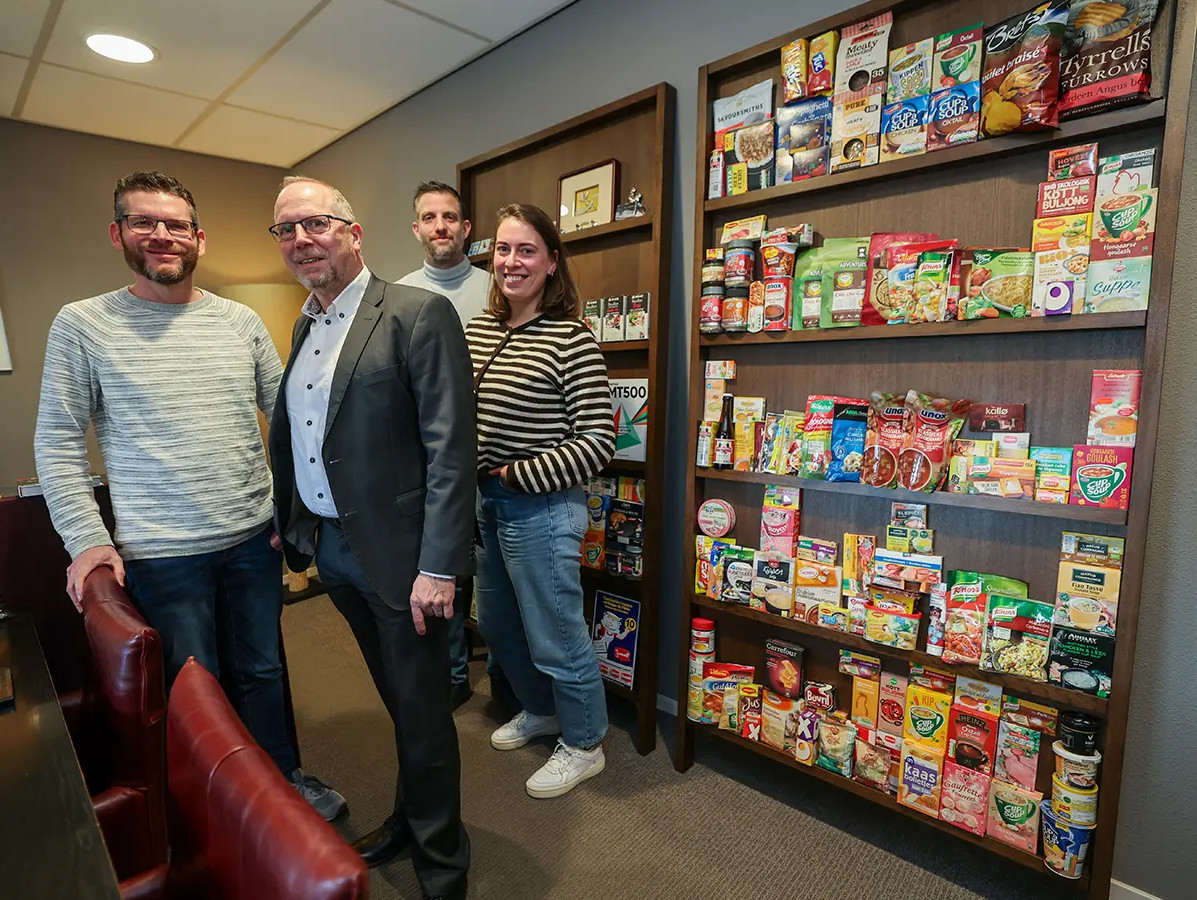
From left to right: Michiel, Corné, Rens, Marieke
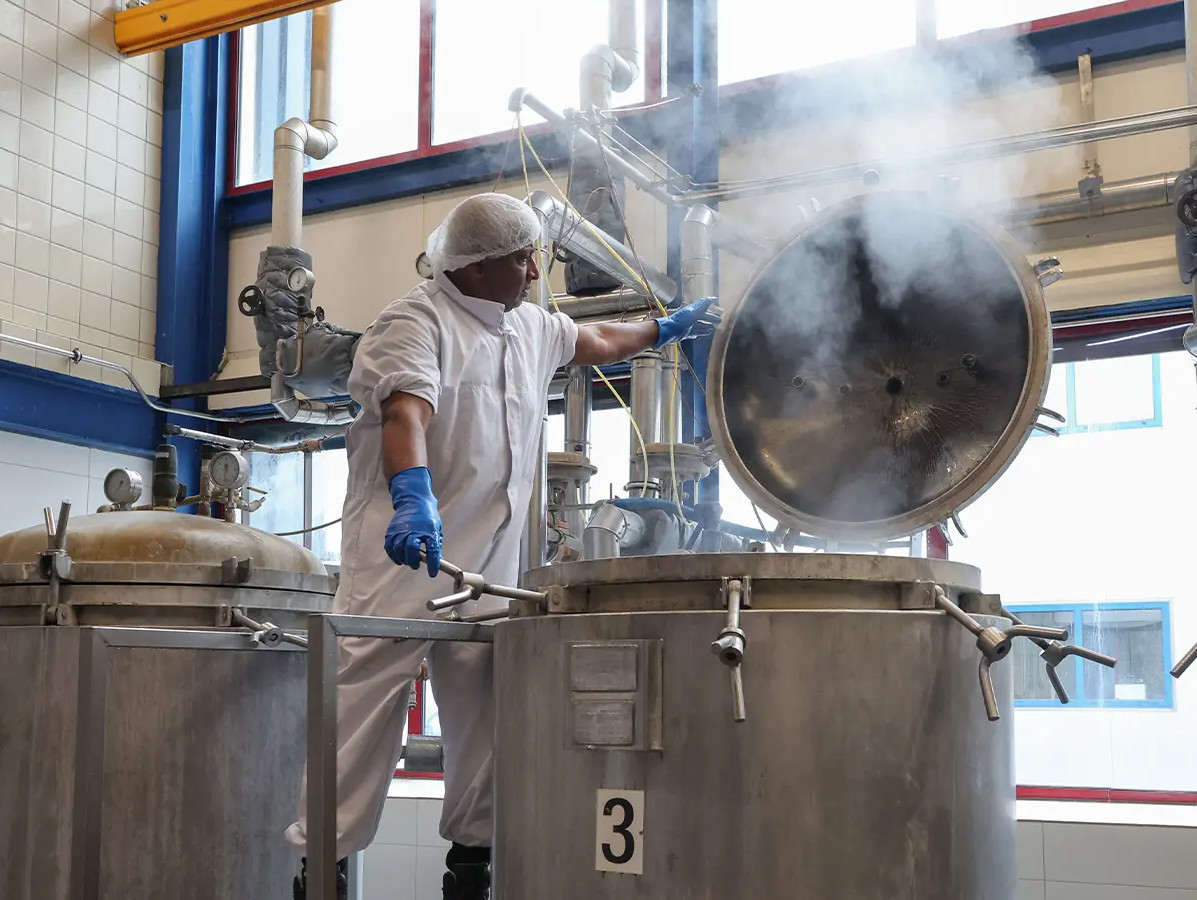
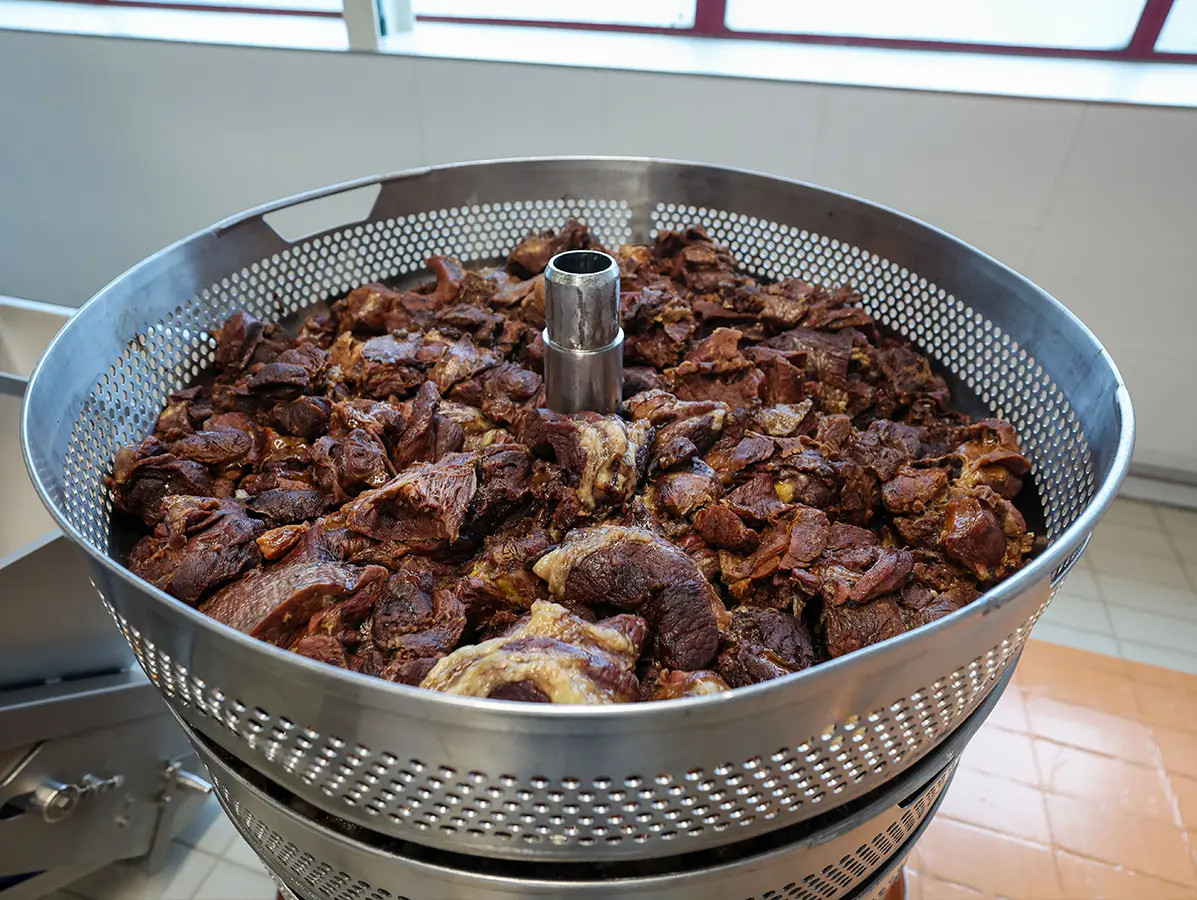
Rens Sondag, Chief Operating Officer, takes us through the factory to see the process up close. The first thing that stands out is the strict separation between the wet and dry parts of production. Hairnets, clogs, coats, tools—everything has its own color, making the division between the two zones immediately visible to everyone. “This layout prevents cross-contamination and any human contact with the meat after the cooking phase, which is essential for safeguarding food safety,” Rens explains. He guides us through the factory, moving from the dry area to the wet one for food safety reasons. In this article, however, we start at the very beginning of the process: the wet area, where blocks of frozen meat enter production directly from the freezer. “This meat comes from by-products from slaughterhouses,” says Corné. “Trimmings and offcuts are traded in deep-frozen blocks of 10 to 25 kilos.” A little further on, an employee tips the blocks into a large kettle, where they are turned back into a liquid meat mass.
Henningsen operates two production lines. On the spray-drying line, the meat broth is atomised under high pressure through countless nozzles into very fine powders. On the air-drying line, coarsely ground powders and granulates of various diameters (from 3 to 12 mm) are produced. The basic principle is the same on both lines: the water evaporates. What remains is granulate or powder. An ingenious system of pipes transports the ingredients to the dry part of the factory, where they are packed into boxes or big bags of 300 kilos or more. As a by-product, the process also yields a small amount of broth and some fat.
Henningsen originally started out as an American company. To serve the European market, a factory on this side of the Atlantic was necessary, particularly because of differences in legislation. “In the 1970s and 80s, the Americans deliberately chose the Netherlands, mainly because of the availability of dairy cows here,” Corné explains after the extensive tour. Years later, in 2013, Henningsen Netherlands bv was acquired as a subsidiary by Ariake Europe, a Japanese company that produces and sells natural broth products. Ariake founder Kineo Okada had already begun manually producing traditional broth recipes in Japan in 1966. To this day, he wants to keep everything fully under his own control; around the two factories in Japan, he grows his own vegetables. ‘Staying close to the source’ still runs like a common thread through the group’s operations. “It doesn’t always work out, but we try to stick to that principle as much as possible,” Corné explains. “Our sister company in Belgium, located in Maasmechelen, is right next to a poultry slaughterhouse, and the supply for the French site is also close by.” At these foreign locations, broths are produced that are defatted and concentrated to the desired form—liquid, paste or powder.
By now, Marieke Vissers, Technical Quality Manager, and Quality Assurance Manager Michiel van de Broek have also joined the conversation. Together, they manage the quality team. Marieke explains that the chicken meat processed in Waalwijk mainly comes from laying hens, while the beef comes from dairy and/or dual-purpose cows. “At the start of the chain, the environmental impact is greatest—during egg and milk production. By ensuring optimal use of the animal, we help our customers further reduce their CO₂ impact.”
Corné adds: “That use results in a very pure product. We do not alter the meat, and we do not add anything to the powders. We remove nothing but the water. Only for the granulates do we sometimes make an exception. A small piece of meat in a meal can be rather bland without salt. In addition, for spray-dried products we sometimes use a small amount of antioxidant during processing, usually rosemary extract. After drying, it no longer has any effect. It is purely a technical aid to prevent the meat from becoming rancid during the process. In most countries, customers do not even have to declare it.”
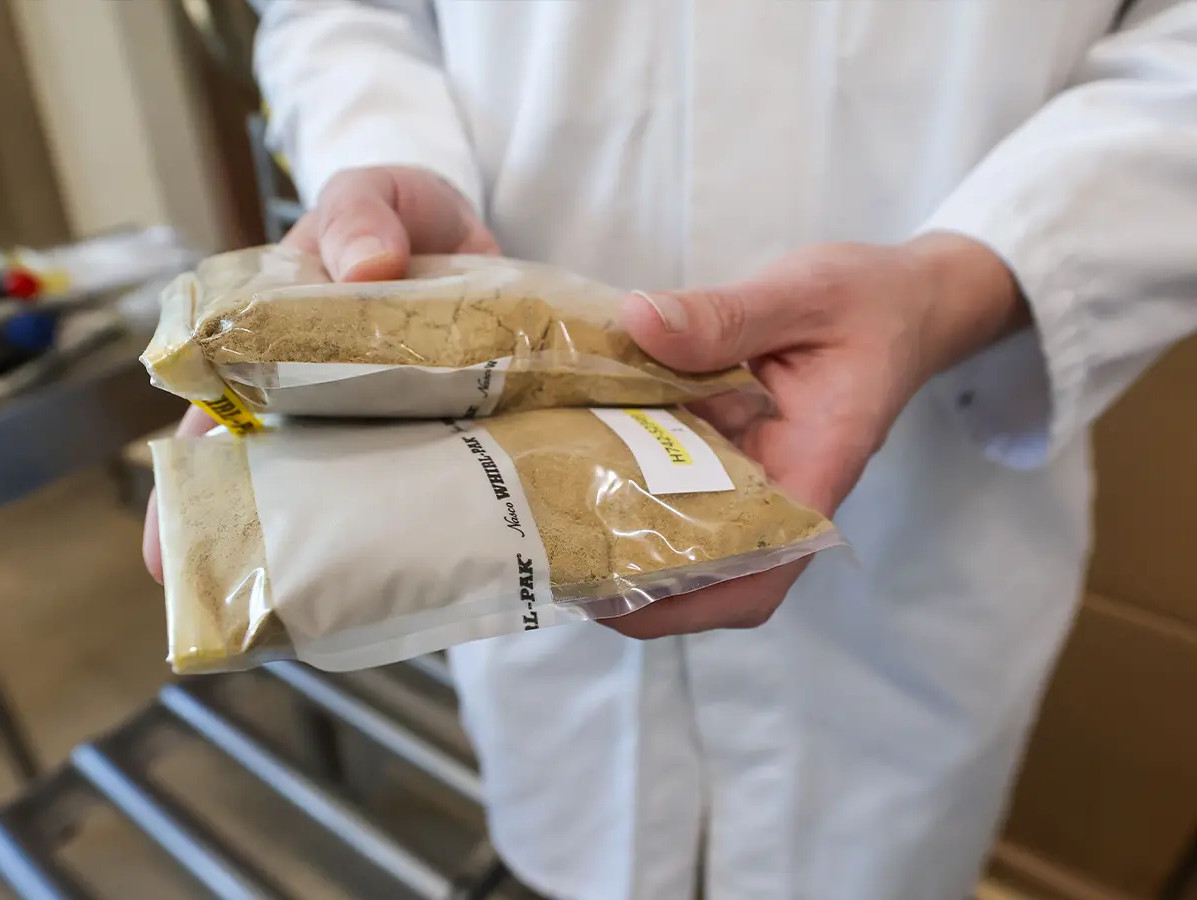
There is no shortage of suppliers. Henningsen processes not only beef and chicken, but also lamb, venison, pork, turkey and duck, in countless variations. The quality managers are visibly proud of the broad product range. “We produce more than 140 different powders and granulates!” they say. “With chicken alone, you can think of whole chicken, chicken fillets, thigh meat, leg meat, chicken with and without skin, chicken with one, two or three stars from the Better Life animal welfare label, soup chickens, broilers, and so on,” says Marieke. The meat from soup chickens—laying hens—is both more flavorful and leaner than that of broilers. “Dutch consumers no longer want this meat; they prefer something softer and more tender. For us, these chickens are actually better to process.”
“The same applies to beef,” Michiel continues. “Although dual-purpose cows form the bulk, we also process, among other things, pure Black Angus, grass-fed and Irish beef. Supply is therefore never the same. On top of that, fat, water and protein levels differ from animal to animal.”
“That’s why I keep stressing the importance of specifications,” Marieke emphasises. “They are essential for fine-tuning the recipes. With every batch, we start by running the numbers, so we can set the machines very precisely and achieve stable, high-quality end products. With new suppliers, we always carry out a trial drying first.”
Michiel adds: “The current trend is that customers—and ultimately consumers—demand a transparent chain. They not only want to know the country of origin, but also what the animals were fed, which animal welfare characteristics apply, and how and where they were slaughtered. After the horsemeat scandal in 2013, we must also be able to guarantee that what we sell is exactly what the customer asks for. That is why we have been conducting DNA tests ever since.”
Corné confirms: “If a customer asks for 100% beef, then they get 100% beef.”
All those different raw materials, origin claims and animal welfare standards must put considerable pressure on planning and coordination. “That’s true,” all three of them acknowledge. “It’s quite a challenge…” They laugh. “But above all, it’s great fun!”
Photos: ©Bert Jansen
Source: Vakblad Voedingsindustrie 2026
Magazine Voedingsindustrie has been made possible in part by:



© COPYRIGHT 2026 VOEDINGSINDUSTRIE | ALLE RECHTEN VOORBEHOUDEN
Powered by Wallbrink Crossmedia © 2026





