
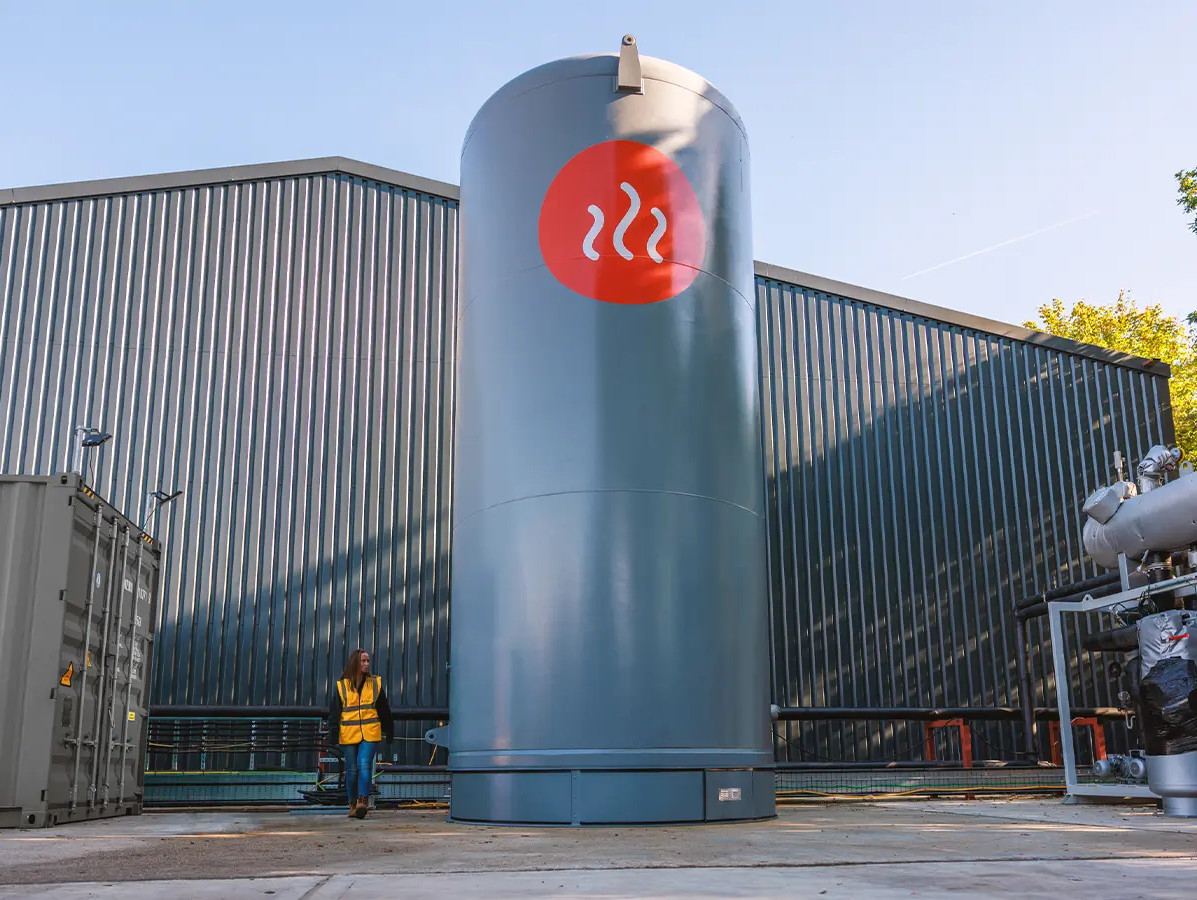
GEA is working with Caldera, a company that develops e-boilers that store electrical energy in the form of heat. Combined with GEA’s heat pump, this creates a solution for making heat demand carbon-neutral. Companies using the technology may qualify for the Sustainable Energy Production and Climate Transition Incentive Scheme (SDE++).
GEA considers the buffering e-boiler with storage capacity from the British company Caldera to be a key element in making process heat carbon-neutral. In the decarbonization of industrial process heat, GEA heat pumps and Caldera’s e-boilers complement each other perfectly. At a time of grid congestion and uncoordinated peak demand, the combination offers a flexible and sustainable solution. Last year, GEA invested €12 million in the developer of the innovative boiler.
“The unique feature of this boiler is its storage capacity,” explains Caldera CEO James Macnaghten. “It functions like a battery. A patented thermally conductive composite made of aluminum and rock stores heat.” Thermal energy storage can reduce ongoing capacity costs by avoiding peak loads. This is important because peak demand is often a major barrier to the electrification of heat. “Our boiler is essentially designed for the temperatures the process actually requires at that moment,” James continues. “It can be charged in less than 2.5 hours, allowing us to make the most of renewable energy sources during periods of low electricity prices.” Thermal storage shifts electricity demand to off-peak hours, enabling a company to purchase power at the lowest available rate rather than when the process requires heat.
“The buffering e-boiler from Caldera allows GEA’s heat pump to operate steadily,” adds Maarten Gelens, Sales Manager Heating and Refrigeration at GEA. The heat pump provides the base load, while Caldera’s boiler handles the peaks. In addition, the e-boiler can be used for requirements above the maximum heat pump temperature. “Ninety percent of production processes in the food industry require a temperature of 90 degrees Celsius. However, some applications require higher temperatures of 120 or even 150 degrees. This e-boiler is ideally suited for that,” says Maarten. “Many companies are struggling with grid congestion. For example, they want to increase production but are unable to do so. They are moving away from natural gas, but there is not enough electricity available. The solution Caldera offers—combined with our heat pumps—largely addresses this challenge.”
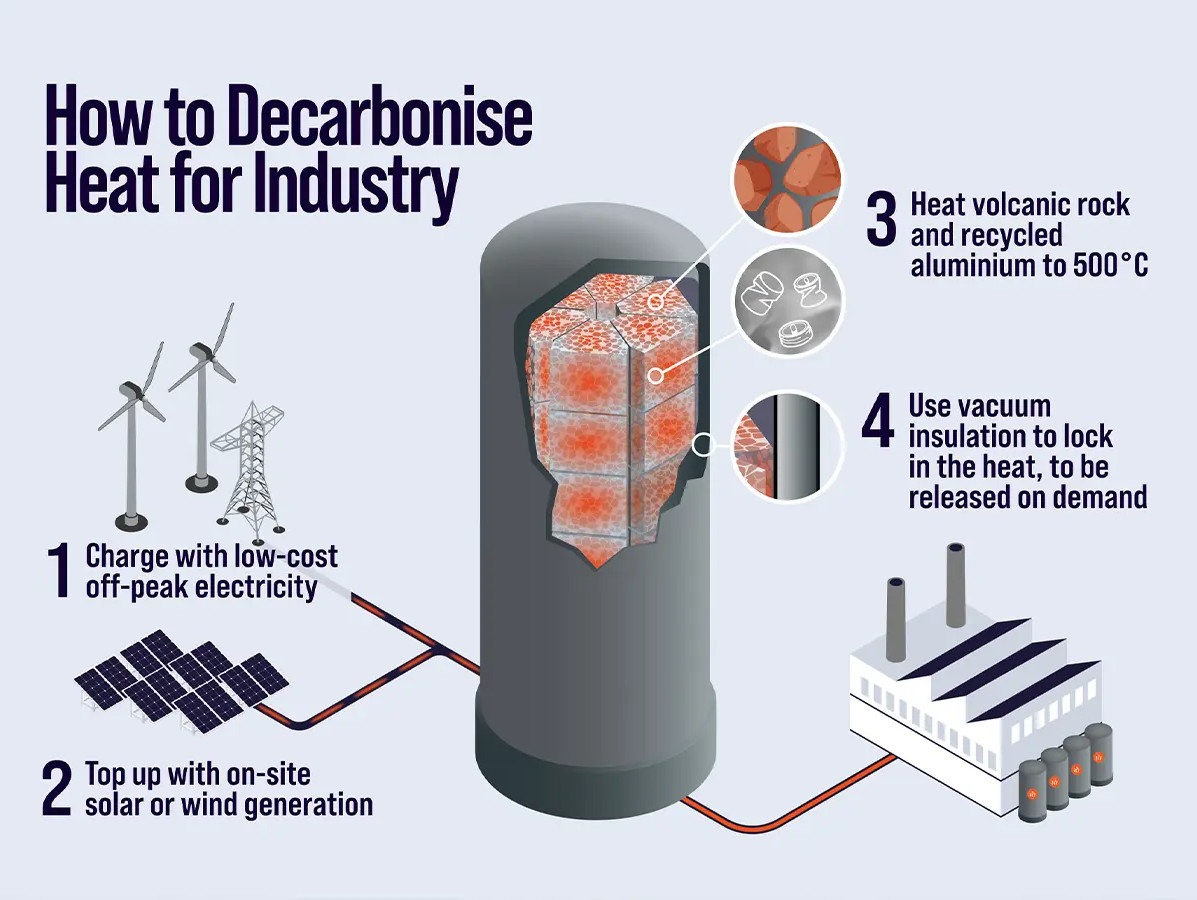
Industrial heat demand fluctuates. Storage through Caldera’s e-boiler therefore decouples electricity consumption from heat delivery. As a result, a company can size its electrical installations based on average load rather than peak load. James explains: “Excess solar energy or low-cost grid electricity that would otherwise be curtailed or exported at low value can be captured by our technology and later delivered as steam or high-temperature process heat.”
James founded the company in 2017, and the e-boilers were initially intended for the residential market. However, since Russia’s invasion of Ukraine led to rising energy prices, Caldera has scaled up significantly. The company now offers boilers that are 50 times larger and suitable for industrial applications. “Their storage boiler, or e-boiler, is a major milestone in the energy transition,” says Maarten. “It bridges the gap between variable renewable electricity generation and the demand for industrial process heat. The innovation provides a scalable and economically viable alternative to fossil fuel boilers.” Patented vacuum insulation and integrated heating elements provide exceptional thermal insulation, and the boilers are delivered pre-assembled. The e-boiler is manufactured, assembled, and prepared off-site, allowing installation to be completed in weeks rather than months. It also integrates easily into existing facilities.
Companies that purchase the new buffering e-boiler may be eligible for support under the SDE++ scheme. Applications must be submitted on time, before October 1, 2026. Businesses that generate renewable energy on a large scale or reduce CO₂ emissions may qualify for this subsidy. The subsidy also applies to GEA heat pumps.
One example of a GEA project is Europe’s largest heat pump, located in Tienen, Belgium. Tiense Suikerraffinaderij installed the industrial heat pump to recover waste heat and reduce energy costs. In addition to SDE++, companies may also qualify for the VEKI (Accelerated Climate Investments for Industry) subsidy in certain situations. “SDE++ is an operational subsidy, while VEKI is a one-time investment subsidy,” Maarten explains. “SDE++ is paid out over a long period. Depending on the technology and project type, a company receives this subsidy for 12 or 15 years.”
James is convinced that the partnership with GEA will help deploy the boilers at Dutch companies from the fourth quarter onward, including breweries, distilleries, dairy processors, and companies in the food and pharmaceutical industries. The ultimate goal: reducing CO₂ emissions.
Source: Vakblad Voedingsindustrie 2026
Magazine Voedingsindustrie has been made possible in part by:



© COPYRIGHT 2026 VOEDINGSINDUSTRIE | ALLE RECHTEN VOORBEHOUDEN
Powered by Wallbrink Crossmedia © 2026





