
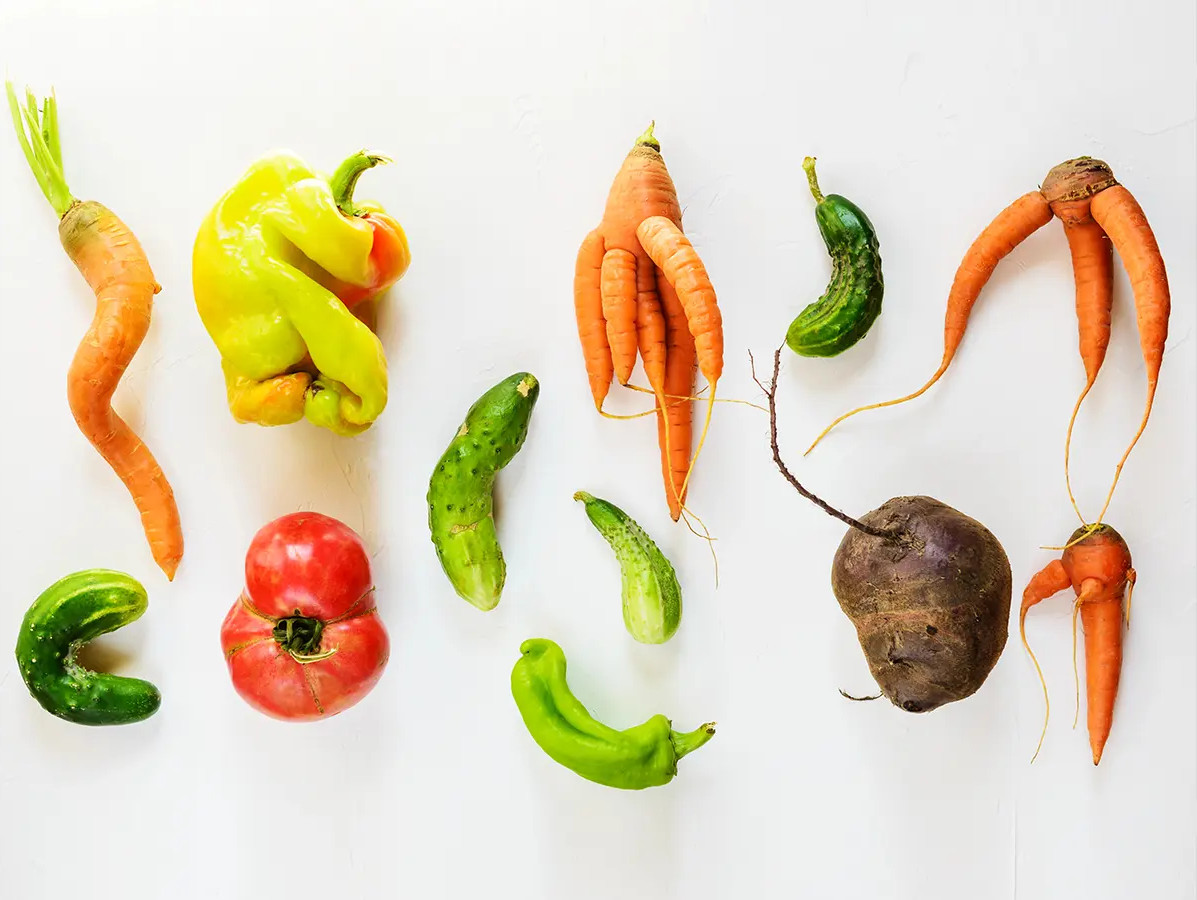
Ugly fruits and vegetables too often disappear from view. Not because consumers refuse them, but because they are barely available on the shelf. When the supply is large enough, shoppers simply take them home. That is the conclusion of research by Professor Ilona de Hooge.
Around one-third of all food waste is linked to aesthetic standards. Products are rejected based on shape or size, even though they are fully edible. “That is a shame and unnecessary. These are perfectly edible products that differ only in shape or size.”
For years, De Hooge has studied how farmers, supermarkets, and consumers deal with imperfect products. Farmers are often willing to sell them but assume supermarkets will not buy them. Supermarkets, in turn, point to consumers, who are said to be unwilling to purchase products that look different. According to De Hooge, consumer research shows otherwise. “If you explain that these products would otherwise be thrown away, more people are willing to buy and eat them.”
To better understand the dynamics, De Hooge fed existing knowledge into a computer model. She simulated scenarios in which 5, 10, 30, or 50 percent of the assortment consists of imperfect products, mixed into the same shelf and offered on a structural basis. At around 10 percent, little changes. Consumers continue to choose the perfect items. The deviating products remain unsold.
From at least 30 percent onward, the picture shifts. Sales initially decline, then recover. “Consumers seem to need time to get used to it. After that, they hardly pay attention and accept that fresh produce simply looks this way.” Presentation is key: “Place imperfect products among the rest. Not on a separate shelf or with a discount label suggesting something is wrong.”
In practice, the situation is less straightforward. “The entire food system is geared toward uniformity.” Transport crates are designed for straight cucumbers. A crate that holds twenty straight ones fits only fifteen curved ones. Processors also rely on machines built for standardized shapes.
Supply is also inconsistent. The same deviations are not available every week. Supermarkets operate with limited shelf space and prefer products with predictable margins. Perfect fruits and vegetables are widely available. As a result, the urgency to change is often lacking.
Source: Wageningen Resource
Magazine Voedingsindustrie has been made possible in part by:



© COPYRIGHT 2026 VOEDINGSINDUSTRIE | ALLE RECHTEN VOORBEHOUDEN
Powered by Wallbrink Crossmedia © 2026