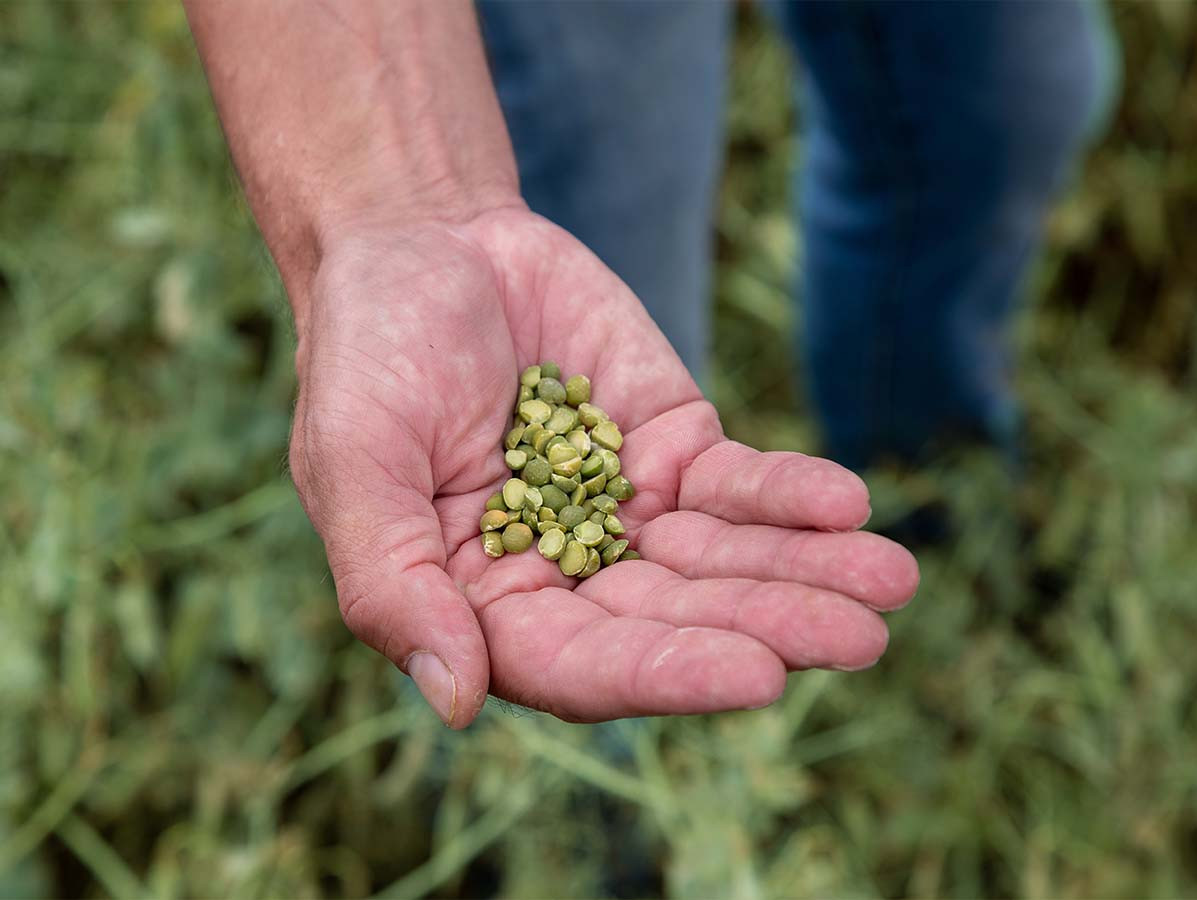
We’ve had to wait fifty years, but it’s back: the traditional Dutch split pea. This year, De Eiwitboeren and HAK have taken the first steps to bring the crop back to Dutch fields. The first harvest is now in, and it’s left them wanting more.
In the 1970s, split pea cultivation moved to North America, where large-scale production could push prices down. Here, it vanished from the landscape. Until now. In March, De Eiwitboeren and HAK sowed ten hectares, spread across the country.
Farmer Lucas Jensema from Groningen took part and looks back with satisfaction. “This year was the first year I grew split peas and it was a valuable learning experience. The weather conditions, a dry, warm spring with the occasional good shower, meant the crops did well. I joined the trial because I enjoy diversifying my crops and because of the sustainable nature of leguminous plants, which makes the split pea a good fit in my crop rotation. This pea doesn’t need nitrogen and even leaves nitrogen in the soil, which benefits the next crop. Besides, we all eat pea soup, but the peas for that soup don’t come from here. That’s a real shame, and it’s fantastic that the traditional Dutch split pea is back in the Netherlands thanks to this trial.”
HAK has been experimenting for some time with growing legumes that usually come from far away. Kidney beans, black beans and white beans have already been successfully cultivated locally. According to De Eiwitboeren chair Henk Janknegt, the next step is to scale up with split peas as well. “My parents still grew split peas in the 1970s. Then production moved en masse to North America. Large-scale farming there meant the Dutch split pea couldn’t compete. That’s still a challenge, but as De Eiwitboeren we believe we can achieve scale here again.”
HAK managing director Nicole Freid highlights the role of legumes in the protein transition. She calls them nutritious, plant-based and an appealing alternative to meat, especially when grown nearby.
The trial fits within the 2023 ‘Bean Deal’, an agreement between the Ministry of LVVN and 56 partners to make the Netherlands less dependent on foreign protein-rich crops.
For now, price remains the main obstacle. Dutch split peas are more expensive than American ones. Increasing production could close that gap, say HAK and De Eiwitboeren, but that will require more players to get involved.
As Janknegt puts it: “We are trying to bring together as many parties as possible to create the scale we need. We therefore call on other market players who sell or process split peas to join us.”
Source: HAK & Eiwitboeren
Magazine Voedingsindustrie has been made possible in part by:



© COPYRIGHT 2026 VOEDINGSINDUSTRIE | ALLE RECHTEN VOORBEHOUDEN
Powered by Wallbrink Crossmedia © 2026