
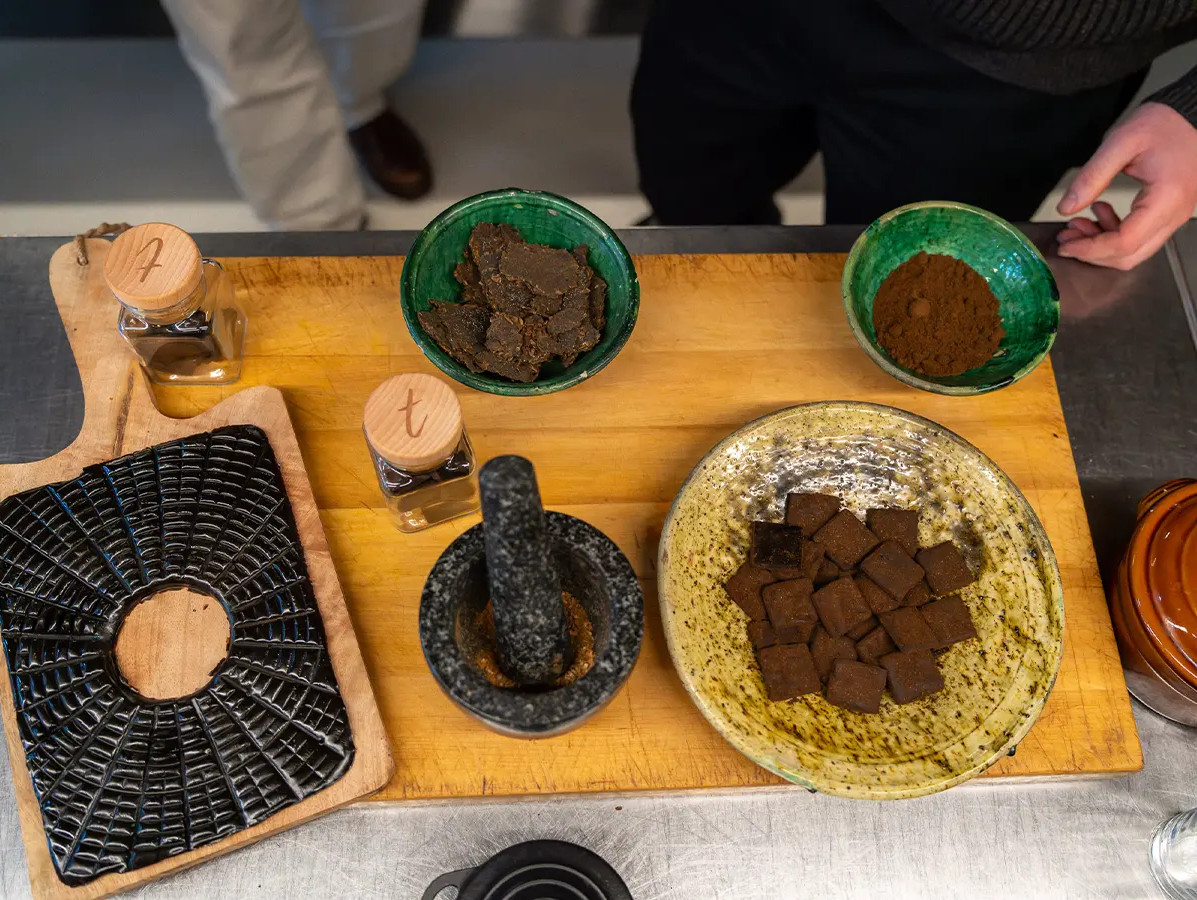
A by-product that usually stays out of sight turns out to be surprisingly versatile. Ten culinary makers were given three months to work with moromi. This is the fermented residue that remains after pressing soy sauce. Their experiments and recipes have been brought together in a publication by Low Food Lab. It shows how this by-product can be applied across a wide range of products, from bread and chips to ice cream and licorice.
Moromi is hardly used as an ingredient in the Netherlands. It is a solid, dark mass with a pronounced aroma. At Tomasu, the Rotterdam-based soy sauce brewery, about five percent is returned to the land for soil improvement. The majority remains unused. This is notable, as moromi is rich in umami, aromatic character, and nutritional value. For Low Food Lab, that was reason enough to place this by-product at the center of a new lab program.
Low Food Lab brings together chefs, bakers, product developers, and researchers. Always around a new or undervalued ingredient. This edition was developed in collaboration with Tomasu Soy Sauce, Food Pioneers, and Stichting SOL. The central question was straightforward: how can this soy sauce by-product be put to use again? Participants examined flavor, structure, and processing, each from their own discipline. Their findings have been documented in a joint publication.
The applications vary widely. Baldo Margiotta replaced salt with moromi and observed that bread dough becomes both more supple and more aromatic. Willem Wolf and Dirk Groeneveld developed licorice in which moromi provides a natural, salmiak-like depth. Friso van Amerongen, Yascha Oosterberg, and Ivana Mik worked on a deep broth using viscozyme and a chestnut–moromi chocolate. Samuel Levie incorporated moromi into tomato sauce, adding a cheese-like umami layer. Kuniyoshi Ohtawara applied it in broth, sushi vinegar, and pickles. Henk Scheele used moromi in chips as a replacement for salt. In addition, vegan anchovies, spice blends, and moromi ice cream were created. Experiments also extended beyond food, including ceramic glaze made from moromi ash.
Source: Low Food Lab
Magazine Voedingsindustrie has been made possible in part by:



© COPYRIGHT 2026 VOEDINGSINDUSTRIE | ALLE RECHTEN VOORBEHOUDEN
Powered by Wallbrink Crossmedia © 2026