
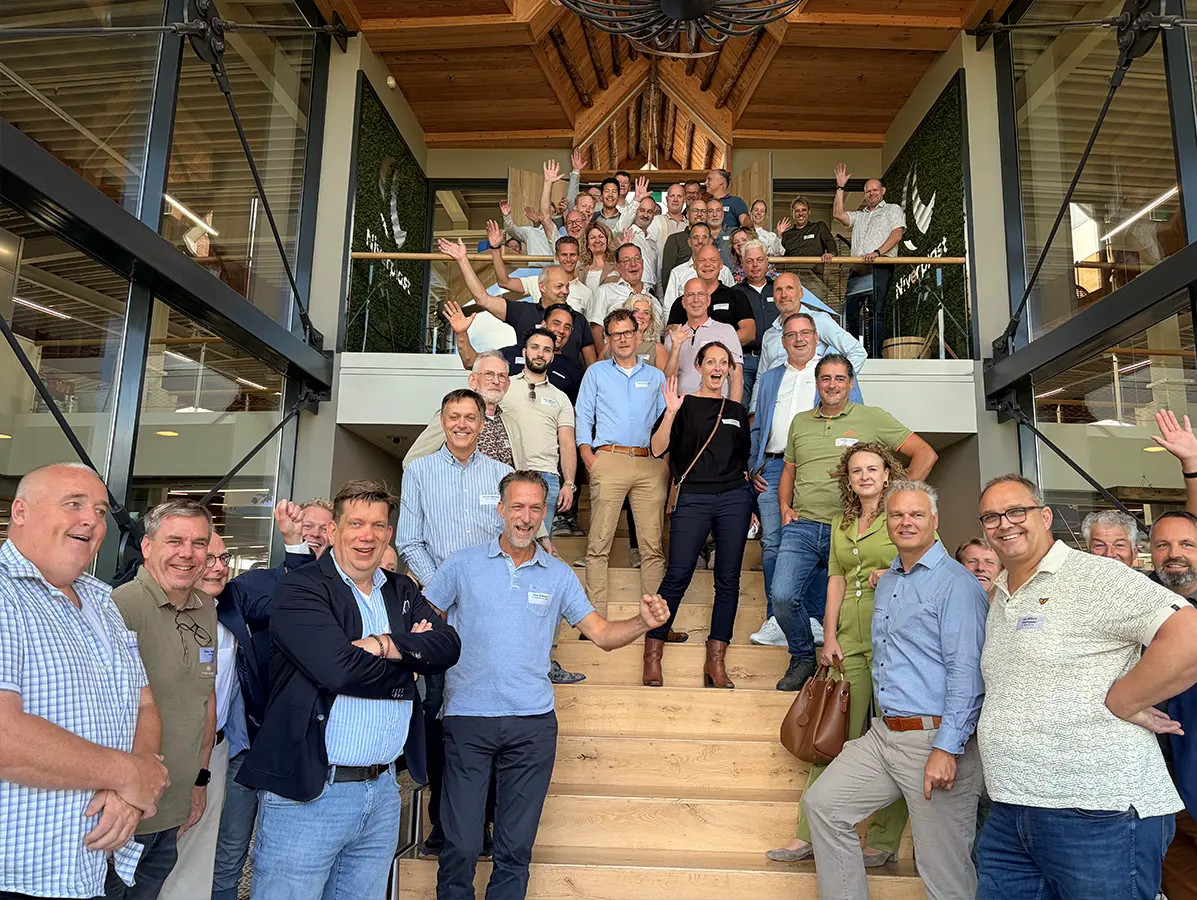
Some company visits stay with you and remain a topic of conversation long afterwards. Our visit to Niverplast on 1 September was one of them. Not just because of the technology or the unusual building. What made the biggest impression was the way the company is organised.
Sixty OSV members joined us in Nijverdal, where we received a warm welcome. From the moment we arrived, there was a friendly atmosphere and plenty going on.
Niverplast started out trading plastic packaging materials and grew by developing machines that automatically place bags into crates. Today, the company develops and builds complete automated packaging lines. Its customers include food manufacturers and logistics companies. But during this visit, the main focus was on the organisation itself. How do you manage more than 300 employees without layers of management? The short answer: you basically don't.
Owner Gerrit Jan Nieuwenhuis shared his story at the foot of the large staircase. A fitting location in a building designed around connection. He originally started the company together with his wife. Today, more than 300 people work across several locations. That growth has not resulted in a traditional management structure. Niverplast operates without the usual hierarchical layers and rigid job descriptions. Employees work in teams and decide on their own roles within those teams. They assess each other, and there are no traditional performance reviews. On paper, it almost sounds too good to be true. During the tour, it became clear that the reality reflects the same approach.
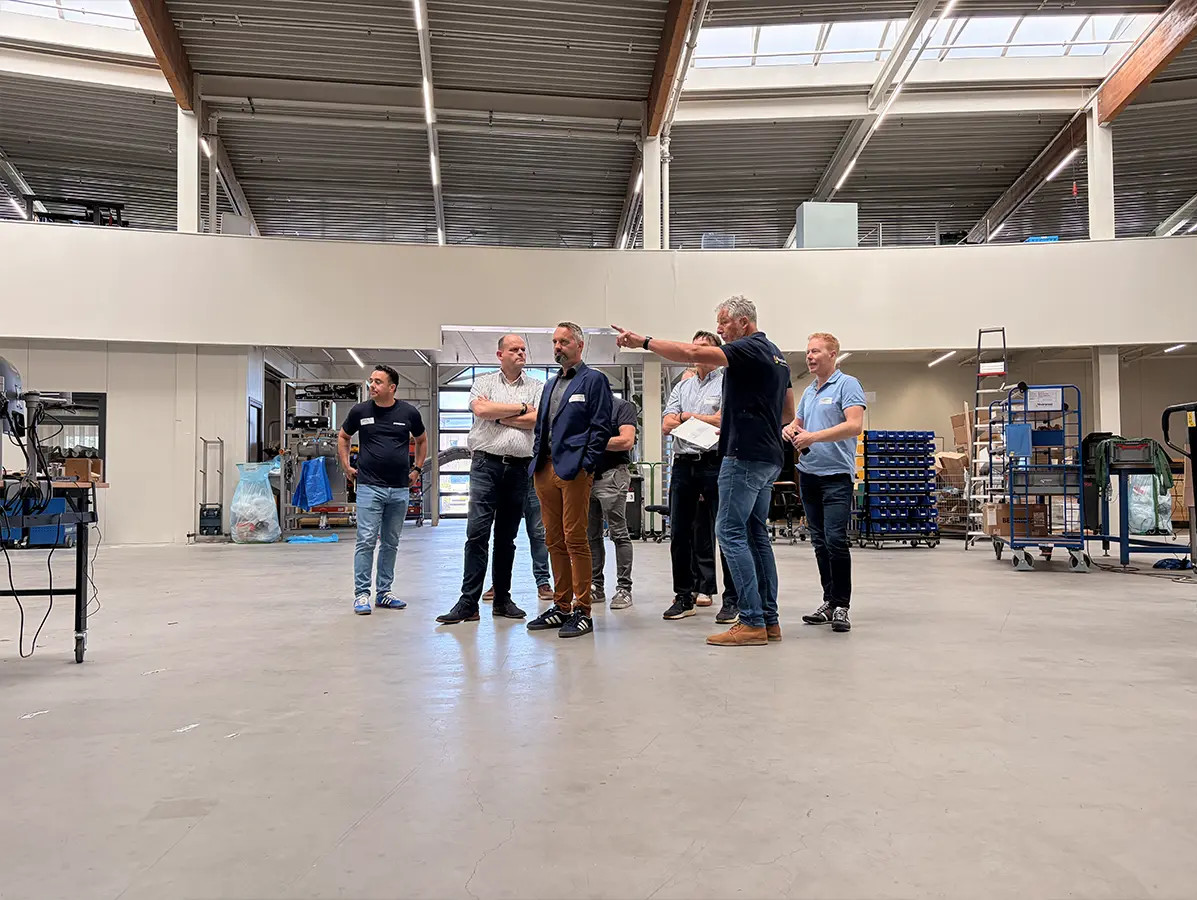
We toured the company in six groups. Each group was shown around by a different employee, although at Niverplast they prefer to refer to everyone as colleagues. Afterwards, it was striking how similar their stories were. Not because they had rehearsed what to say. Quite the opposite: their enthusiasm and involvement came across as completely natural.
Employees are given a great deal of freedom and responsibility. There is no manager constantly looking over their shoulder. Naturally, that requires a strong sense of responsibility. That sense of ownership appears to run deep throughout the organisation. If someone has a good idea, they are given the opportunity to work on it. There is no need to go through several layers of management or committees first. If someone believes something could work, it is investigated or even put into practice straight away. This creates speed, but also leads to innovation.
During the tour, we saw just how direct the lines of communication really are. If someone encounters an issue while building a machine, they simply go and speak to engineering. A hole drilled in the wrong place does not result in a form or a meeting. People find each other and solve the problem together, straight away. That is why technology, engineering, development and production are all located close to one another. Problems are discussed quickly and opportunities are acted on without delay.
A good example is Niverplast's collaboration with Picnic. Niverplast already had a solution for placing bags into crates. For Picnic, the technology had to be adapted to accommodate several open bags in a single crate. That specific requirement was solved technically and the solution was put into operation. Niverplast then immediately looked beyond that one customer. If one online supermarket needs this solution, other companies may well need it too.
This directly connects innovation with entrepreneurship. Development, engineering, construction and installation flow almost seamlessly into one another. The next step is to identify where else the same technology could add value.
Just as striking is Niverplast's appeal as an employer. Many companies struggle to fill technical vacancies. At Niverplast, that does not appear to be an issue.
The company is known in the region as an attractive employer. For some positions, there are even waiting lists of interested candidates. This gives the company the opportunity to be selective. Niverplast deliberately looks beyond qualifications and what is written in an application. During personal interviews, employees try to get to know the person behind the CV. Ultimately, the most important question is whether someone is a good fit for the culture. If it turns out not to be the right fit after all, an appropriate solution is found. If it is a good fit, it is often ‘a job for life’.
The average age at Niverplast is around 36. During our visit, what stood out most was how open the employees were. People spoke enthusiastically about their work and their organisation. No one seemed uncomfortable answering questions from visitors. That enthusiasm may well have made the biggest impression of all.
After all, you can put an organisational structure down on paper. You can list trust as a core value on your website. But ultimately, it is the employees themselves who show whether it really works.
Among the sixty participants were several HR professionals. Unsurprisingly, the visit gave them plenty to talk about.
You cannot simply replicate an organisation without traditional management layers. Particularly in established companies, structures and responsibilities have often developed over many years. Even so, participants saw elements that could potentially be applied within their own organisations.
And that is exactly why we organise our company visits. Not to copy a formula exactly as it is. Instead, the aim is to see how others work, ask questions and take ideas home with us. The reactions afterwards were particularly enthusiastic. About the organisation, the culture, the technology and the building. But above all, about the people who work there. Several visitors even joked that they would quite happily work here themselves. I suppose I can add myself to that list. But I'll stick with my own company for now.
After the tour, we finished the afternoon outside with an excellent barbecue prepared by, indeed, Niverplast's own employees. Fortunately, the weather also played its part. There was plenty of conversation afterwards about everything we had seen and heard.
We received many compliments about the afternoon, and I am happy to pass them on to Niverplast. We made sure that sixty OSV members came to Nijverdal. Niverplast did the rest. And they did it very well.
The bar has been raised a little higher for our next company visits. Above all, we are pleased that so many of our members had the opportunity to see what goes on inside the company. Not just the machines, but the organisation behind them. Technology can be bought and processes can be documented. But you cannot simply create a company culture in which more than 300 people feel a genuine sense of ownership. That is exactly what made this visit so interesting.
Sharing knowledge and sharing connections. That's what we do it for.
Source: ©vakblad Voedingsindustrie
Magazine Voedingsindustrie has been made possible in part by:



© COPYRIGHT 2026 VOEDINGSINDUSTRIE | ALLE RECHTEN VOORBEHOUDEN
Powered by Wallbrink Crossmedia © 2026