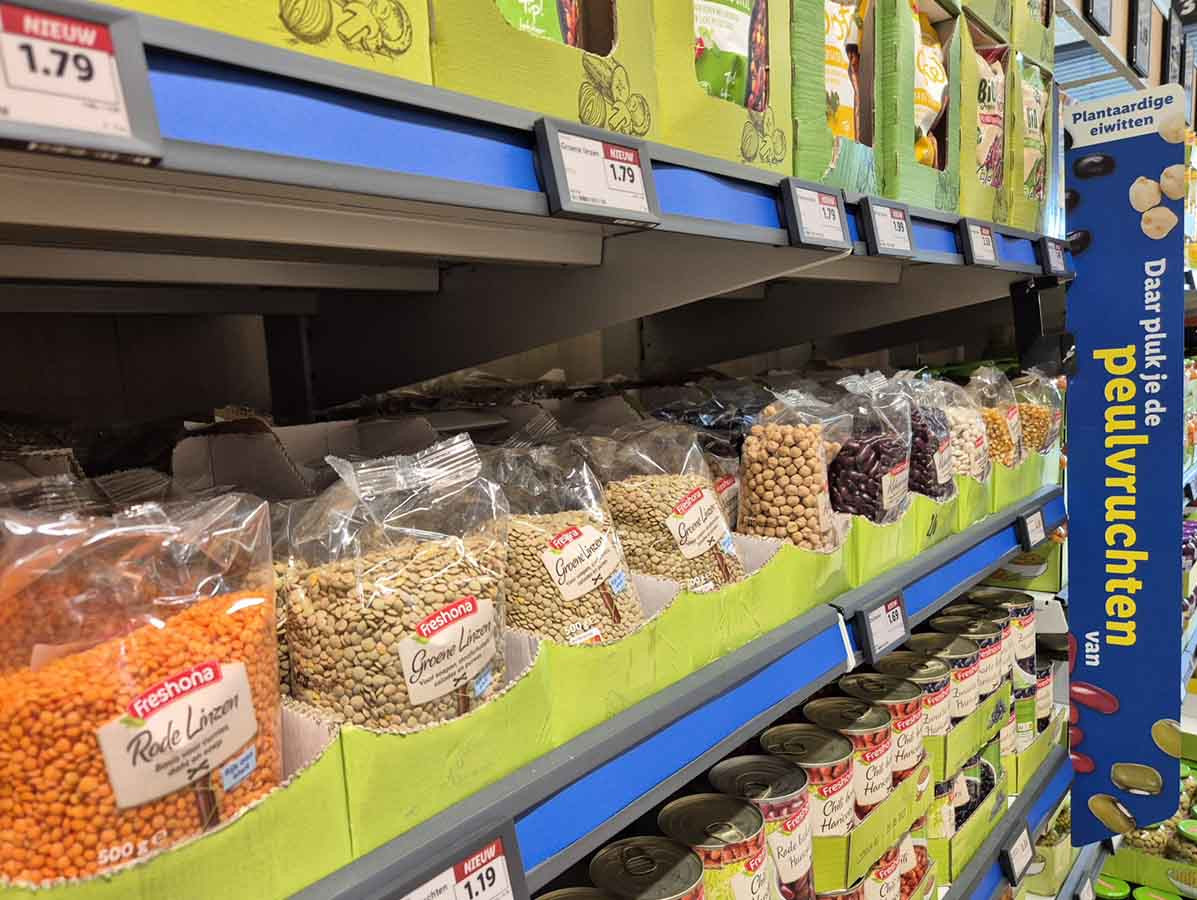
Starting July 21, legumes will take up more shelf space at Lidl. Eleven new products will be introduced, including dried lentils, canned chili beans, and a veggie bowl with red beans, quinoa, and wholegrain rice. With this move, the supermarket aims to support the protein transition. Making healthy choices more accessible, that’s the idea. And the message in-store is clear: Reaping the benefits, one bean at a time.
Legumes are nutritious, sustainable, and high in plant-based protein. They fit into both the ‘Schijf van Vijf’ dietary guidelines and the Planetary Health Diet. Yet consumption remains low: the average Dutch person eats just 49 grams a week. That’s less than half of the recommended 135 grams. Lidl wants to raise awareness by giving the shelf a more prominent role. Think: new recipes on the Lidl website, a bean guide in the online leaflet, special offers, POS materials in-store, a newsletter, and attention on social media. In short, this isn’t a side display, legumes are taking center stage.
This expansion ties in with the guidelines of the Planetary Health Diet, developed by the EAT-Lancet Commission. Less animal-based, more plant-based; that’s the core message. And it’s reflected in Lidl’s own goals. Internationally, the retailer wants to increase sales of plant-based proteins, whole grains, and fruit & vegetables by 20% by 2030 compared to 2023. In the Netherlands, the focus is specifically on proteins: by 2030, 60% of all protein sales should come from plant-based sources. Progress is measured using the EIWEET method.
“Legumes are nutritious, versatile, and sustainable. A small bean with a big impact,” says Niki ten Haaf, Junior Buyer at Lidl Netherlands. “They’re a tasty and nourishing addition to many dishes and perfect for a meat-free day.”
Source: Lidl
Magazine Voedingsindustrie has been made possible in part by:


© COPYRIGHT 2026 VOEDINGSINDUSTRIE | ALLE RECHTEN VOORBEHOUDEN
Powered by Wallbrink Crossmedia © 2026