
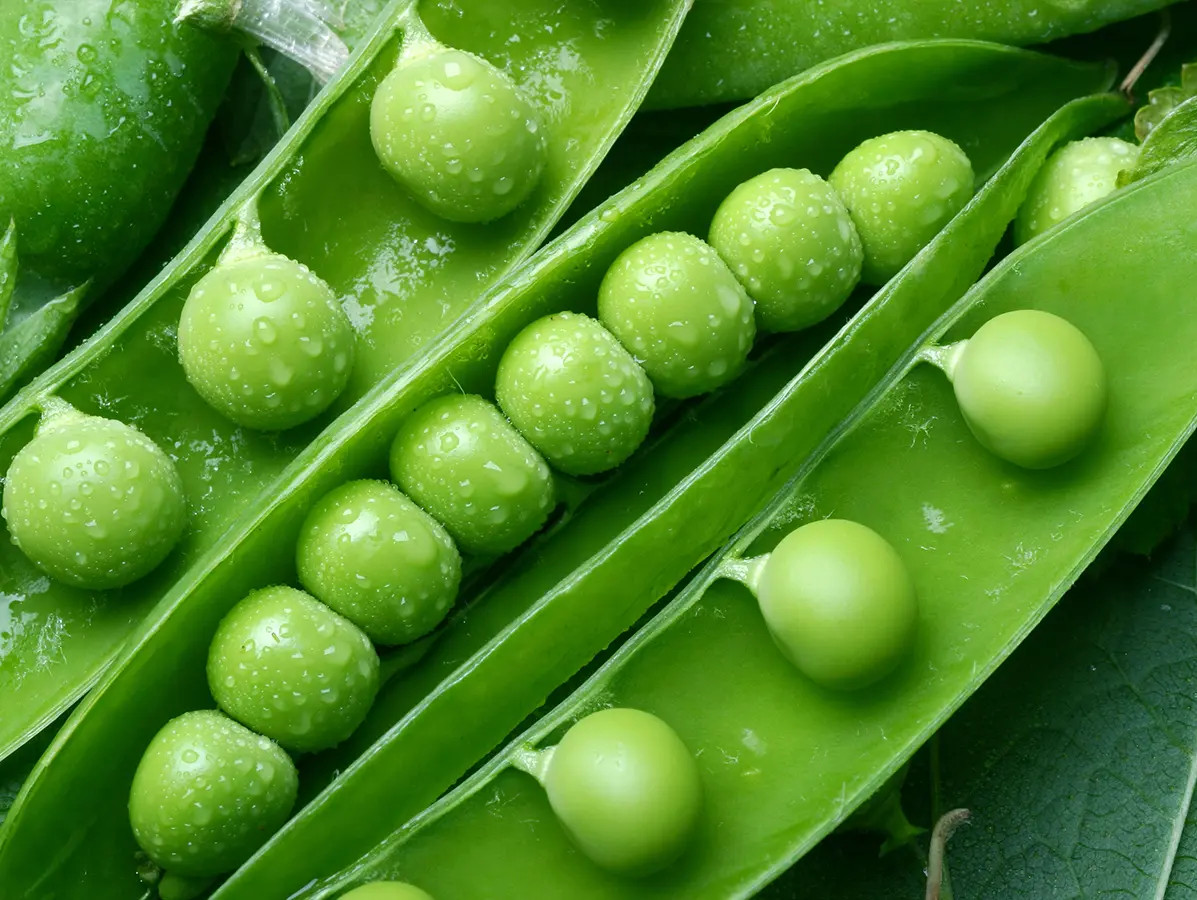
Creating vegan alternatives for meat and dairy is not easy. A major challenge is making common ingredients such as beans and grains taste like something they are not: meat, cheese, or milk. Texture and mouthfeel must also resemble their animal-based counterparts. Wageningen Food & Biobased Research (part of Wageningen University & Research, WUR) is investigating whether it is possible to produce a bean- and pea-based product with fewer off-flavours while maintaining functionality.
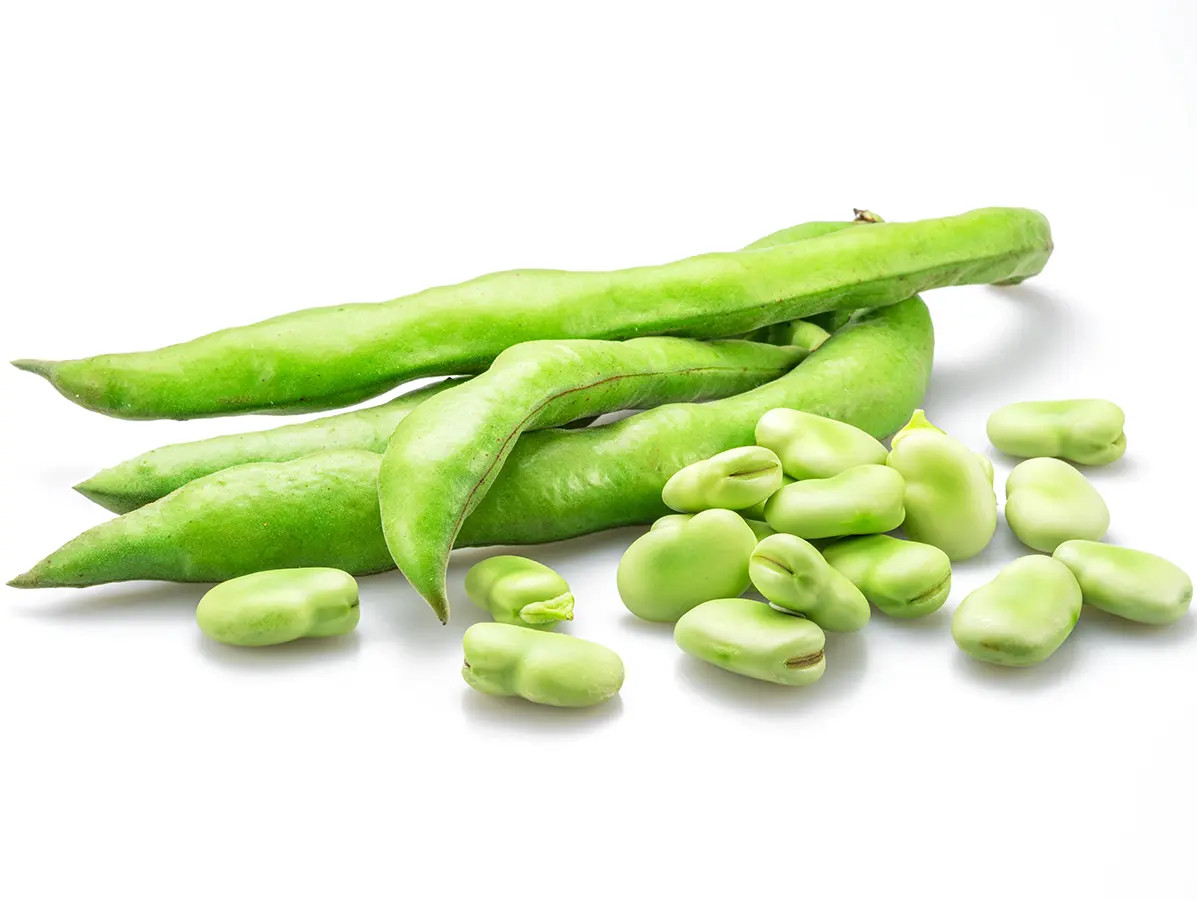
At present, most vegan alternatives are made from soy. For this bean, a complete toolbox has been developed to improve quality and reduce off-flavours. One drawback of soy is that it is an allergen. In addition, most soy is not grown locally, while demand for locally produced products continues to rise. Although there are initiatives around soy cultivation in the Netherlands and more broadly in Western Europe, most soy is still imported. It is therefore worthwhile to investigate whether we can work with crops that have traditionally been grown in the Netherlands, such as peas and fava beans.
The taste of peas and fava beans differs from that of soy, and so do the challenges in using them for meat, cheese, or dairy alternatives. In fact, even peas vary widely. Depending on the variety, there can be significant differences in flavour. Harvest year and soil type add another source of variation: they have a major impact on the final taste. Just like the chosen processing method used to transform the crop into a protein ingredient. Still, there is also a key similarity between all pulses: the off-flavours are comparable across all these beans. Both the volatile components, perceived through the nose and responsible for the beany, earthy taste and grassy, green aroma, and the non-volatile components, perceived in the mouth and responsible for bitterness and an astringent mouthfeel.
The compounds responsible for these off-flavours may be naturally present in the plant. Several bitter compounds occur as secondary metabolites, for example serving as natural pesticides. However, off-flavours can also form during harvesting and/or processing into a protein ingredient. For both volatile and non-volatile components, lipid oxidation plays a crucial role in the formation of off-flavours during processing. Lipid oxidation occurs when oxygen comes into contact with components inside the cell. This happens, for example, when cells are damaged during processing. Oxidation can occur spontaneously (auto-oxidation), but a significant portion of the oxidation is caused by enzymatic reactions.
There are two ways to produce protein ingredients: via dry and wet fractionation. An example of dry fractionation is separation by air (air classification). In this process, the crops are finely milled after defatting, and the particles are then separated in an air stream based on their density. During grinding, the cells break down, but cell components such as starch granules or protein particles generally remain intact. Because of the size difference between starch granules and protein particles, they can be separated. This technique produces protein concentrates with a protein content of 50–65%.
In wet fractionation, a pH precipitation step can be used: the milled crop, again after defatting, is placed in a solution with an alkaline pH (typically around pH 9). Under these conditions, proteins generally dissolve quite well without unfolding (which occurs at even higher pH levels). Once the proteins are dissolved, the solid material is removed. The proteins are then precipitated from the solution by lowering the pH to the isoelectric point of the protein (typically around 5.5 for legume storage proteins). At neutral pH, proteins carry a slight negative charge, causing them to repel each other and remain dispersed (and dissolved) in solution. At the isoelectric point, the protein has no net charge (having an equal number of positively and negatively charged groups). As a result, the proteins no longer repel each other and precipitate. This precipitate is collected, further dried, and used as a protein ingredient.
Wet fractionation uses significantly more energy, water, and chemicals (to adjust pH) than the dry process, making it less sustainable. The large pH shifts can also lead to partial unfolding of the protein. This often results in lower technical functionality (foaming, gelling, emulsifying). However, wet fractionation does yield a highly pure product, typically around 80–90%.
Both wet and dry fractionation result in the formation of different off-flavours. Wet fractionation generally includes a pasteurization step that stops enzymatic activity. The subsequent spray-drying step removes a large portion of the off-flavours through evaporation. These steps are absent in dry fractionation, meaning off-flavours may be more pronounced. However, we expect enzymatic activity—and thus off-flavour formation—in dry-fractionated ingredients to be low, as enzymes require water to function. Dry-fractionated ingredients are therefore sensitive to moisture.
Let’s focus on the use of dry-fractionated ingredients due to their sustainability benefits; after all, this requirement is becoming increasingly important. What can be done about off-flavours? One option is to optimize the crop by breeding varieties with fewer off-flavours, fewer off-flavour precursors, or fewer enzymes that generate off-flavours. Another option is to add additional processing steps to the production process. Soaking, heat treatment, germination, fermentation, solvent extraction of off-flavours, and toasting are all being investigated.
For soy, one of these methods is already applied at industrial scale: toasting the beans to limit enzymatic activity and thereby reduce off-flavours. This technique is not yet used for peas and fava beans. Other heat treatments, however, have been described in literature. The results strongly depend on the exact conditions used, likely because there is a “sweet spot” in the process: you want to stop enzymatic activity, which is best achieved at high temperatures, but at high temperatures, auto-oxidation accelerates, thereby actually reducing quality. And if the heat treatment takes place in water, an additional complication arises: enzymes initially become more active before they unfold (and thus deactivate). During this initial heating phase, additional off-flavours are formed. In addition to this balancing act for off-flavours, there is another important factor to consider: how do you preserve technical functionality (foaming, gelling, emulsifying)? If you treat the proteins in such a way that they unfold, functionality generally decreases. This should be avoided as much as possible, since technical functionality is essential for the final product.
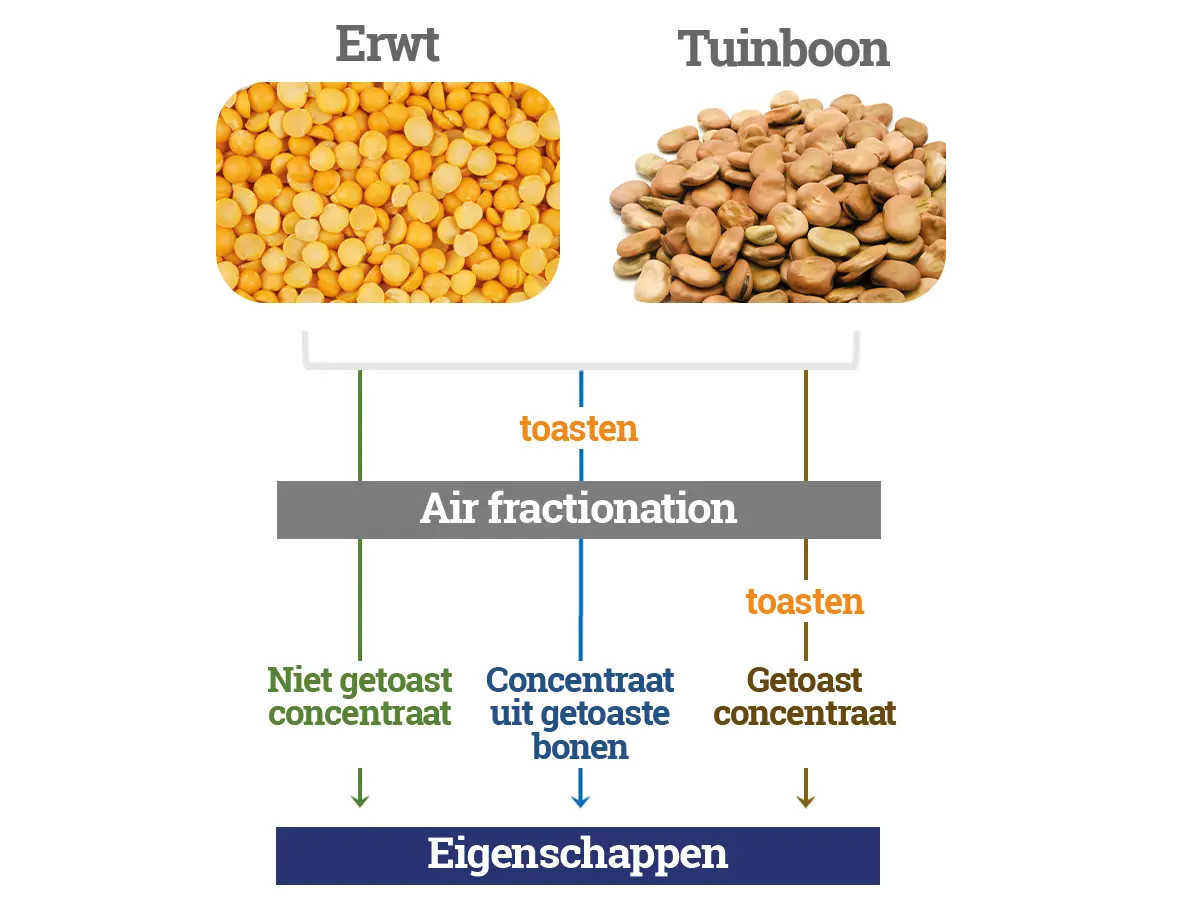
As researchers at WUR, we investigated the toasting of peas and fava beans. Our aim was to create a product with fewer off-flavours without compromising functionality. We produced three samples:
1. Untoasted bean concentrate
2. Beans that were toasted before air classification (“toasted beans”)
3. Concentrate that was toasted after air classification (“toasted concentrate”)
Flavour was assessed using a sensory panel. Furthermore, off-flavours (both volatile and non-volatile) were measured analytically. Technical functionality was evaluated based on color, solubility, and gelling properties, as well as the extent to which the protein unfolded during toasting.
First, the separation process itself. It was slightly less efficient for the toasted beans (2) than for the concentrates (1 and 3). At the same time, the colour of all six samples (three pea, three fava bean) was nearly identical, and there was minimal unfolding of the protein. This may seem surprising: with heat treatment, one would expect proteins to unfold (similar to boiling an egg). However, for proteins to unfold, they require space in the form of water surrounding it. In our samples, the proteins were tightly packed together in a dry state, leaving no room for movement. This is also reflected in the gelling behavior, which was virtually identical across all samples. All positive outcomes, especially since there was a real possibility that functionality would decrease during processing.
The sensory panel observed that the untoasted concentrate (1) closely resembled the toasted concentrate (3), while the concentrate from toasted beans (2) contained significantly fewer off-flavours. The bitterness score was twice as low for the toasted beans (2) compared to the other two samples, the pea flavour was two to three times lower, and the green and raw bean notes were almost absent in the toasted bean sample (2), and so on. These trends were also confirmed by the analysis of both volatile and non-volatile compounds.
In addition to the sensory panel, we conducted analytical measurements focusing on both volatile and non-volatile compounds. For the volatile components, we analyzed two markers of lipid oxidation: hexanal and nonanal. These compounds contribute directly to off-flavours, but more importantly, they indicate that processes are occurring that generate additional and different off-flavours. Hexanal is formed from the oxidation of omega-6 fats, while nonanal originates from the oxidation of omega-9 fats. In the toasted bean sample (2), we found ten to twenty times less hexanal than in the toasted concentrate (3) and the untoasted concentrate (1). The toasted bean sample (2) also contained two to three times less nonanal. This substantial effect helps explain the lower sensory scores for pea, green, and raw bean notes. It also shows that when pea flavour, green notes, or raw bean flavours are perceived (in these types of samples), they are likely linked to lipid oxidation.
For the non-volatile components, we examined both bitter secondary metabolites, that serve, for example, as natural pesticides in the plant, and bitter compounds formed through lipid oxidation. Processing had little effect on the concentration of secondary metabolites. However, compounds formed through lipid oxidation showed a significant difference: the toasted bean sample had much lower concentrations than the other two samples (toasted concentrate and untoasted concentrate). The sensory testing (see above) showed that the toasted beans were far less bitter than samples 1 and 3. The reduction in bitterness must therefore be linked to lipid oxidation.
The difference between toasted beans (2) and the untoasted concentrate (1) can be easily explained: in the former, enzymatic activity has been eliminated, resulting in much less lipid oxidation and therefore fewer off-flavours. It is far more surprising that the toasted concentrate (3) resembles the untoasted sample (1) much more in terms of off-flavours than the toasted beans. We expected enzymes to be inactive during fractionation, since the process takes place under dry conditions. In that case, it should not matter whether the beans are toasted before fractionation (2) or afterward (3). However, we observe that toasting the concentrate has little effect. Two possible explanations come to mind: A) the oxidation has already occurred during dry separation, despite the absence of water, or B) the toasting of the concentrate was insufficient, meaning more intense heating would be required.
In principle, oxidation is not expected in a dry product, making option A unlikely. However, option B also seems unlikely, as experience shows that the toasting conditions are sufficient to deactivate enzymes. This remains an unresolved aspect of the study. What is clear, however, is that toasting beans (sample 2) has a strong positive effect and can significantly reduce off-flavours.
Although not all questions have been answered, we can conclude that toasting peas and fava beans is highly effective in reducing off-flavours. It has minimal impact on technical functionality, which is a key factor in product development. This approach therefore offers strong potential for a broader range of plant-based protein ingredients—and, ultimately, better-tasting plant-based products in the future. Enjoy your meal!
Source: Vakblad Voedingsindustrie 2026
Magazine Voedingsindustrie has been made possible in part by:



© COPYRIGHT 2026 VOEDINGSINDUSTRIE | ALLE RECHTEN VOORBEHOUDEN
Powered by Wallbrink Crossmedia © 2026