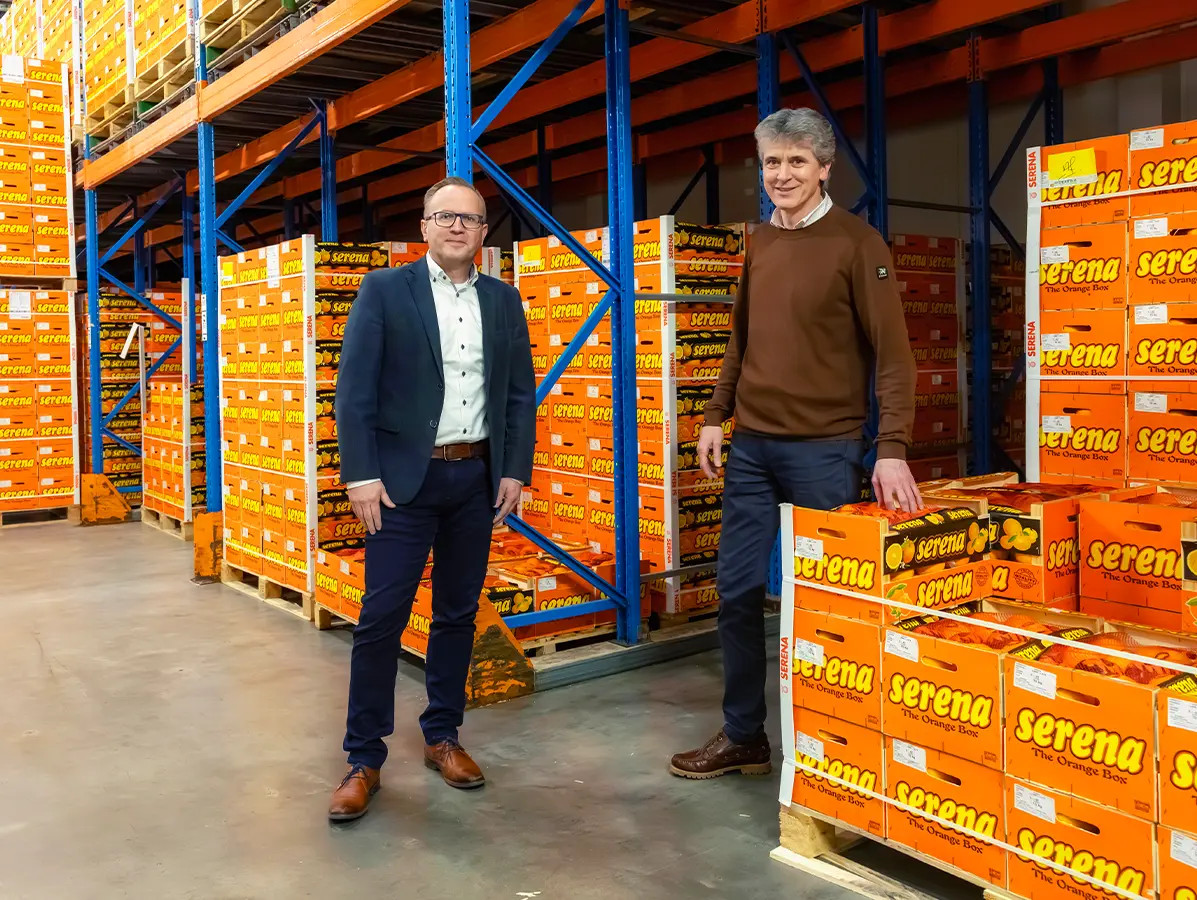
It’s a familiar challenge for many food professionals: combining quality assurance with sustainability goals. How do you save energy without compromising on quality? Frukar, an importer of fruits and vegetables, found the solution with FOPRO® from RBK Group.
Frukar has been active in importing fruits and vegetables since 1990. The company from Barendrecht started with the import of citrus fruits, mainly from Spain. Today, trade knows no borders, and Frukar sources the best fruit, herbs, and vegetables from all over the world. Koenraad Luijendijk, Financial Director, has been with Frukar since 2000. That was also the moment Frukar moved to Barendrecht and RBK Group came into the picture as an advisor for refrigeration systems. It marked the beginning of a strong and productive relationship.
Koenraad: “At Frukar, we understand fruits and vegetables; at RBK, they have the specialists when it comes to refrigeration technology. After more than 20 years, the cooling system was due for replacement. With stricter F-gas regulations and high energy prices, patching up old systems was no longer an option. We were looking for a sustainable and future-proof solution for the long term, without compromising the quality of our fresh produce.”
With this remark, Koenraad refers to a common dilemma: saving often comes at the expense of quality. RBK shows that it can be done differently. Intelligent control technology ensures that quality and sustainability are not opposites, but actually reinforce each other. Theo Vliek, Sales Director at RBK, explains: “In traditional systems, there is usually a direct link between energy consumption and stability. Many installations are constantly shifting, with compressors starting and stopping too frequently. This leads to large pressure differences, energy losses, and a higher risk of failures. Every start-up is a potential failure point. Modern control technology breaks this linear link by actively steering and optimizing. This results not only in lower energy costs, but also in reduced maintenance costs.”
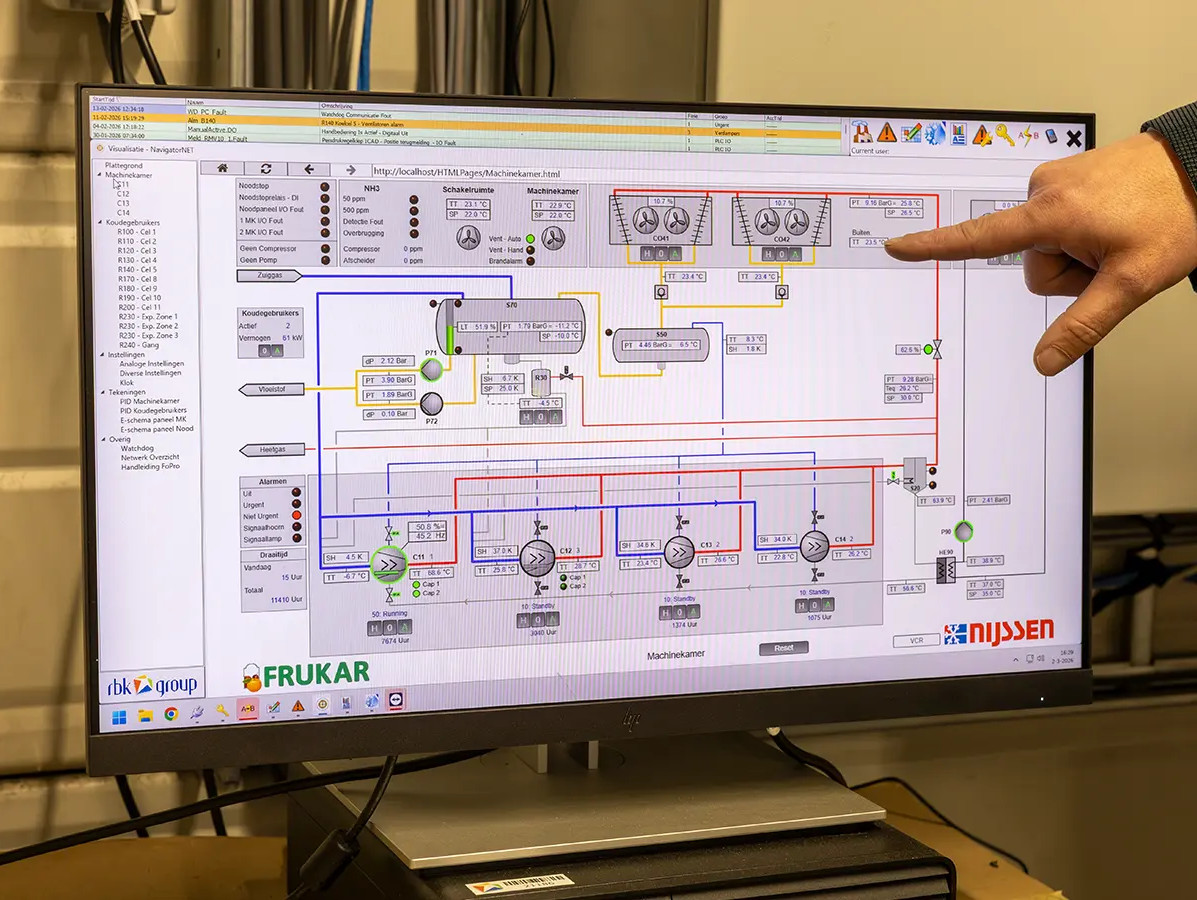
Frukar uses, among other things, the FOPRO® balance control system to manage its refrigeration installations. Supply and demand of cooling are brought into balance, allowing compressor output to better match fluctuating demand. This results in a more stable temperature in the cold storage rooms, less energy waste, and reduced wear and tear. Koenraad mentions energy savings of around 15%, but according to him, that is not the only added value: “Products are constantly coming and going here. Even though the cold storage doors are opened regularly, there is hardly any noticeable change in temperature. Temperature fluctuations have a direct impact on the shelf life of our products. Since installing the new cooling systems, we have seen less product loss.” Whether there is a direct causal relationship is difficult to determine, as quality at the source can vary. Consider weather conditions in the country of origin or conditions during transport. What is clear, however, is that a reliable cooling system combined with smart control maximizes the potential of incoming products and can significantly contribute to reducing energy costs.
With the new installation, Frukar is also prepared for the future in terms of legislation and regulations. “Regulations are increasingly steering toward the use of natural refrigerants,” Theo explains. “Ammonia is an excellent solution in that respect. This classic refrigerant used to be cost-effective only for large distribution centers, but it is becoming financially more attractive. Modern installations require less refrigerant, chemical refrigerants are becoming more expensive, and companies may qualify for EIA if they switch to a natural refrigerant.”
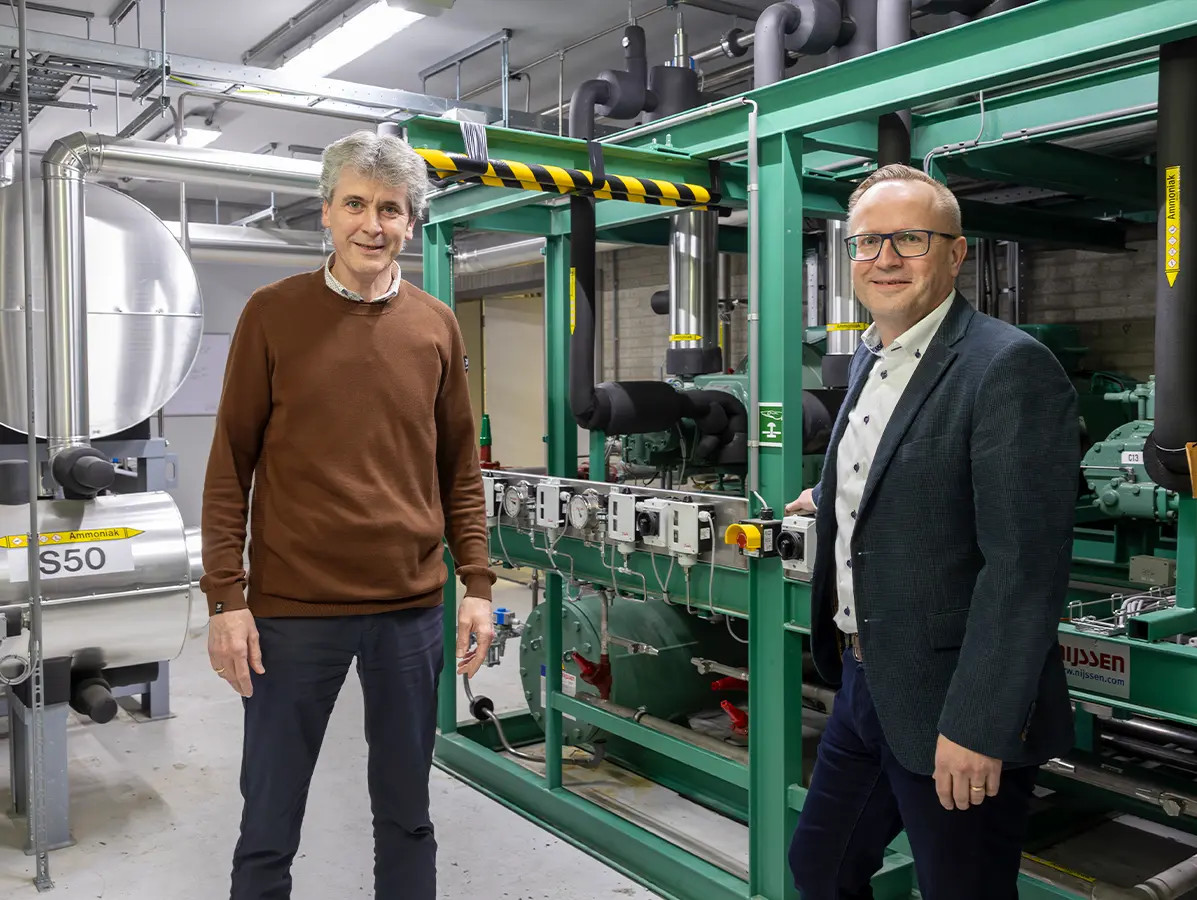
Koenraad Luijendijk (left) and Theo Vliek
“In our advisory process, we take everything into account,” Theo continues. “We use an integrated approach and look at the Total Cost of Ownership. For example, where are the opportunities in terms of waste heat, peak shaving, and the conversion efficiency of solar panels? We bring everything together in a comprehensive specification. Koenraad adds: “Safety has also been carefully considered. The control sections are all located on the roof, and the spaces are equipped with uninterrupted piping systems. This prevents any ammonia emissions in the cold storage rooms, making it safer for both people and products.”
Cooling has been replaced and optimized in all nine cold storage rooms and the conditioned distribution area. Theo describes it as a powerful three-way collaboration between Frukar, RBK, and the installer, in this case Nijssen. “Each of us contributes our own expertise, from blueprint to daily operations. We reinforce each other—not only through knowledge sharing, but also because our software supports the executing party, for example with fault analysis. From our screen, we can often assess what’s going on better than a technician standing next to a rattling machine. As the connecting factor between client and installer, we create an objective truth as the foundation for a high-performance process environment.”
Photos: ©Dennis Wisse
Source: Vakblad Voedingsindustrie 2026
Magazine Voedingsindustrie has been made possible in part by:



© COPYRIGHT 2026 VOEDINGSINDUSTRIE | ALLE RECHTEN VOORBEHOUDEN
Powered by Wallbrink Crossmedia © 2026