
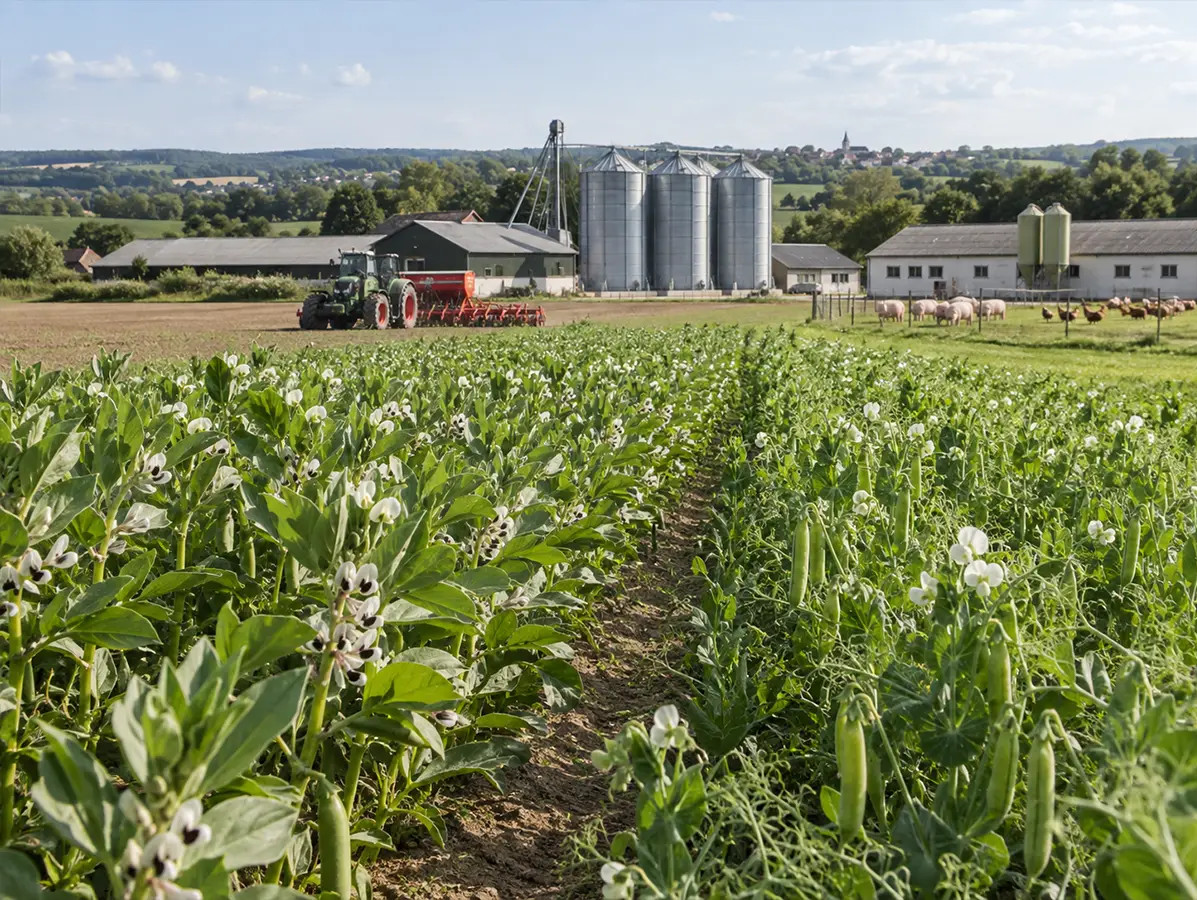
Europe wants to reduce its dependence on imported soy. Expanding the cultivation of legumes appears to be a logical solution. However, new research shows that achieving self-sufficiency remains difficult. Economic incentives and changes in consumption patterns ultimately have the greatest influence on the outcome.
Researchers analysed three pathways towards 2030. They examined trade restrictions, agricultural support and changing dietary patterns. To do so, they combined economic models, farm-level analyses and life cycle assessments. The study covers the European Union and the United Kingdom.
Europe imports around 95 percent of its soy. Pig and poultry production in particular relies heavily on concentrated, protein-rich feed. A complete ban on imports would therefore provide a strong boost to European production. The area used to grow legumes would increase by several million hectares.
Even so, Europe would not be able to fully replace the lost imports. In this scenario, the price of soy would rise by 150 percent. The use of soy in animal feed would subsequently fall by half. European livestock production would decline by around 2 to 3 percent. As a result, imports of poultry meat in particular would increase sharply.
Targeted support would have a less disruptive effect on the market. A payment per hectare would make legumes economically attractive to a larger number of farms. For Germany, the calculations were based on a payment of €110 per hectare. This would encourage farms to include field beans, peas or soy more frequently in their crop rotations.
The third pathway assumes an 11 percent reduction in protein from meat, replaced by plant-based protein sources. As a result, European imports of legumes would more than double. At the same time, global greenhouse gas emissions would fall significantly.
According to the researchers, this demand-driven change would deliver the greatest climate benefit worldwide. Lower meat consumption would reduce emissions by 18.8 million tonnes of CO₂ equivalent. By comparison, an import ban would reduce global emissions by just 2.9 million tonnes.
The study therefore shows that European protein production can increase. However, achieving full self-sufficiency would require substantial amounts of land and significant price adjustments. A combination of agricultural policy, economic incentives and changing consumption patterns offers greater potential.
Read the entire article on www.nature.com
Source: vakblad Voedingsindustrie 2026
Magazine Voedingsindustrie has been made possible in part by:



© COPYRIGHT 2026 VOEDINGSINDUSTRIE | ALLE RECHTEN VOORBEHOUDEN
Powered by Wallbrink Crossmedia © 2026