
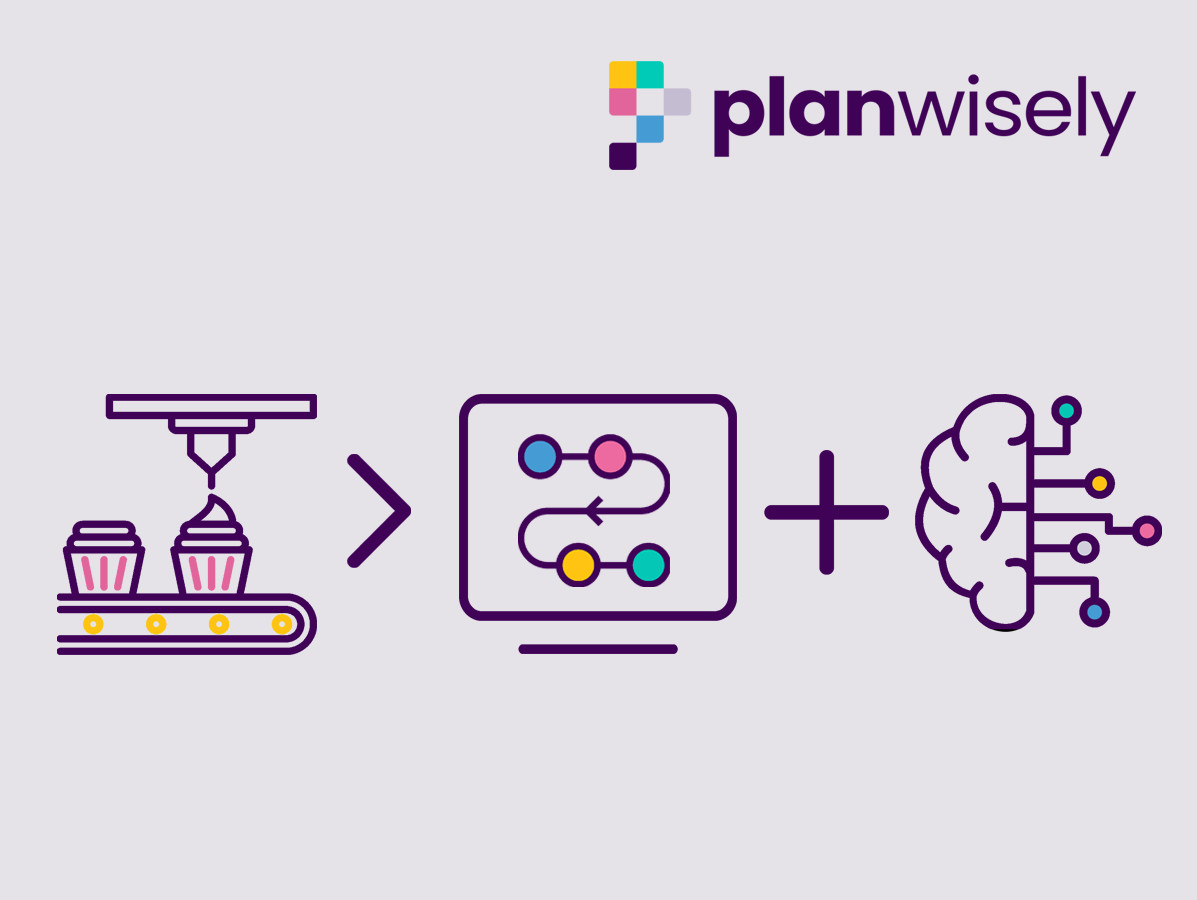
Creating an optimal and robust production plan is becoming increasingly complex. With a digital twin combined with AI, you can make that complexity manageable—and even turn it into an advantage. This is the central theme of Planwisely’s upcoming webinar. Instead of relying on assumptions, you work with data-driven scenarios that are continuously optimized.
A digital twin is a digital representation of your factory or production process. It is fed with real-time data, such as machine performance, lead times, and inventory levels. In this virtual environment, you can analyze and adjust processes without putting operations at risk. The key benefit: you test decisions digitally before implementing them in practice.
Production planning involves countless variables: machines, product variants, changeover times, delivery times, and customer agreements. Together, these factors create an enormous number of possible schedules. For humans, it is nearly impossible to quickly identify the best option—especially when unexpected changes occur.
AI provides a solution here. By simulating and comparing thousands of scenarios, AI rapidly selects the most optimal plan. It does not focus on a single objective, but balances multiple KPIs at once, such as cost, lead time, and waste. In addition, AI can handle uncertainties—such as disruptions or fluctuations in demand—and continuously adjusts plans based on new data.
Using the Digital Twin, AI rapidly simulates countless planning options and evaluates them based on KPIs such as delivery reliability and efficiency. The result is an optimal proposal based on the available data.
Because real-life operations on the shop floor do not always go as planned—think unexpected delays or human preferences—the planner always remains in control. The system makes it easy to fine-tune details manually. You immediately see the impact of your changes on the objectives. AI handles the heavy calculations, giving planners the space to manage exceptions.
Companies working with a digital twin and AI often see immediate improvements:
Even small optimizations can have a significant impact on areas such as profitability and sustainability. Think of better rescheduling of rush orders, responding more flexibly to downtime, and achieving higher capacity utilization.
With a digital twin and AI, production planning changes fundamentally. Instead of planning reactively, you work proactively and in a data-driven way. You no longer settle for a “good” plan, but choose the best possible option at any given moment.
After generating an optimized plan, Planwisely replays it under dozens of realistic, probabilistic disruption scenarios, such as sudden machine failures or delays in material supply. By simulating these events, we measure exactly how sensitive a plan is to operational uncertainty. This gives planners a fundamentally stronger basis for decision-making. We transform robustness from an abstract concept into a measurable property of the plan, based on operational risk.
Would you like to take your production planning to the next level? In this webinar on Thursday, June 4, Planwisely shows how a Digital Twin combined with AI can significantly improve your planning.
Practical information:
Sign up and see how you can future-proof your production planning!
Source: Planwisely
Magazine Voedingsindustrie has been made possible in part by:



© COPYRIGHT 2026 VOEDINGSINDUSTRIE | ALLE RECHTEN VOORBEHOUDEN
Powered by Wallbrink Crossmedia © 2026