
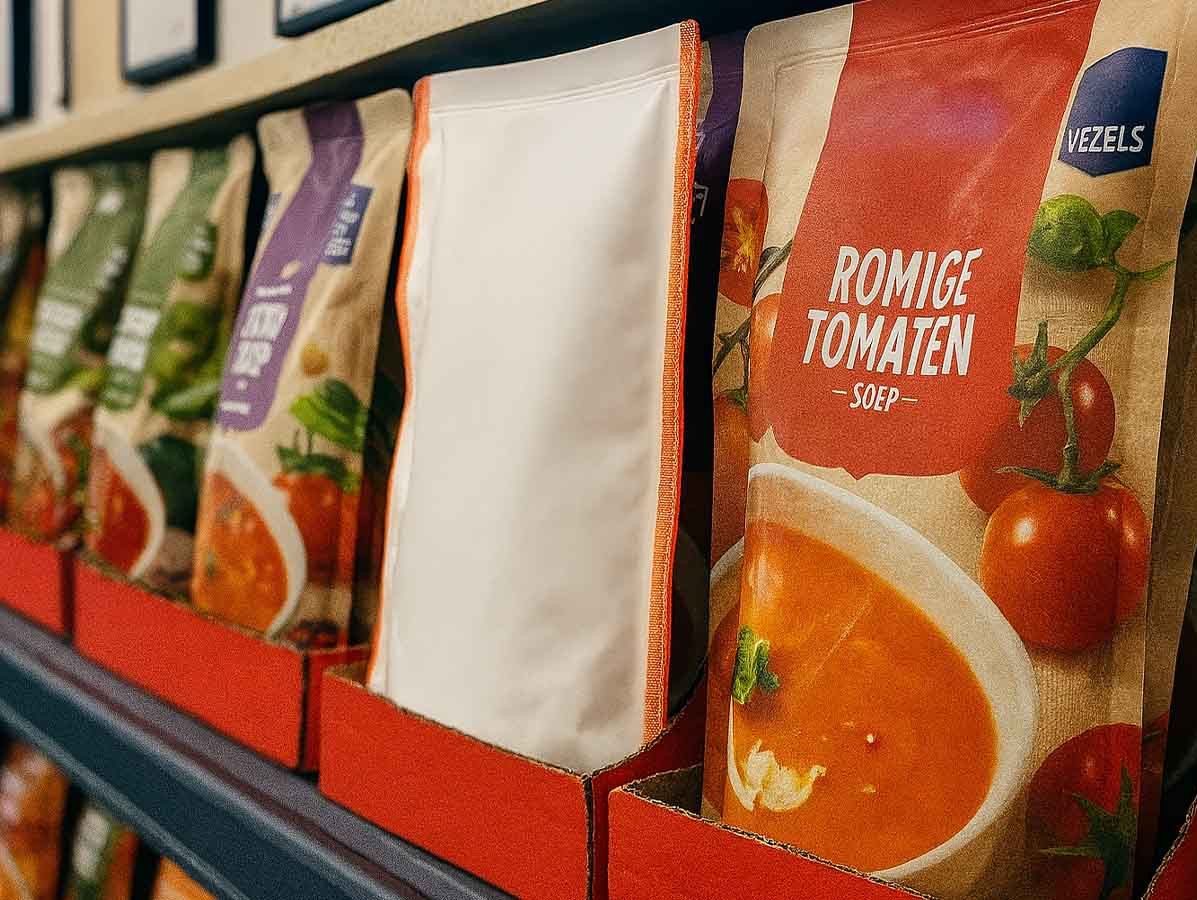
Selling soup often means dealing with complex packaging. Not because of its shape, but because of the materials involved. Multiple layers of plastic, aluminium and foil—necessary for flavour, shelf life and sterilisation. But nearly impossible to recycle. That’s exactly what TNO Brightlands Materials Center, together with several partners, aims to change. And they’ve already made significant progress.
Polypropylene (PP) forms the base of the new packaging. No more mixed layers, just one type of plastic. Yet it still meets all the requirements: long shelf life, printable surface, and able to withstand heat up to 130°C.
The packaging was developed together with Sabic, Oerlemans Plastics B.V., Four Seasons Food B.V., Greenyard Prepared Belgium, Hogeschool Zuyd and Plato product consultants. Over 2,000 units have been tested on commercial filling lines. The outcome? Flavour and aroma held up well, the pouch remained intact, and sealing went smoothly.
That said, there are still a few challenges. Drop resistance is currently lower than that of existing soup pouches. And that’s something A-brands take seriously.
Recycling isn’t fully sorted yet either. The pouch meets the RecyClass guidelines, uses approved barrier layers and can be detected by infrared systems. However... not all sorting facilities can properly separate PP from other flexible plastics like PE. System upgrades are needed—and those are expected within two to five years.
A life cycle analysis shows the new pouch has a 41 to 53% lower CO₂ footprint compared to traditional versions. That’s a significant cut. On the flip side, costs are slightly higher due to extra lamination steps. That’s why the development team is now working on simplifying the structure to reduce production costs.
In short, the circular soup pouch is making solid progress. But it’s not quite there yet. TNO and its partners are actively looking for companies willing to think along and help bring it to market.
Source: TNO
Magazine Voedingsindustrie has been made possible in part by:



© COPYRIGHT 2026 VOEDINGSINDUSTRIE | ALLE RECHTEN VOORBEHOUDEN
Powered by Wallbrink Crossmedia © 2026