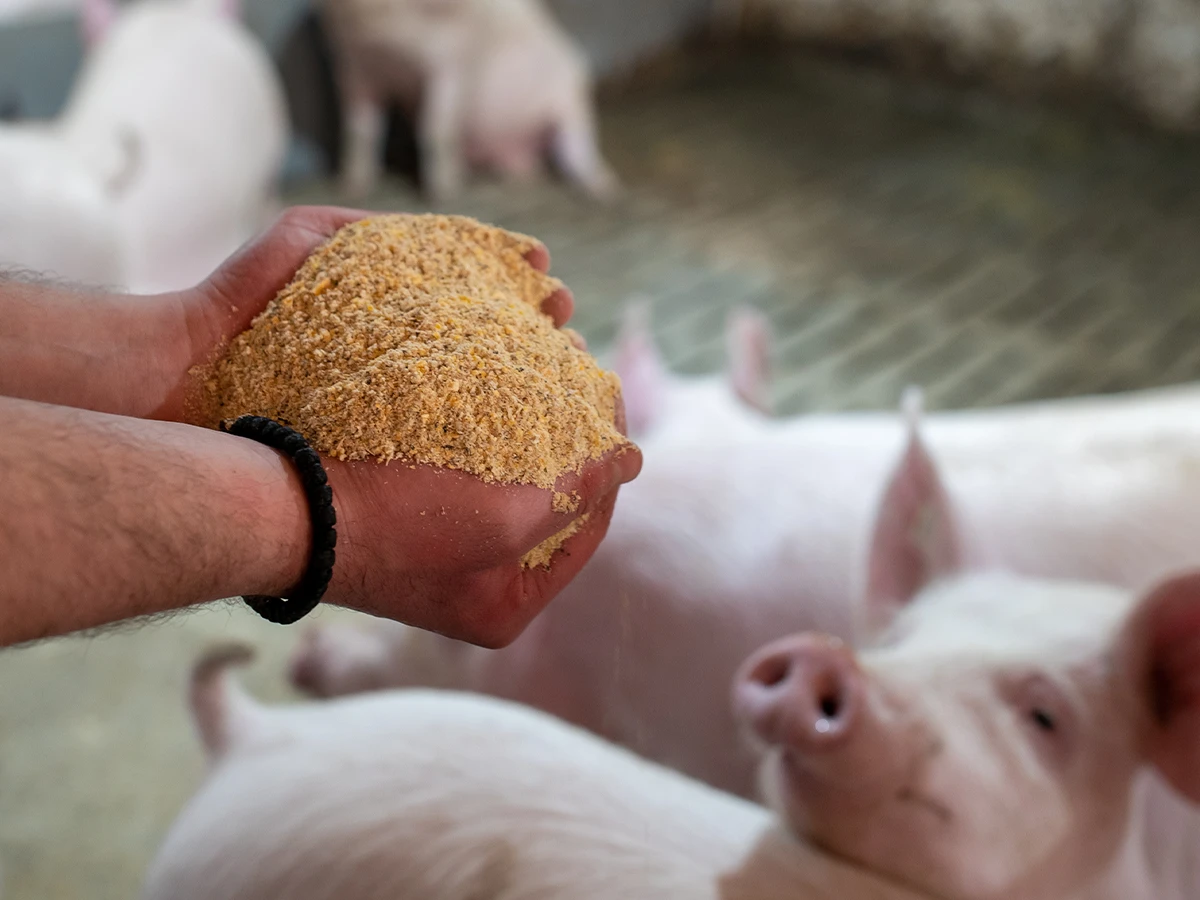
Side streams from the food industry can regain value as animal feed. This retains nutrients that would otherwise leave the food chain. But does using more circular feed also reduce climate impact? That depends in part on the animal and the feed composition. A letter to Parliament on sustainable animal feed outlines the opportunities and conditions for wider use.
Research examining different scenarios assesses the climate impact of circular pig and poultry feed. According to the study, the proportion of circular raw materials could increase substantially. However, this does not automatically reduce emissions.
For poultry, total greenhouse gas emissions decrease in the scenarios studied. This is mainly due to lower emissions from feed production and land-use change. For pigs, lower digestibility leads to higher methane and nitrous oxide emissions from manure. As a result, total greenhouse gas emissions increase in the scenarios studied. Removing manure from animal housing promptly could help limit this effect. The manure must then be treated or processed through anaerobic digestion.
The Ministry of Agriculture, Fisheries, Food Security and Nature (LVVN) supports research and pilot projects on new applications. It also advocates a gradual expansion of permitted uses under European regulations. Researchers first assess new applications for safety, nutritional value, and practical feasibility. Food safety and traceability remain the key prerequisites for any expansion.
Supply chain partners are working within the Kennishub Circulaire Dierlijke Eiwitketen to increase the use of side streams. Around fifteen practical case studies and knowledge development projects have been carried out over the past three years. The ministry is assessing whether the knowledge hub can continue in 2027.
Lidl and FeedValid are investigating how to process unsold food into liquid feed for pigs. The products come from ten stores in the supermarket chain. The pilot covers safe separation, transportation, and processing. Laboratory testing assesses the feed’s safety and nutritional values.
The Netherlands Food and Consumer Product Safety Authority (NVWA) is involved in ensuring a safe process. The aim is to develop a validated blueprint that supermarkets can adopt nationwide if successful. At Lidl alone, this could prevent an estimated ten million kilograms of food waste.
Source: Tweede Kamer
Magazine Voedingsindustrie has been made possible in part by:


© COPYRIGHT 2026 VOEDINGSINDUSTRIE | ALLE RECHTEN VOORBEHOUDEN
Powered by Wallbrink Crossmedia © 2026