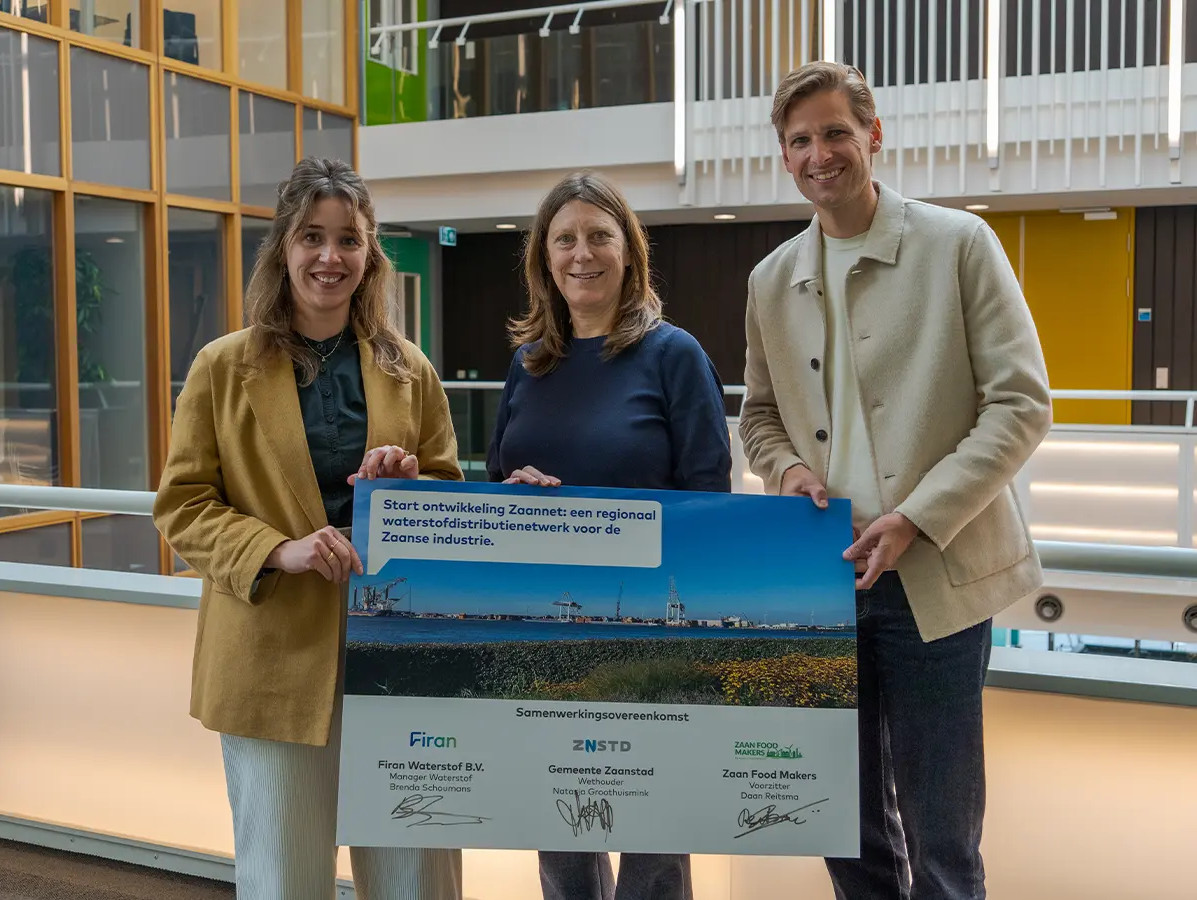
The food industry in the Zaan region is investigating the development of a regional hydrogen network. The initiative is intended to support further sustainability efforts across the sector. Four parties have signed a cooperation agreement for the project. Zaan Food Makers, Firan Waterstof, Eneco and the municipality of Zaanstad are jointly assessing the feasibility of the Zaannet project. The plans focus on companies located at HoogTij, Westerspoor and Zuiderhout.
The Zaan region is one of the leading food industry clusters in the Netherlands and Europe. Zaan Food Makers represents sixteen international manufacturing companies in the region. Many companies are dealing with challenges related to sustainability and energy supply. According to the parties involved, full electrification does not always provide sufficient solutions. Hydrogen could therefore play an important role in industrial processes.
“For many of our companies, this is no longer a question for the future, but a question for today,” says Daan Reitsma of Zaan Food Makers. “Without new energy infrastructure, further sustainability progress will stall.”
The parties are examining the affordability of the network, among other things. They are also looking at safety and how the infrastructure can be integrated into public spaces. Firan Waterstof is taking a leading role in the project due to its experience with regional hydrogen infrastructure.
Zaannet ties in with developments across the North Sea Canal Area. Part of the design includes a connection to the hydrogen network in the Port of Amsterdam area, known as the H2avennet project. The Port of Amsterdam is focusing on the import and production of hydrogen for the region and beyond. This could allow Zaannet to become part of the regional hydrogen supply chain.
According to alderwoman Natasja Groothuismink, industry currently accounts for around 80 percent of all energy consumption in Zaanstad. “If fossil fuels are no longer needed for that, we will take a major step toward making our economy more sustainable and future-proof.”
In the coming period, the parties will work on a preliminary design and feasibility studies. By the end of 2026, it should become clear whether the next steps toward detailed design and implementation will move forward.
Source: Zaan Food Makers
Magazine Voedingsindustrie has been made possible in part by:


© COPYRIGHT 2026 VOEDINGSINDUSTRIE | ALLE RECHTEN VOORBEHOUDEN
Powered by Wallbrink Crossmedia © 2026