
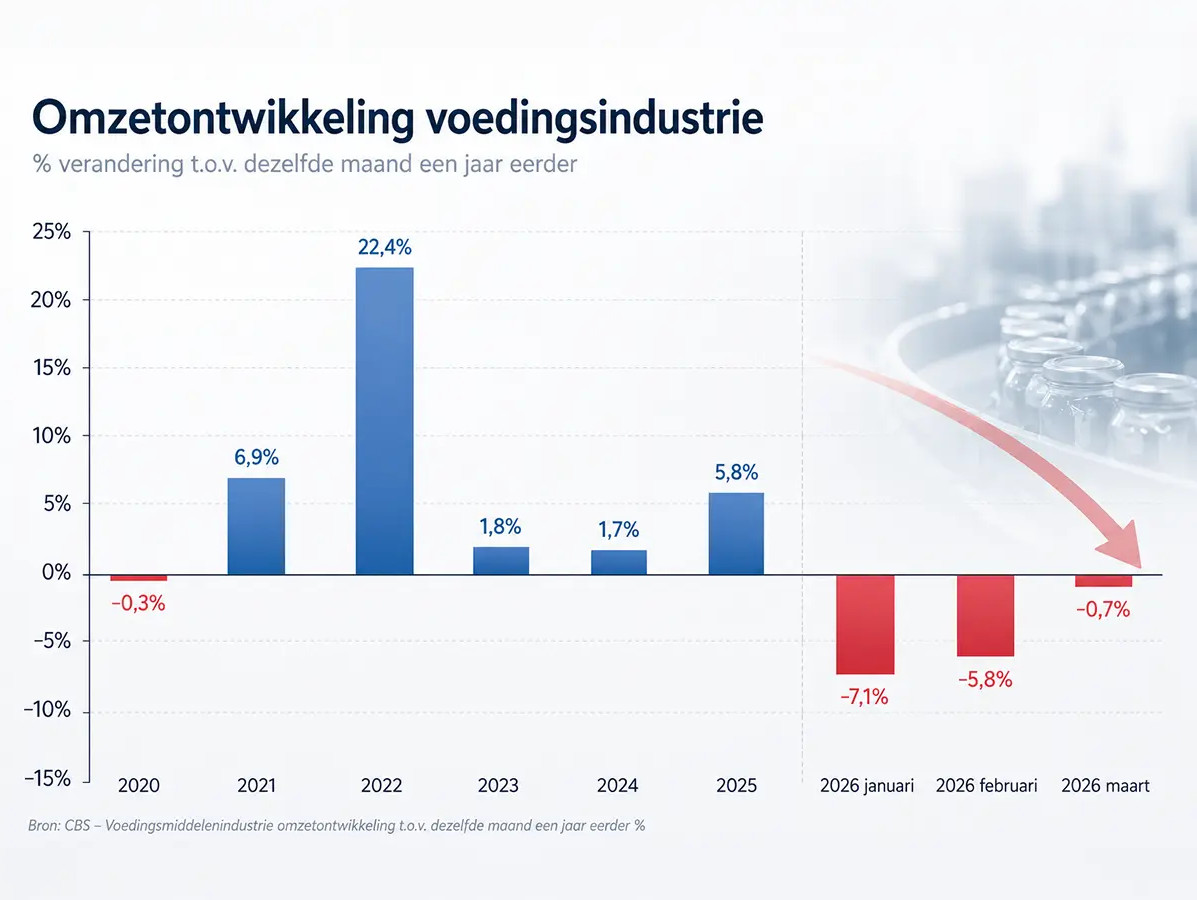
The food industry began 2026 with a major setback. After a year in which the market had already become increasingly unsettled, the first months of the year immediately show negative figures. In January, turnover in the food industry fell by 7.1 percent compared to the same month a year earlier. February (-5.8 percent) and March (-0.7 percent) also ended in negative territory. Demand declined in both the domestic market and exports.
At the beginning of 2025, the sector was still performing remarkably well. In January, turnover increased by 12.3 percent. February and March also posted solid gains of 8.4 and 6.8 percent respectively. Demand from abroad in particular remained strong at the time. In April, turnover growth even reached 11.8 percent, while export turnover rose by more than 15 percent. The sector appeared to be heading into the year with strong momentum.
But somewhere along the way, that momentum started to fade. During the summer months, demand weakened and growth continued to slow. By August, turnover growth had dropped to just 2.2 percent.
Toward the end of 2025, sentiment continued to deteriorate. In November, the sector recorded a 2.5 percent decline in turnover, mainly due to weak performance in the domestic market. The negative figures at the start of 2026 therefore fit into a broader trend of slowing turnover growth throughout 2025.
The volatile turnover trend is largely tied to movements in producer prices. In 2025, average selling prices in the food industry still increased by 2.9 percent overall. At the start of 2026, however, the picture changed completely. In January, producer prices were 4.7 percent lower than a year earlier, followed by declines of 5.6 percent in February and as much as 5.9 percent in March.
Not every sector was hit equally hard. The strongest price increase in 2025 came from the so-called other food products industry, including confectionery, ready meals and spices. Selling prices in this segment rose by 6.7 percent. Prices also increased in the dairy industry (+4.1 percent), fish processing industry (+3.9 percent) and meat industry (+2 percent).
At the same time, other sectors came under pressure. In the flour industry, selling prices fell by 4.2 percent in 2025. The fruit and vegetable processing industry also recorded a slight price decline of 0.6 percent.
That downward trend continued into early 2026. Producers of other food products in particular faced significant price pressure. In March, prices in this sector were 11.5 percent lower than a year earlier. Price declines in the dairy industry also accelerated sharply, reaching more than 9 percent. In March, the fruit and vegetable processing industry came in roughly 5 percent lower than a year earlier.
At the same time, concerns among business owners are increasing. Business confidence fell to -14.8 at the beginning of April — the sharpest decline since early 2022. Confidence within the industry also remains negative (-10.9). Companies are especially concerned about the economic climate. Geopolitical tensions and unclear legislation and regulations are adding to that uncertainty. Labor shortages are still a factor, although a smaller share of companies now see this as their biggest challenge. Concerns are shifting more toward weakening demand and uncertainty in the market.
Source: Vakblad Voedingsindustrie 2026
Magazine Voedingsindustrie has been made possible in part by:



© COPYRIGHT 2026 VOEDINGSINDUSTRIE | ALLE RECHTEN VOORBEHOUDEN
Powered by Wallbrink Crossmedia © 2026