
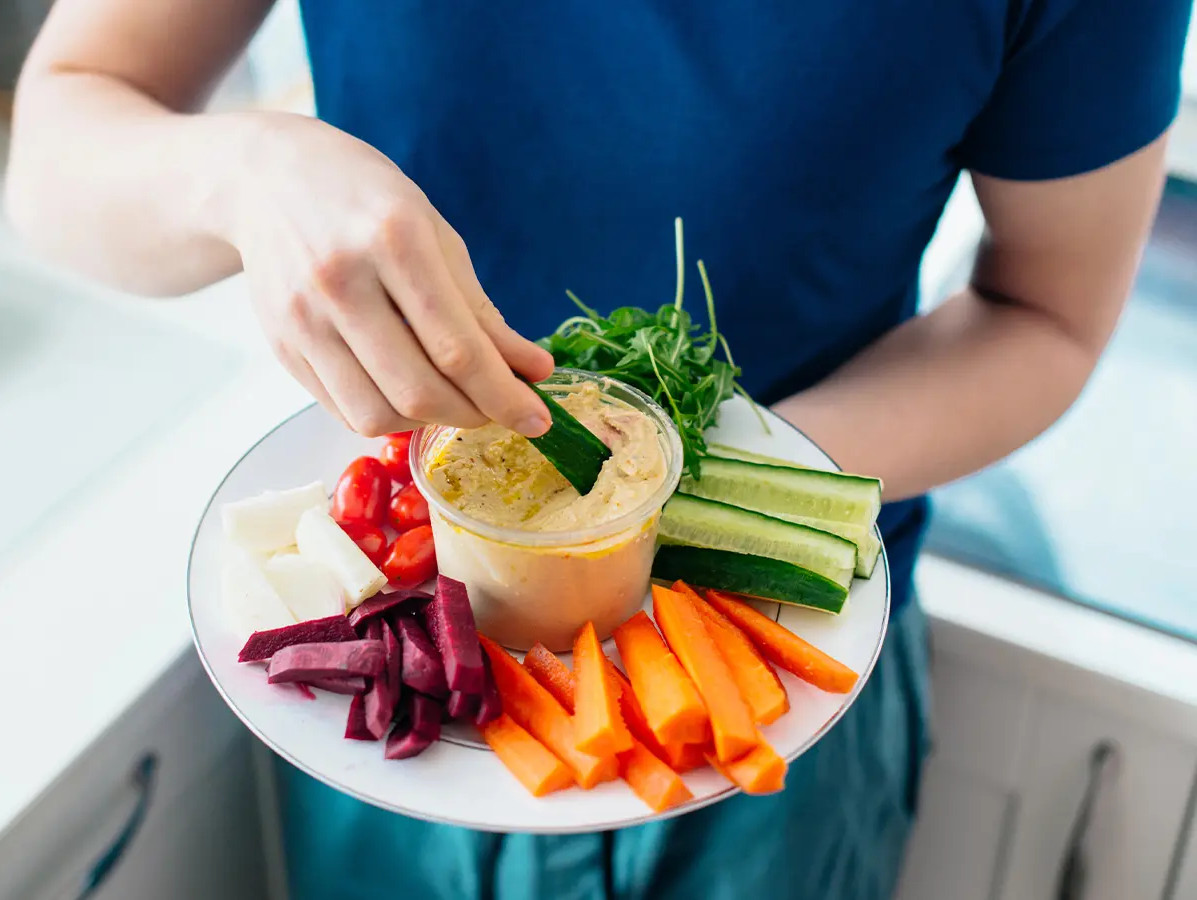
Healthy and sustainable eating. Everyone considers it important. Yet consumer eating habits change only slowly. According to researchers, that is not only due to people themselves. The environment in which food is purchased and consumed plays at least as large a role. In a new Route and Opportunities Map, Wageningen University & Research and HAS green academy outline the main bottlenecks as well as the key opportunities.
The roadmap was developed on behalf of TKI Agri&Food and TKI Tuinbouw & Uitgangsmaterialen. The research examines how healthier and more sustainable food choices can become reality more quickly.
It is striking that within the Knowledge and Innovation Agenda (KIA), mission 4D, hardly any projects are getting off the ground that focus on healthy food environments and long-term consumer behavior. Yet according to the researchers, that is precisely where considerable impact can be achieved. Focusing only on the behavior of individual consumers often proves insufficient. If the environment mainly encourages unhealthy or less sustainable choices, meaningful change remains difficult.
The Route and Opportunities Map brings together opportunities for the short, medium and longer term. Four themes form the foundation: ownership, collaboration, instruments and knowledge development.
One of the most important bottlenecks is the lack of clear ownership. Many parties acknowledge the importance of a healthier food environment. Yet responsibility for implementation, follow-up and scaling up often remains unclear. This leads to fragmentation and projects that struggle to move forward once they are completed. Collaboration can also improve. Initiatives are still frequently carried out independently. A more thematic form of collaboration should ensure that projects reinforce one another and that knowledge moves more quickly toward practical application.
Based on the analysis, the researchers put forward five concrete recommendations to accelerate the transition toward a healthier and more sustainable food environment:
The parties involved are now examining possible next steps. A recent meeting brought together the REK team, the board and coordination team of the Roadmap Food, Health en Living environment, and other stakeholders. Discussions focused on potential follow-up steps, for example the development of a strategic food agenda in which consumer behavior and the food environment are explicitly included.
Source: TKI Agri&Food
Magazine Voedingsindustrie has been made possible in part by:


© COPYRIGHT 2026 VOEDINGSINDUSTRIE | ALLE RECHTEN VOORBEHOUDEN
Powered by Wallbrink Crossmedia © 2026