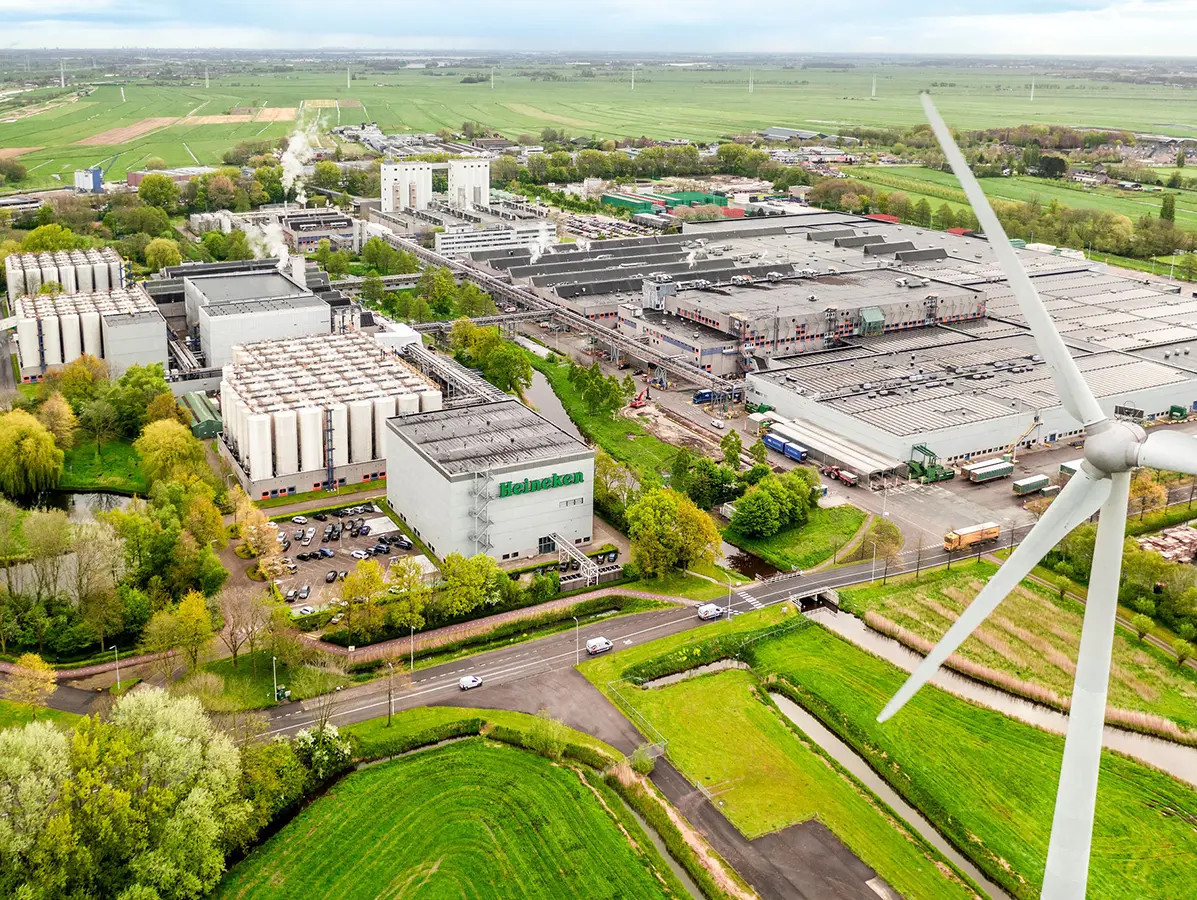
Water savings are receiving increasing attention within the food industry, where processes are often water-intensive. As a result, using this resource more efficiently is moving higher up the agenda. The Heineken brewery in Zoeterwoude shows what is possible in practice. In March 2026, a record was reached at 2.81 liters of water per liter of beer; the lowest water consumption ever measured at the Zoeterwoude brewery.
The figures show a clear downward trend over several years. In 2023, the average was still 3.21 liters per liter of beer. This decreased to 3.08 in 2024 and 3.01 in 2025. Heineken applies a fixed calculation method for water use across all its breweries worldwide. This includes all incoming water, including losses during treatment. This ensures that performance can be compared across breweries.
The lower figures are the result of targeted adjustments in the production process. Cleaning is carried out more efficiently and in shorter cycles, without compromising hygiene. In addition, water is reused through additional filtration steps, including reverse osmosis. On several production lines, installations have been modified or replaced. For example, ionized air is used instead of water for rinsing. Residual water from earlier process steps is also reused where possible. Daily control of water use per line has been further tightened.
According to Tjeerd Meijer, employee involvement also plays a role. “A few years ago, we launched an initiative in which we highlight colleagues with a strong idea for water savings.” He continues: “This recognition is contagious, as colleagues now also challenge each other to come up with smart ideas.”
The brewery in ’s-Hertogenbosch has also been working on water savings for years. It operates with self-extracted groundwater, which requires a more intensive treatment process. Across both breweries, water use had decreased by 600,000 m³ by the end of 2025 compared to 2023.
Source: Heineken
Magazine Voedingsindustrie has been made possible in part by:



© COPYRIGHT 2026 VOEDINGSINDUSTRIE | ALLE RECHTEN VOORBEHOUDEN
Powered by Wallbrink Crossmedia © 2026