
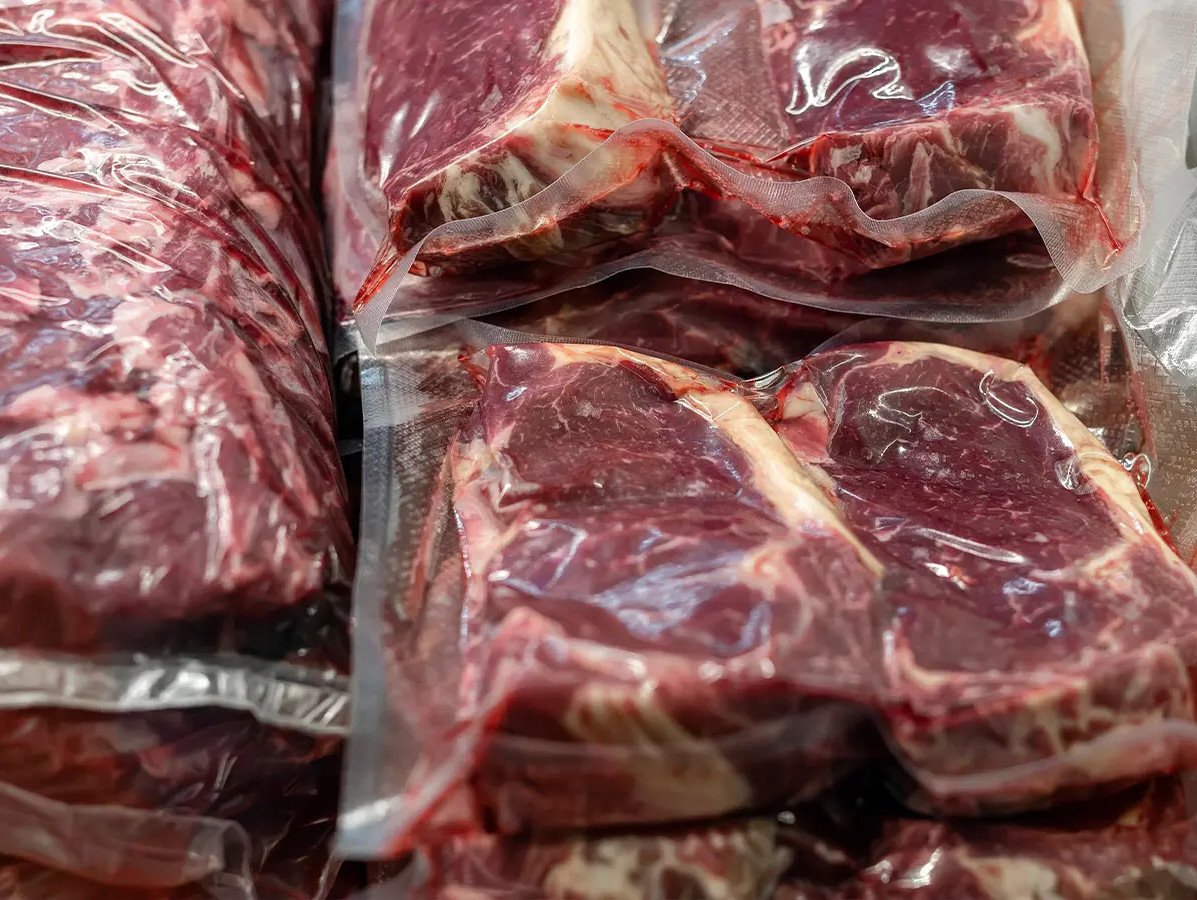
Storing meat prior to freezing plays an important role in bacterial growth. This is shown by a risk assessment conducted by EFSA. The European food safety authority examined how bacteria develop during chilling, storage, and defrosting. The assessment covers meat from cattle, sheep, and pigs. The European Commission may use the findings when considering adjustments to EU regulations.
EFSA examined the impact of storage conditions on bacterial growth. This included pathogenic bacteria such as Salmonella and Listeria. Bacteria that cause spoilage, changes in odor, and appearance were also taken into account. Factors such as temperature, storage time, and vacuum packaging proved to be decisive. The assessment focused on the period between slaughter and freezing. Defrosting and subsequent storage were also examined.
EFSA used a fixed reference scenario as a baseline. In this scenario, meat without vacuum packaging was stored for fifteen days at 7°C. Other storage and defrosting scenarios were compared against this reference. EFSA applied the concept of “equivalent time.” Using mathematical models, experts calculated when meat stored under different conditions reaches the same bacterial levels.
When meat was stored at 7°C with immediate vacuum packaging, Salmonella was the determining factor. Equivalent bacterial growth was reached after five to six days of storage following slaughter. At a storage temperature of 3°C, the equivalent time was longer. In that case, lactic acid bacteria were decisive, with the equivalent time set at 29 to 30 days. EFSA notes that when initial bacterial contamination is high, spoilage may occur sooner.
During defrosting at 4°C or 7°C, bacterial growth was absent or limited. Further storage after defrosting can lead to additional bacterial growth. This depends on the conditions. In some of the scenarios assessed, EFSA therefore recommends shorter storage times prior to freezing.
Source: EFSA
Magazine Voedingsindustrie has been made possible in part by:



© COPYRIGHT 2026 VOEDINGSINDUSTRIE | ALLE RECHTEN VOORBEHOUDEN
Powered by Wallbrink Crossmedia © 2026