
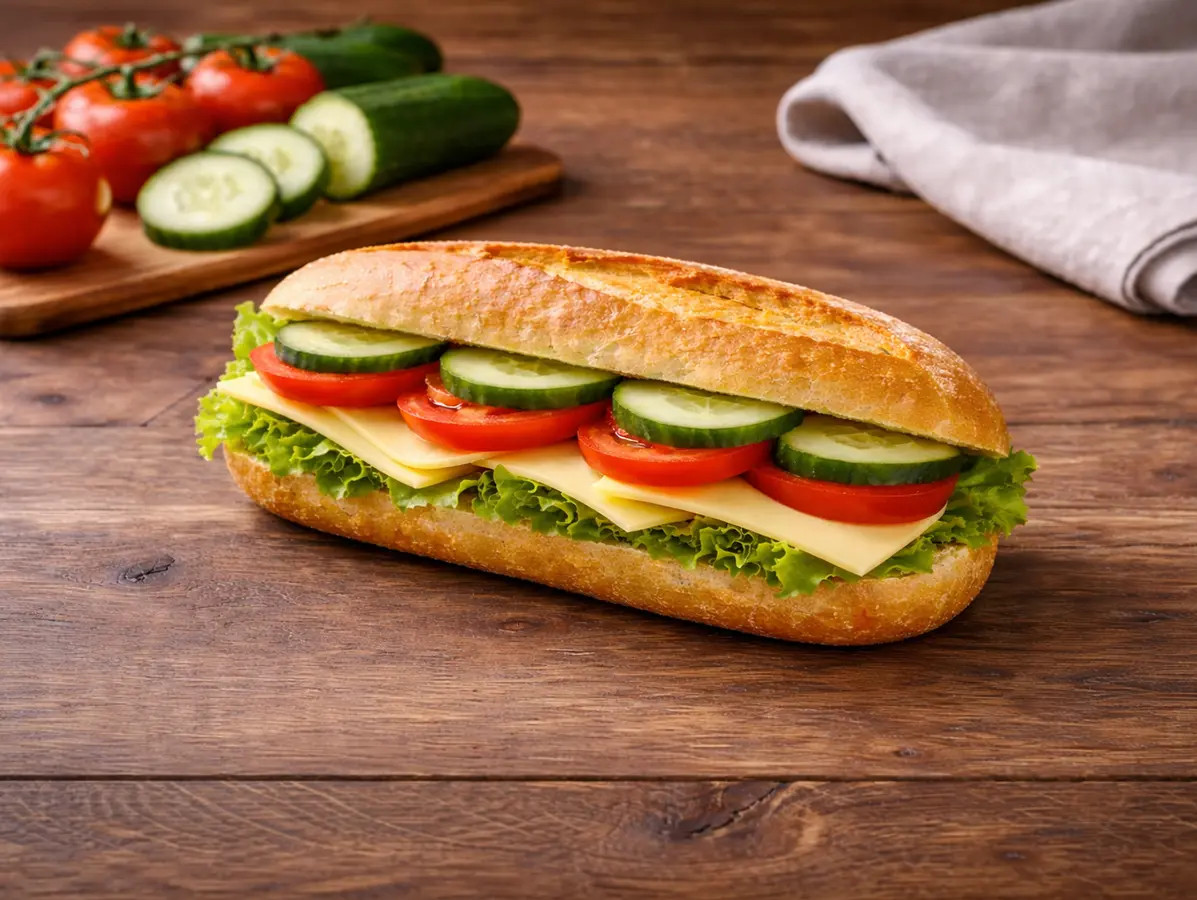
The Dutch signature sandwich 'broodje gezond' (healthy sandwich) is more than just a tasty lunch option. It also shows how profoundly Dutch food production has changed. De Eerste Duurzame Generatie (the First Sustainable Generation) used the sandwich as a benchmark. What does it show? Today, the same sandwich requires more than 75 percent less farmland than in 1950.
The report calculates the footprint of a standard broodje gezond: bread, cheese, butter, tomato, and cucumber. In 1950, this required roughly 0.84 square meters of farmland. In 1980, that figure was still 0.41 square meters. Today, only about 0.23 square meters remain. “The same sandwich, four times less land,” the authors write.
This reduction did not come from a single source. Wheat yields tripled over a 75-year period. Milk production per cow more than doubled. In greenhouse horticulture, yields increased by a factor of five to six.
The climate impact has also changed. Greenhouse gas emissions per sandwich are now roughly 30 percent lower than in 1950. This is linked to higher yields per hectare and more efficient production in arable farming, dairy, and greenhouse horticulture. Since 1990, pesticide use has declined by approximately 60 percent. Stricter approval standards, biological control, and precision techniques play a major role. The sharpest declines are visible in greenhouse horticulture and arable farming.
According to De Eerste Duurzame Generatie, this progress often goes unnoticed. “What goes wrong is visible; what improves usually is not.” At the same time, the authors point to tensions with current policy. European and Dutch frameworks strongly steer toward extensification. Less intensive systems, by definition, use more land per kilogram of food. In a densely populated country, that can increase pressure on space and nature.
The authors therefore call for a renewed appreciation of efficiency as a sustainability strategy. They argue that investments in modern plant breeding, precision agriculture, greenhouse horticulture, and alternative proteins are essential to maintain and accelerate the decline in land use.
Source: De Eerste Duurzame Generatie
Magazine Voedingsindustrie has been made possible in part by:



© COPYRIGHT 2026 VOEDINGSINDUSTRIE | ALLE RECHTEN VOORBEHOUDEN
Powered by Wallbrink Crossmedia © 2026