
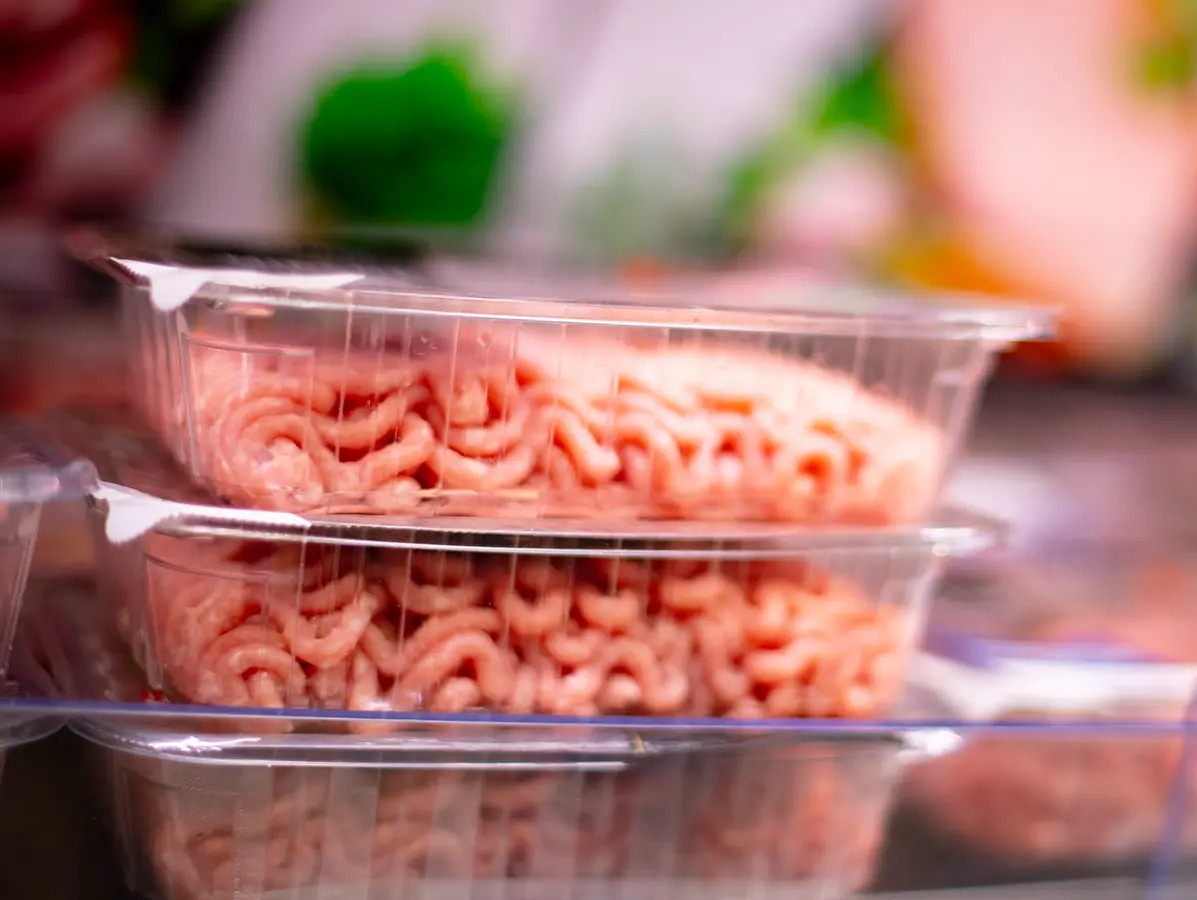
The November 24 episode of the Keuringsdienst van Waarde caught many viewers off guard. Supermarket meat appears to contain blood plasma more often than expected. The label then lists it as “animal protein.” Legally, that is correct, but for many consumers it feels different. And that is where the tension lies: the ingredients are neatly stated, yet the information still falls short.
Meat naturally contains about 20 to 30 grams of protein per 100 grams. Even so, labels continue to show terms like ‘beef protein,’ ‘pork protein,’ or ‘chicken protein.’ In many cases, it simply refers to plasma. During centrifugation, the heavier part of the blood sinks to the bottom, while the lighter plasma rises to the top. That plasma is then dried into powder and ends up as an ingredient used by the industry.
According to meat processor Paulo Zonneveld, this protein serves several functions. It helps meat retain its color, acts as a binding agent, and reduces costs. As a result, a product may consist of only about seventy percent meat. The remainder is protein, water, and flavorings. And because of its binding effect, small pieces of meat can be connected to each other, which in practice can result in so-called reformed meat.
In his book Het complete E-nummer handboek – Van E- tot Z, food technologist Folkert Fennema describes this exact type of example. Starting in 2024, he says, added proteins are being used on a large scale in minced meat, hamburgers, and sausages. The law allows these ingredients to be listed as ‘beef protein,’ because they do not fall under the stricter rules for E-numbers. Still, Fennema questions whether this provides enough clarity. “For many consumers, this approach can be perceived as misleading,” he says. People who avoid blood for religious reasons are particularly affected. According to him, an E-number would provide clearer information.
Fennema’s handbook includes all E-numbers approved by EFSA, as well as those recently rejected. It covers functions, applications, origin, legal status, and a health assessment. The annexes offer additional structure, from alphabetical lists to classifications by function or supplier. The section on the use of blood plasma in minced meat is included on page 25. The book can be ordered via www.vanetotz.com, in print or as an e-book. English and German translations are on the way.
Source: Van E tot Z
Magazine Voedingsindustrie has been made possible in part by:



© COPYRIGHT 2026 VOEDINGSINDUSTRIE | ALLE RECHTEN VOORBEHOUDEN
Powered by Wallbrink Crossmedia © 2026