
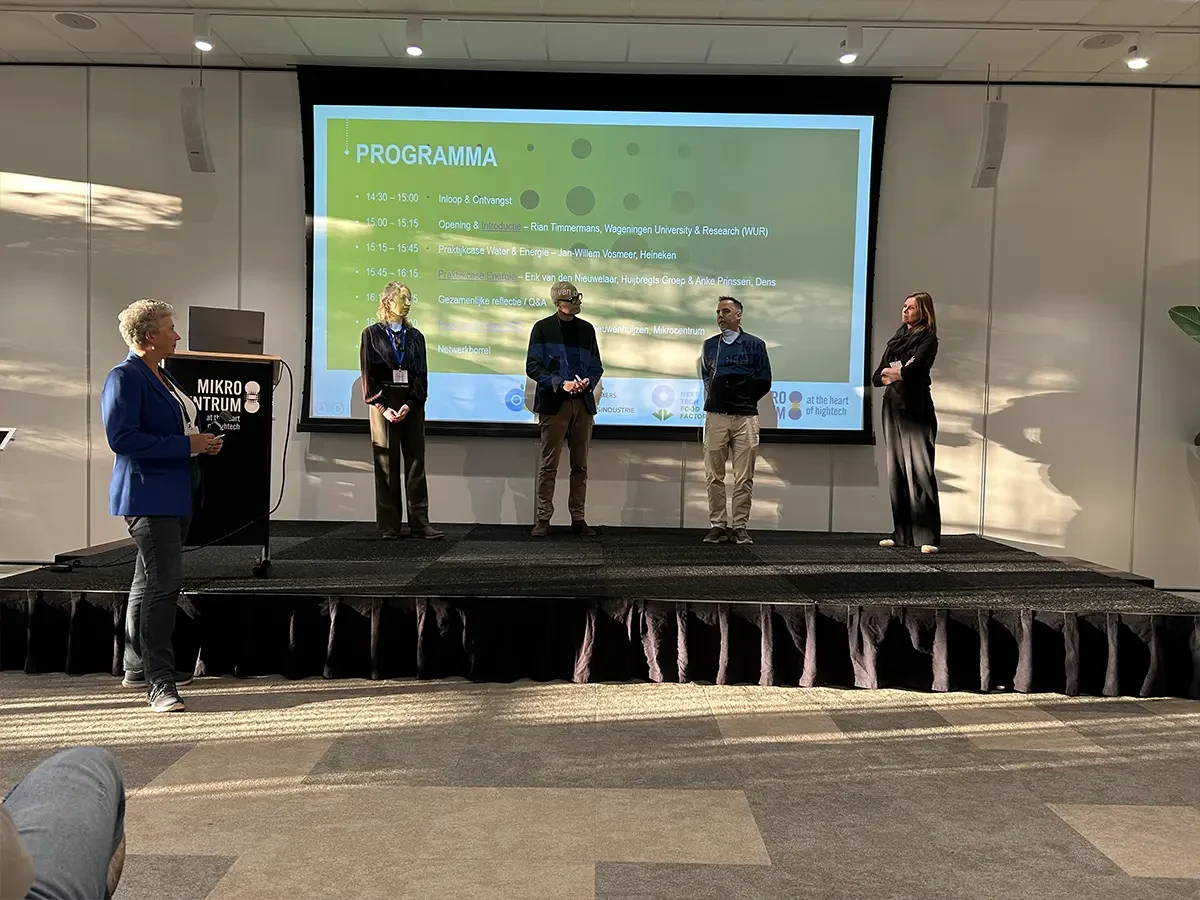
What does it mean for your investment plans if the power you need isn’t available? And how do you maintain production levels when you can no longer count on an adequate water supply? Those questions were at the heart of the Grip op Groei food industry conference on November 5. Food manufacturers, equipment makers, and technology partners discussed possible solutions at Mikrocentrum in Veldhoven. With Saskia Stender of OSV Netwerk moderating, the conference brought together research and practical experience.
How much water and electricity do different processes in the plant use? Rian Timmermans of Wageningen University & Research (WUR) shared a real-world example. In that case, refrigeration accounted for about 50% of electricity use. Rinsing and cleaning accounted for roughly 60% of water use. Companies can use high-quality water for several applications in succession. That reuse often takes extra electricity.
In the FROSTEQ project, WUR is studying whether frozen products can be safely stored at a slightly higher temperature. Each degree of increase in storage temperature could cut energy use by about 3%. WUR is also studying whether frozen inventory can serve as a thermal buffer. Refrigeration systems could then do more cooling at favorable times and draw less power during peak demand.
In 2008, Heineken needed an average of five liters of water to produce one liter of beer. That average is now around 2.9 liters of water. Heineken tracks its water use, improves its processes, and reuses water.
According to Heineken’s Jan-Willem Vosmeer, the biggest challenge lies outside the brewery. In France, Heineken works with around 400 farmers. The partnership covers nearly 75,000 hectares of farmland. The goal is healthier soil that holds water better. Another goal is to reduce reliance on synthetic fertilizers.
Huijbregts Groep wants to electrify its operations and faces grid congestion and uncertain energy prices. That’s why the company invested in battery storage with DENS. The batteries compensate for brief voltage dips and provide a more stable power supply. During a prolonged outage, they supply power until a backup generator takes over.
Source: Mikrocentrum
Magazine Voedingsindustrie has been made possible in part by:


© COPYRIGHT 2026 VOEDINGSINDUSTRIE | ALLE RECHTEN VOORBEHOUDEN
Powered by Wallbrink Crossmedia © 2026


